“To Trust or to Despair: The Choice is Ours”
Job 19: 23-29; Psalm 13
March 7, 1999
A child wakes in the night and cries out. Alone in the dark, he is full of fear. The dark world around him seems vast and threatening. His mother rushes into the room, takes up the child, and soothes him, saying, “Everything is all right.” Finally, the child drifts off to sleep, calm and reassured.
Peter Burger, the sociologist, suggests that the scene between the mother and child is basic to the human journey. We wake up to a vast, threatening world. We then look around for someone to tell us that everything is all right, and then we go back to sleep.
Albert Einstein, the greatest scientist of the 20th century, put it this way when a reporter asked him what the most profound question he had ever raised was. Einstein thought for a moment and then replied, “Is the universe friendly, or is everything just a random happening?”
A friend of mine translated his words this way: “Is God involved in life, or is it all just a crapshoot?”
Erik Erickson, the renowned developmental psychologist, wrote, “The first and deepest issue human beings have to resolve is that of trust. In the first six months of life, the infant decides whether life is trustworthy.”
The writer of the 13th psalm penned it this way, “How long, O Lord. Will you forget me forever? How long shall I have perplexity in my mind, and grief in my heart, day after day? How long shall my enemy triumph over me?
That’s a cry from someone who is wondering if everything will turn out all right. That’s a cry from someone who is painfully aware that disease and destruction are very much a part of life. That’s a cry from someone who wants to believe in God, but is beginning to question some of his basic assumptions. Isn’t that everyone’s cry at one time or another? Isn’t that our cry when the world we have carefully assembled crumbles, or when we are worried sick over someone we love, or when we are looking at the end of all that we planned? “How long, O Lord, how long O Lord – will you forget me forever?
Finding the answer to this question is probably the most profound task we will ever have. It is further complicated by our tendency to say one thing, but live as if we believe something else. Or to believe in our head, but not in our hearts.
The Book of Job is a story of one person facing this dilemma. Job’s story is not unfamiliar to any of us. Death strikes and wrenches a child from our arms. A plane goes down, and with it, a dear friend is lost. An accident permanently disables a young girl. Job’s story is the story of Bosnia or Uganda. At some point, Job’s story touches each of us, and we find that pat answers will no longer do. They stick in our throats. We need to go beyond the standard responses.
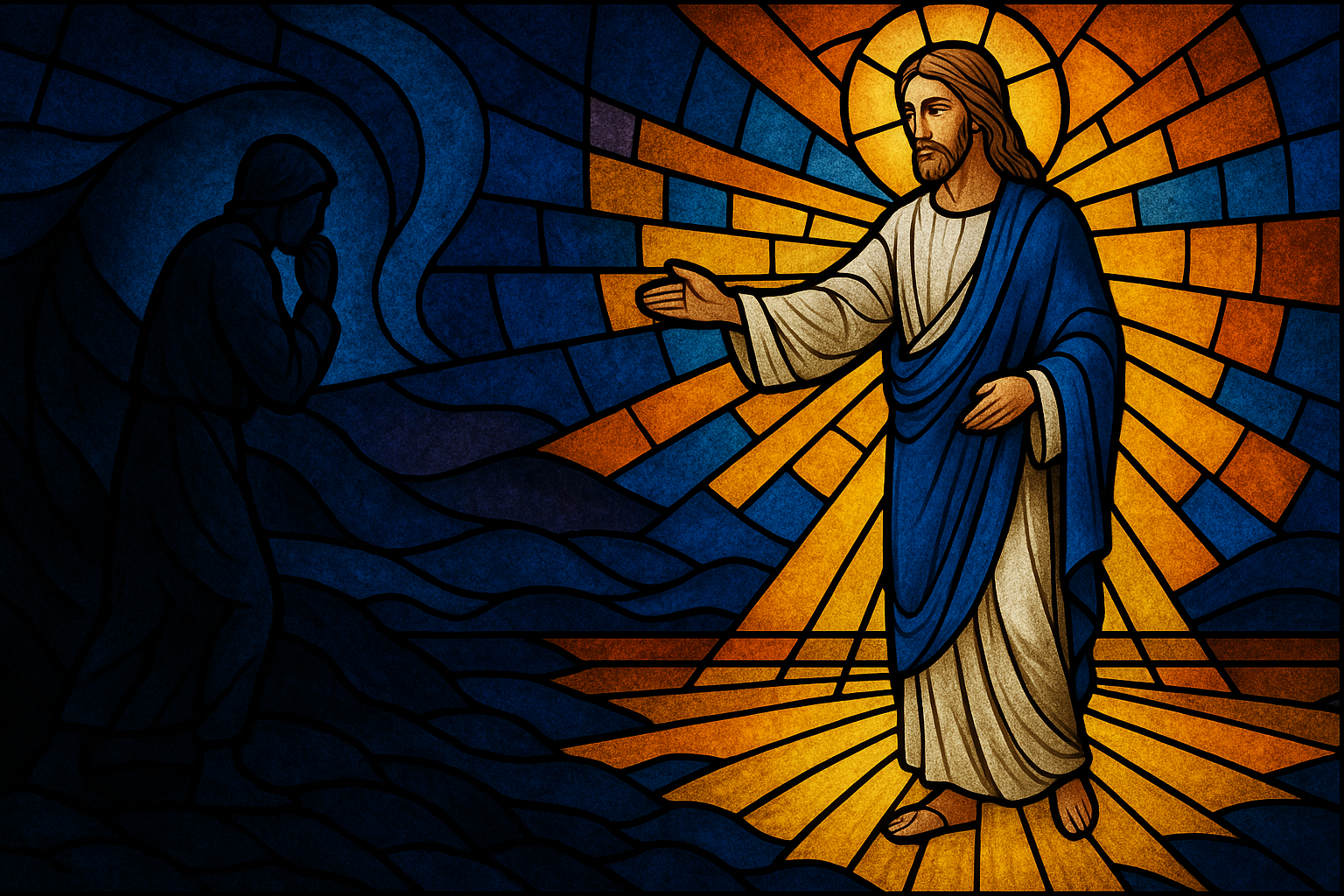
The choice facing Job, as his life was being torn asunder, was to trust God or live as if there were no God. And those are the choices facing each of us. Do you recall where Job finally emerged after a lot of soul searching?
This morning we read from the 19th chapter of Job. It’s interesting that these are the words said at the beginning of most funeral services, yet I would guess that most people haven’t the foggiest idea where they came from. They come, as you know, from Job, who wrestles with the same dilemma that all of us do. Listen to his words once again. “I know that my redeemer liveth, and that he shall stand at the latter day, and though this body be destroyed, yet I shall see God and not as a stranger.” Job says that he believes, he relies upon, he trusts God, who will make all things right in the end. This is the experience of Job, but also of many who have faced the abyss of suffering and come out whole on the other side.
Jess Trotter, the former Dean of Virginia Seminary, in an autobiographical piece called Christian Wholeness, told how he learned to trust God and walk in the paths of wholeness. Let me share it with you.
He recounts how at 56, he was a successful, busy dean of a seminary, and then the unthinkable happened. His son, John, committed suicide. Jess wrote, “From his earliest years, John was a fun-loving, rambunctious child. He seemed headed in the right direction. But then he left college, failed the Marine physical, and came home in a deep depression. He saw a psychiatrist for a while.” Then one day, as Jess entered the house at lunchtime, a shot rang out.
Jess goes on to say, “His mother and I rushed to the third floor. John had shot himself. He died in our arms. We were plunged into an agony of hours, of slow do’s, and long nights, of weeks and months, and of years. Now, years later, the indescribable pain is gone, but the sadness remains.”
Finally, Jess says, “Our community lovingly closed around us to comfort and support us. We unashamedly clung to them, and to each other, and most of all we clung to God. I learned in the depths of my heart what I had taught intellectually in class. I learned that notions, ideas, and concepts of God were fragile things. You can fall through such notions, ideas, or concepts. But I also learned you can ‘fall into God.’ You will not fall through God into nothingness. There is a divine ground, and that becomes the ground beneath your feet. You stand and you walk. And after you’ve done all you can, you stand because you are standing on the firm ground of God, and you can walk because you trust that the ground is secure.”
Several years ago, an anthology called The Choice is Always Our Own. The book made the point that we are not free to determine what happens to us. But we are free to decide how we respond to these happenings.
Job and Jess Trotter responded by deciding to live with a sense of trust. They were able to look to the future and didn’t curse the darkness. They each made a choice – the choice of faith over despair – the choice to stand with God. They could well have said life is depleted and been finally destroyed by the bad things that happen. But instead, they chose to believe that an infinitely creative God is behind all of life, and yet has more to bring. The choice was theirs, and the choice is ours whenever we face suffering and tragedy. Remember the choices you make will affect the way you view life. Remember you can never fall through God. Remember. what you trust in will determine how you face suffering.
Thomas Merton, priest, monk, mystic poet, and writer, captured that very essence of trust in a little book called Thoughts of Solitude. Near the end of the book, he shares a very personal prayer which speaks to me as I learn to be more trusting, and reminds me that I can fall, but I will fall unto God.
“My Lord God,” he says, “I have no idea where I am going. I do not see the road ahead of me. I cannot know for certain where it will end.” And then Merton concludes by saying, “I will trust you always, though I may seem to be lost and in the shadow of death. I will not fear, for you are ever with me, and you’ll never leave me to face my perils alone.”
That’s a faith that has learned to trust. That’s a faith that can look on the cross and see a Savior. That’s a faith that can say, “Though this body be destroyed, still I will see God and not as a stranger.” That’s a faith that holds a child and says, “Go to sleep. Everything is all right.”
Amen
“To Trust or to Despair: The Choice is Ours”
“To Trust or to Despair: The Choice is Ours”
March 7, 1999
Scripture: Job 19: 23-29, Psalm 13