“OUR MANY SIDES : THE ILLUSION OF INNOCENCE”
Luke 15 : 11-3
March 9, 1986
A Spaniard once declared :” If you want to see the soul of Spain you have to look at Goya’s paintings. But you have to look at all of them, from the nightmarish sketches to the formal court portraits.
Similarly, if you want to see the soul of humanity, you can look at the parables of Jesus. But you have to look at all of the many people involved in the stories, for each parable presents many facets of ourselves.
I suppose that’s why I have been so drawn to Bill Dols ‘ way of doing Bible study. Some of you may recall that Bill came to preach here last fall. His major thesis was that Scripture is not only the record of God’s dealings with people, it also is a mirror image of our lives.
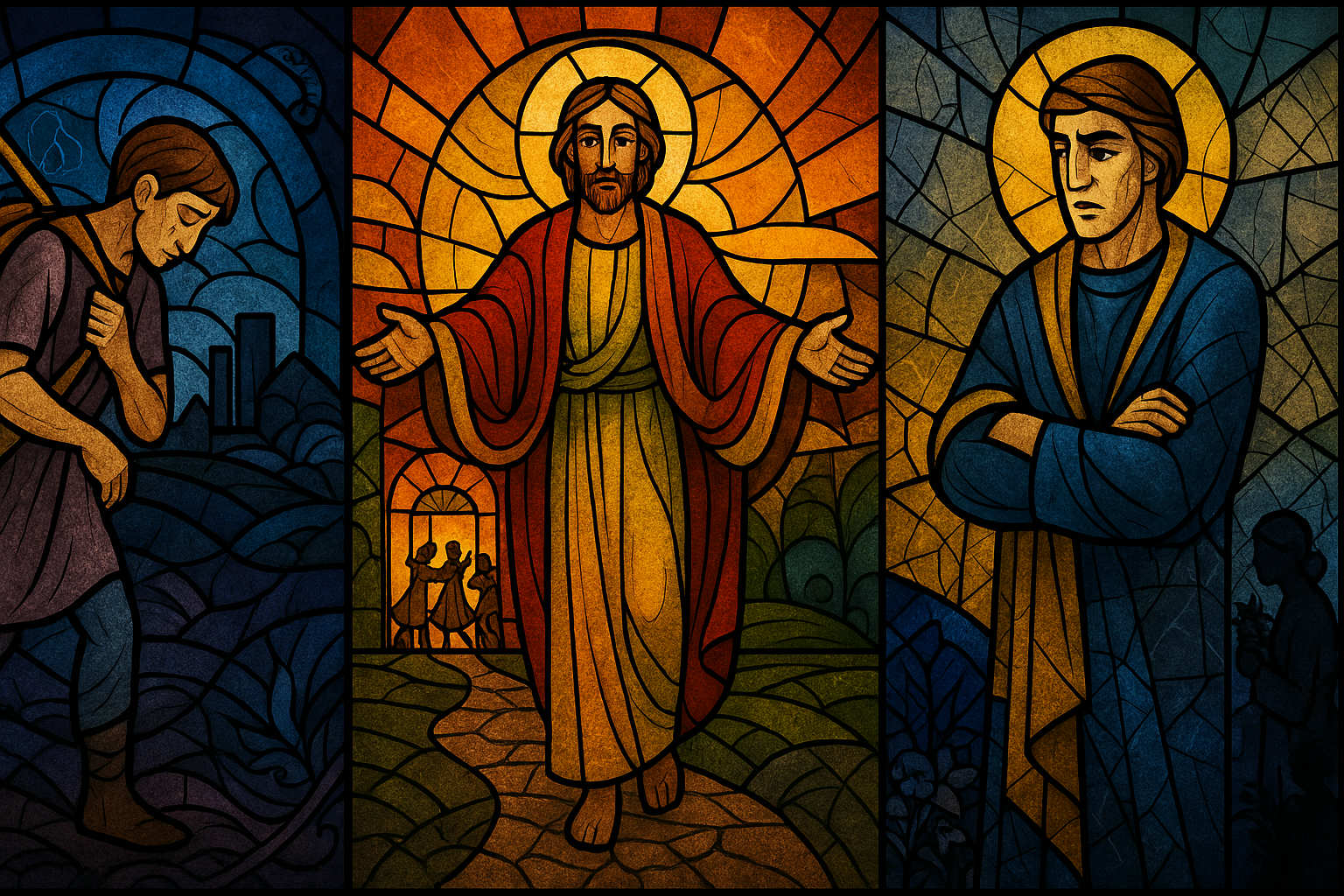
If Bill were here this morning, i could easily hear him saying after reading our Gospel parable: Each of us has within him a prodigal, a wilful child, who values freedom and independence more than anything else, who wants nothing more than to cut all ties, who every so often becomes aware of being caught in a far country, lost and lonely, and wants to come home. We know that person well, don’t we?
But also, we know that we have something of the father within us, too . There are times when we recognize our capacity to love, not counting the cost , being able to set aside the past, letting people go their own way, yet standing ready to welcome them home . This is another side of us, the bright side, which we hope people will see.
Both the bright side and the darker side — the loving parent and the wilful child — we readily acknowledge. But we cannot remain at ease in Zion simply with these two facets of our personality. The parable reminds us that there is still another side to our souls, a side we rarely acknowledge -the elder brother.
This elder son stands for that part of us that is quick to lay blame on others, which is judgmental in most relationships. He epitomizes the person who tends to complain and seek justice rather than mercy
It is one thing to have been a sinner, knowingly to have squandered part of one’s inheritance. This image we can own.
But to be reminded that you are a good person and that this goodness actually is more destructive to your relationship with God — this is hard for us to understand.
The parable tells us that you don’t have to be a Bengal tiger to be on the outs with God. Actually, it is just as bad to be a tame tabby, whining about the injustices of the world, and this is difficult to take. It calls into question even -our good behavior.
And so we deny it. We are not Pharisees, we are not elder brothers, we are not prudes. And when we look at the parable, we concentrate on the prodigal or the loving father, and gloss over the elder brother.
Yet let me say, as a pastor or as a people watcher, that in my observation, more harm, more hurt, has been done by people in the role of the elder brother than has ever been done by the dark side, the prodigal child, that lies within us.
One of the great tragedies in life is the vast amount of time and energy that we .all put into denying the ”elderbrother’ side of us. Yet at the same time, the elder brother keeps cropping up , laying guilt trips on people, sprinkling our conversations with oughts and shoulds, demanding that God punish the bad guys and reward the good guys, which we generally hope will be us.
Tennessee Williams has always been a favorite playwright of mine, and ”Streetcar Named Desire” is his very best. I never tire of hearing the dialogue between Blanche and Mitch — Mitch, who loves Blanche and wants to put aside her sham and pretense; Blanche, who has never allowed him to see her in the sunlight.
In his anguish, Mitch rips the cover off the light and floods her aging and bruised face.
(Blanche) What did you do that for? (Mitch) : So I can take a look at you good and plain.
Of course you don’t really mean to be insulting. No . Just realistic .
I don’t want realism. I want magic. Yes, yes , magic! I try to give that to people . I don’t tell the truth. I tell what ought to be the truth.
And, as they argue, the blind Mexican vendor, in a dark shawl, moves through the shadowy streets. She carries bunches of those gaudy tin flowers that are used by Elle poor at funerals. She softly ca11s out, ”Flores , flores para los muertos .” Flowers for the dead. The dead Magic had the illusion of innocence that Blanche will not bury.
Blahch3 is each of us some of the time and some of us all the time. We want to appear as the righteous, innocent ones. And the cost of maintaining righteousness is incredible. We have to do a lot of denial, keeping the harsh light of truth away from our own actions, telling what ought to be the truth rather than what is , constantly pointing fingers at those around us.
What a terrible cost it is to maintain the illusion of innocence! I remember in a former parish talking to a couple whose marriage was falling apart. One of the spouses had had an affair and felt awful about it, but the other party kept throwing it up and playing the injured party.
After listening for a while, I turned to the spouse playing the innocent party and said, Look, you have two choices. One, you can maintain your righteousness and end up divorced. Or, two, you can begin to ask forgiveness for yourself and maintain the bond of love. ”
They chose divorce. What an incredible price we pay to maintain the elder brother in us– the illusion of innocence!
A man named Roger Gould wrote a book a few years ago called Transformations. It is about adult life cycles and the predictable crises we encounter along the way toward maturity. It defines progress as the discovery of assumptions and the ability to discard them.
Between the ages of 18 and 22, for example, we might discover that we believed life would reward us if we kept the rules and did what is expected of us . Maturity is when we find that this is not always so.
Another assumption that Gould mentions is that in middle age, when you believe that if you take care of yourself and stay healthy, you will live forever. At some point, which Gould calls maturity, we lose this belief.
Then, later, as Gould says, there is another assumption that we begin to question — the illusion of innocence.
Sometime past middle age, we start to see that we cannot be righteous, and even when we have not done anything overtly, we still are a part of the brokenness of the world. Putting this aside is the beginning of growth.
The tragedy of the elder brother was that he never turned that corner in his life. He never was able to put off that false assumption of innocence, and therefore never was able truly to come home and experience God’s love.
The tragedy of the righteous person is that he always sees the sins of others and is not aware of his own participation In evil_ St _ Augustine said it: Never fight evil as if it were something that arose totally outside of yourself.”
We are all part of the evil of the world. The old gospel hymn is so right: we don’t have to look to other people.
It’s me, it’s me, O Lord, standing in the need of prayer.
There is a fantastic line in ” Auntie Mame” when she says, ”Life is one great banquet, and most poor slobs are starving to death. ” This is to say, I think, that we are waiting outside, but not because we don’t think we deserve to be inside in the Kingdom. It is just that we were waiting for justice to be meted out, for the bad guys to repent, for God’s special recognition, instead of rejoicing at the incredible love of our heavenly Father.
This period of Lent calls us to move beyond the obvious, to grow by putting aside our older images of ourselves. Lent seeks to do for us what it did for those who first listened to our Lord’s teachings. It gave them a clearer picture of who they were so that they could come clean and let go of their pretensions. May Lent do that for us all.
The feast is ready, the banquet hall is set. Can you hear the music and the dancing? Will you sit outside doing a slow burn at the injustices of life? 0r will you come in and be warmed, loved, filled, accepted?
It is hard to believe how often you and I say, “No,” and choose to starve ourselves to death, maintaining the illusion of innocence.
Amen
“OUR MANY SIDES : THE ILLUSION OF INNOCENCE”
“OUR MANY SIDES : THE ILLUSION OF INNOCENCE”
March 9, 1986
Scripture: Luke 15: 11-30