Resentment
Philippians 4: 4-13
March 11, 1979
A funny thing happened to me on the way to preach in South Carolina last week. Actually, it wasn’t too funny. It was the kind of incident that makes you want to stay in bed, or at least stay in Tucson, or at least confine your trips to no farther than Green Valley.
I was to preach at the Cathedral on Tuesday, Wednesday and Thursday, at the 12: 30 Lenten services. I had already flown the day before to Washington, and on Tuesday morning, I got up early to make a flight to Columbia. That’s when it all started to happen. The first occurrences were small ones. On the way to the airport, the zipper to my bag broke. This necessitated my driving with one hand on the wheel and the other holding my clothes in. But I coped admirably so. When I went to turn in my car at the rental agency, however, no one was on duty. Right there and then I began to say to myself, It’s going to be one of those days — the kind of day when you look up into the sky and whisper How long, oh Lord, how long? I can see by your expressions that some of you have been there before.
After a lot of trouble, I made it to the airport, where they taped lay bag together and sent it off to be loaded on the plane. About ten minutes later, they informed us that our plane was in the hangar and was not going to be running that morning. Anger – I want to tell you it sounded like a Greek chorus. All of us were howling, and I led the cries. I was mad not only at the airline but also at the rent-a-car company, as well as the bag manufacturer. It’s mornings like that that make a person lose his religion.
Finally I was able to make a connection to Atlanta, and found a plane on a different line that arrived in Columbia at 11:40. The airport was 20 minutes away from the Cathedral; so I still had time to spare.The morning seemed to be picking up, and I arrived in Atlanta in plenty of time to make the connection.
Once again, I went through the check-in procedures and was waiting to board the plane when suddenly everybody headed for the window. There was our plane all right, except that smoke and fire were billowing out of the engines. The attendant announced with an embarrassed smile. that there would be a slight delay while they got another plane. The only thing that kept going through my head was, ‘Why me, oh Lord, why me?’
Instead of arriving at 11 40, we were still in the air at noon, and I could feel my temperature rising with each ticking second. I was so deeply into my resentment that I hardly knew what was happening. I mean, what did Job know about suffering? He never had to fly Delta or Eastern.
We touched down about ten after twelve, and I was met by a nervous assistant canon and hustled into a car. I changed my clothes in the back seat and rushed into the service just as a very upset dean was announcing the sermon hymn. As I walked breathless to the pulpit, everybody was lustily singing Hymn 536. For those of you who don’t know that hymn, it starts out with the words, “Turn back, oh man, forswear thy foolish ways. ”
I suspect we all have days like that — days when we have all the ingredients for making a case, large or small, against God, or the airlines, or some faceless entity, or even some person who has dealt us a grave injustice. And I suspect that all of us could echo Auden’s words :
Come to our bracing desert, where eternity is eventful,
For the weather glass
Is set, but Alas,
The thermometer is Resentful.
And the thermometer is at Resentful — l’ve been there and so have you. This is why, as our second deadly sin, I want to focus our attention on the dynamics of resentment. I want you to understand it, and see it for all its destructive force, for resentment is at the heart of our sulkings, holding grudges, living angrily, poisoning relationships, and generally, much of the evil of our day. Resentment is the fuel that fires the enmity between nations, families, and individuals.
Psychologically, resentment means becoming childlike and then dissipating one’s energies on feelings of helplessness. In counseling situations, I’m always aware that the resentment button has been pushed when a person’s voice seems to change and their attitudes toward life are characterized by a no-choice/no-options type of reaction. It’s amazing to watch the emotion of resentment take hold of people. A 49-year-old man begins to come across like a 9-year-old; a 60-year-old woman sounds as if she were 6. The inner rage that resentment produces within us is one of the most costly luxuries in which we mortals indulge. It can hang us up, prevent us from moving as adults, leave us helpless, and ruin our effectiveness in relating to the world around us.
Sociologically, resentment means focusing almost exclusively on the past. Whatever did happen is more important, to those who want to maintain their resentment, than would could happen. For those who are into resentment, the future is blanked out, and we deal strictly out of our past. The times we didn’t get our way, the injustices perpetrated upon us, the unresponsiveness of that bureaucracy — those are the memories we cultivate. The problem, of course, is that we cannot roll back history any more than we can push toothpaste back into a tube. What’s done is done, and if we continue to concentrate on the past, we will lose sight of the future.
Theologically speaking, resentment represents a state of rebellion against God. It is a way of protesting what is taken to be the unfairness of life, but even more than that, its appeal to justice seems to place the blame on God for life’s happenings. When I listen to people speaking out of their resentment, it is as if they are saying, If only God had the perception that I have, if God were only concerned with my problems the way he should be, then something would be done about it. (How long, oh Lord, how long?) Resentment twists our anger and hardens it into self-pity. This can color our whole existence.
Psychologically, sociologically, theologically -any way you describe it, we’ve all been there before. The question is: Can we ever escape from the tentacles of resentment, or are we doomed to go through life the way A. A.Milne described Edward Bear?
Here is Edward Bear
Coming downstairs now,
.Bump, bump, bump,
On the back of his head.
It is, as far as he knows,
The only way of coming
Downstairs. But
Sometimes he feels that
There really is
Another way, if only
He could stop bumping
For a moment and think of it.
If only we could stop resulting long enough to think of it — if only we could stop bumping, rehashing, replaying our resentments — maybe we, too, could for a moment to think of another way,
But first, you have to begin to realize that you do have some choices. There are other ways to handle the slings and arrows of outrageous fortune. Too often, we tend to operate out of patterns and ways that were learned as children. Too often we say to ourselves,
“I have no choices. I react, It’s programmed, I respond to life in only one way. ”
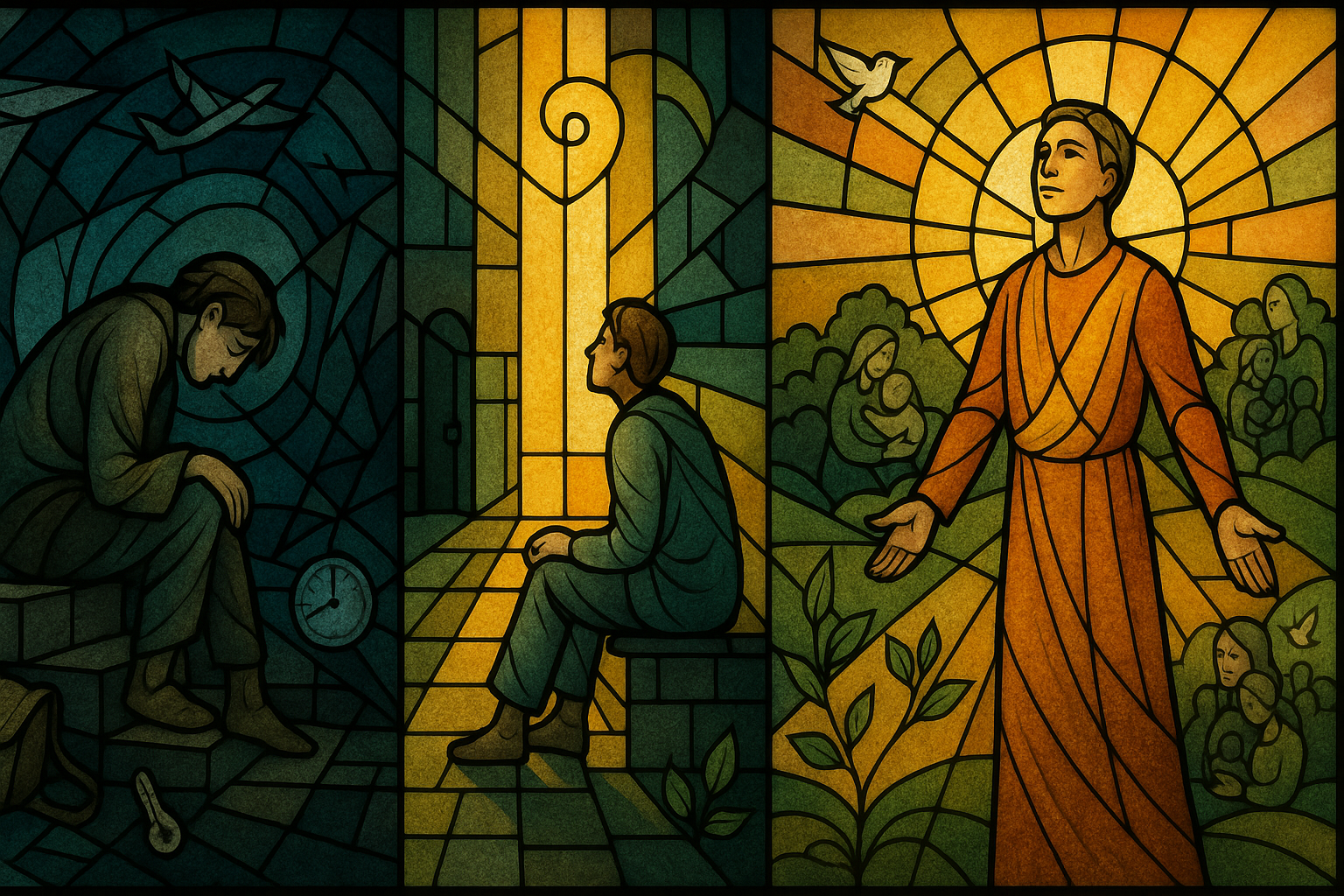
Not so . In every situation, the choice is always there. We can ask the resentment question, “Why did this happen to me?” and then concentrate on mobilizing our childlike responses. Or we call -ask another type of question, one that I have called the rejoicing question: “What is there here for me to be thankful for, and what can I use joyfully for my future?”
Obviously, these are two different ways of approaching a single event. One leads to the sanctification of self-pity, while the other leads to what Charles Boddie calls “courageous cope-ability’
We have heard this morning from a man who understands this principle more than most. While he was sitting in a Roman prison, he did not raise the 11whyt1 question, or else his epistles would never have been written. Instead, he asked the “how” question, and so he finally was able to say, “Not that I complain of want, for I have learned, in whatever state I am, to be content. I know how to be abased and I know how to abound, in any and all circumstances. I have learned the secret of facing plenty and hunger, abundance and want. ”
And what, then, is Paul’s secret? I think he tells us throughout his letter. Paul tells us that he chose to rejoice in his situation rather than to resent what had happened. He had a choice, just as we do. We are not free to determine what happens to us, in terms of events, but we are free to determine what response we will make to these events. Paul raises the “what” question: What is it that I can use and rejoice in, amid all this wreckage of life? What can I find to be glad about?
Now let me insert a parenthesis here: This is no Pollyanna view of life; it doesn’t deny the difficulties of existence. It simply faces the fact of choice, and marks the difference between being a victim and being a victor over events. Where does one get courage in the worst of times to keep on doing the best of things? By learning the strategy of rejoicing rather than the strategy of resentment.
I think I preached the sermon this way because, just this past week, I have experienced what it all means. Last Sunday night, we received a phone call from two of our very best friends. They told us that their 17-year-old son, our godson, had just been killed in an automobile accident. The tragedy of losing a youngster, I think, is the most difficult any family ever has to face. For many people, this is the beginning of a long spiral downward; they never do recover from this loss.
But not these people. On Wednesday, I spoke with them again, and they shared not only their loss but also some of the love that had been expressed. At one point, the boy’s mother said, ‘I’m grateful for the love that has been given us but even more than that, I’m looking forward to taking some of that love and passing it around to all the homes of our community.” The secret of rejoicing — there it is.
Here is someone who knows how to abound in all circumstances. Here is someone who can weep, but still ask the “what” question. We thank God for letting us know that wonderful family.
Well, what about yourselves? Where are you in all this? Do you see a Choice for yourselves? Are you able to move into tragedy and sail above it, and through it? Are you able to be a victor rather than a victim of life? if you are, you have learned the secret of rejoicing, the secret of living closely with our Lord.
Remember. Remember. This is the day the Lord hath made. We will rejoice and be glad in it!
Amen
Resentment
Resentment
March 11, 1979
Scripture: Philippians 4: 4-13