“The Next Step After Failure”
Genesis 12: 1-8; Luke 15: 11-24
March 11, 1990
Recently in the news, there appeared a picture of the Intercontinental Hotel in Bucharest, Hungary. Graffiti was spread across its front. There, written in big, bold letters 1 were the words n Communism is dead, Throw away your membership card. ” My mind began to wander, and suddenly the thought came up, ” What membership cards do we hold that might be thrown away?”
“Communism is dead. Throw away your membership card! ” At least those people in Bucharest felt they had something important enough to throw away. It seems like the only cards we have to throw away would be our credit cards, which signify membership in nothing. If we dig deeper and take the admonition figuratively instead of literally, we Might be able to see that all of us hold membership cards in more than visa or MasterCard. For example, we all hold membership in the human race, and that’s not an easy card to lose. The problem with that membership is that it’s so general it’s taken for granted. There used to be an old joke. One person would ask another as an outsider what do you think of the human race. The humor of course, lies in the degree of difficulty in turning in one’s membership card.
Life also holds membership cards in our families of origin. We are Douglas, a Smith, a Jones, and one of our credit card companies is want to advertise membership has its privileges. Sometimes membership in a family means you are nurtured, taking care of, given certain advantages, and sometimes you might receive an inheritance. Membership has its privileges but it also has its responsibilities, which credit card companies usually omit when advertising. Unfortunately, they don’t forget to remind you about the responsibilities at the end of each month.
But enough about American Express, and more about family membership. The interesting thing about family membership is that you can throw away your cards. You can choose to live a life separated from your family, and you can do it many times without suffering any direct consequences.
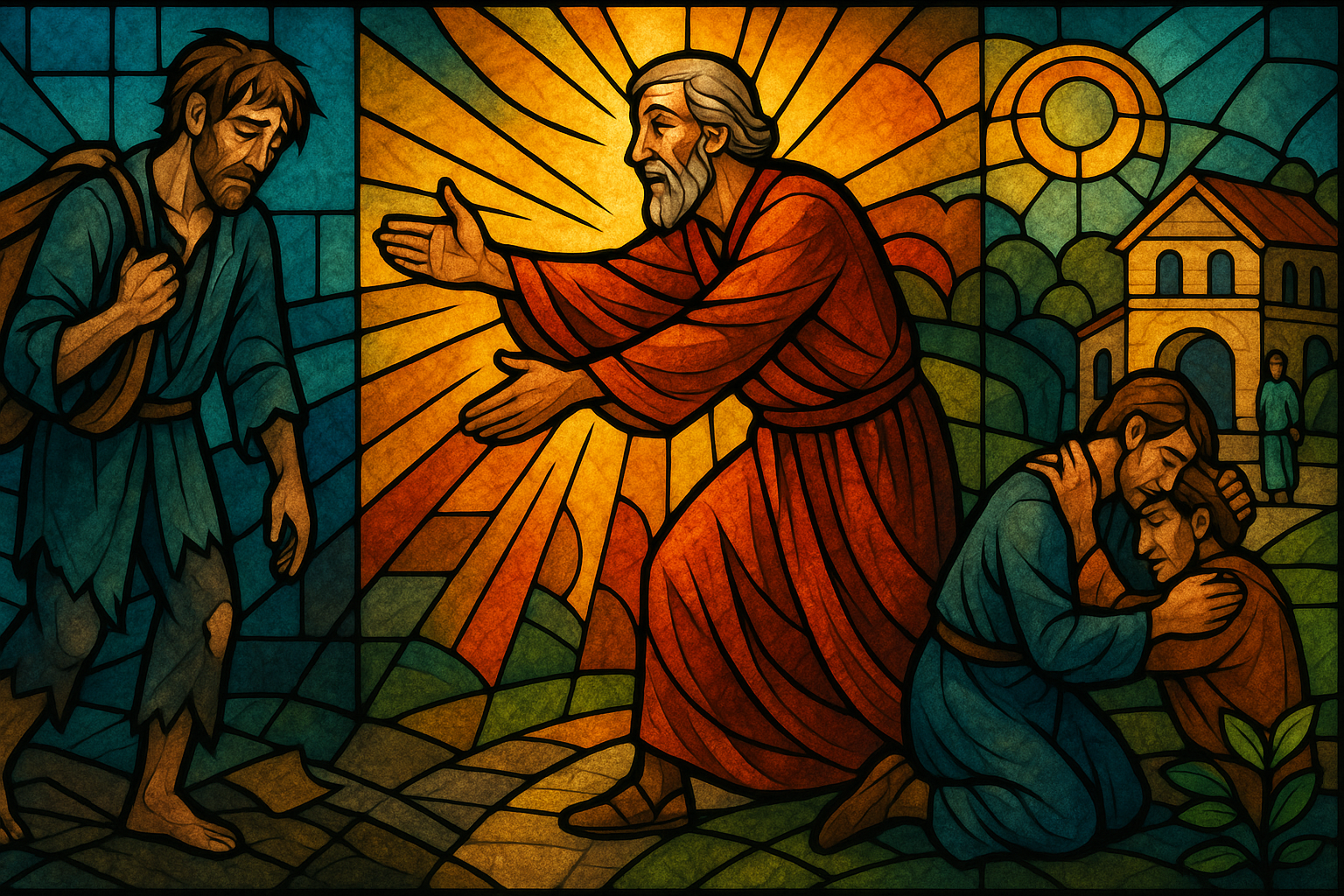
In our gospel this morning, we have a story of a young man who turned in his membership card and later regretted his decision. The son in the parable throws away his card and starts life afresh in a far country, not unlike Abraham in our first lesson. But the results of his moving away were quite different. This man doesn’t make it. He loses his money, he cannot get a decent job, and the friends he recently made desert him. And then, like a lot of children who long for independence and finally going not as smooth as they had had envisioned. The sun begins to see that the membership card in the family isn’t quite as useless as it had seemed.
The problem with our hero is that he is blessed, or cursed, with self honesty. He basically learned to blame others, to hide the truth, to mask one’s only responsibility. He knows he has blown it, used up his inheritance, thrown away his membership card. And, this insight makes him ready for growth and healing. But let’s face it, the only kind of people who are open to the good news are those who can admit they have failed. Going even further, the only kind of people who are any fun to be with are those who have some insight into their own failings.
GF snow, in his novel tells the story of an Oxford college looking for a new master. Some of the professors are walking around the quadrangle discussing what sort of person should be the new master of the college. One says to another, I want a man who knows something of himself, and is appalled and forgives himself every day to get along.
Well, half the statement certainly applies to the prodigal. He has learned something about himself. He is aware of his failures, painfully aware, and he certainly is appalled at himself. He is ready to return home and say, father I have sinned against heaven and before you. I am no longer worthy to be called your son; treat me as one of your hired servants.
A nice, we say, the sun has finally come to his senses. Receive a sigh of relief, redemption is around the corner. But is it? Good people, you’ve heard the story so many times, listen to countless sermons mostly focusing on the father’s love for his inherent son, and we don’t realize we’re looking at a potential tragedy.
Let’s scrutinize the sun’s remarks. Isn’t it true that he’s saying, I am not worthy and therefore I can’t receive mercy, only justice. All I want to do is an employee now that I have lost my status as a child of the family. What we’re looking at is despair, real despair, ohh someone who feels that his membership card is gone for good, and nothing, probably will change that. The only possibility of change that the young man recognizes is this possibility of working hard as an employee in his father’s business. And maybe, just maybe, he can earn back the respect and love of his father.
Despite the fact that he recognizes his failures, despite the fact that he is ready to turn over a new leaf, despite the fact that he was repentant, it won’t wash. He is headed for a disaster if we read between the lines, we can see that the young man is still not ready to receive back his membership card in the family. He is not open to receiving forgiveness. He thinks he has to earn it.
WH Alden, in one of his books, gives us the small vignette which I wish could be placed on the foreheads in every relationship undergoing problems, every marriage that is shaky, every friendship going through hard times, every family coming apart. Many promising reconciliations have broken down because while both parties came prepared to forgive, neither party can prepared to be forgiven.
The son’s relationship to the father is of a defendant to a judge, an employee to an employer. Take me back as one of your hired servants, he says, and in those words we can see that he is not prepared to receive mercy, forgiveness, or grace. The son was not prepared to receive his membership card back without earning the privilege.
One of my hobbies is the reading of sermons. I thoroughly enjoy reading the weekly homilies of my friends and colleagues OK the other night, I ran across an old one by John Claypool in which he said, there are just two kinds of people in this world. In terms of what we have done or failed to do, we are all the same, but some have found forgiveness while others continued to strive and fall all the more
in light of today, there are those who accept their membership as forgiven sons and daughters. And there are those who tried to earn their privileges. Look at it from the outside these two types look about the same. They have the same failures, the same sins, the same wasting of their potential to which all of us are prone. It’s part of our common humanity, all of us fall on our faces some of the time, but there is a difference between the two types, and is found in the depths of failure.
One type seeks forgiveness, the other seeks to make up for it by earning love. John Claypool was right. There are two types of people. One has found forgiveness, the other just struggles until exhaustion sets in. And if there are two kinds of people, it means that there are also two kinds of people seated right here in church. We are all prodigals, we are all human, and we are all loved by our heavenly father. But some want to receive forgiveness and this others want to earn their status. Which are you?
You see, our membership cards are always being handed back. Some try to earn it, some simply receive it. One way leads to tragedy, one way leads to coming home as her son or daughter.
Amen
“The Next Step After Failure”
“The Next Step After Failure”
March 11, 1990
Scripture: Genesis 12:1-8, Luke 15:11-24