To Those With Burdens
II Kings 6:15-17
March 22, 1981
The next few sermons have been inspired by last Sunday’s good sermon. Many of you will remember that Canon Reid preached on cross-bearing, but first he made the distinctions among burdens, thorns, and crosses. I would like to continue his theme and focus today on burdens.
A friend of mine tells about his ordination some 27 years ago. He says he was the recipient of a lot of fine advice at the time. The sermon at the service was filled with well-meaning admonitions. Each of the prayers was carefully selected to maximize learning. And all his clergy friends met with him before the service and shared their counsel. Interestingly enough, though, as John tells it, through the years he has forgotten everything that was done or said, except a few words whispered to him hurriedly by a layman in the’ receiving line outside the church.
Amid the long line of well wishers came an old friend, who grasped his hand and said: “John, as you become a minister, remember one thing: Everybody you meet will be having a hard time. No matter how successful or competent they may look, don’t believe it. There is a struggle of some sort going on in every life. Keep that in mind, and try to lift some of it off, rather than adding to their burdens.”
John later recounted that he was only 25 at the time and didn’t realize the wisdom he was receiving. It was only after living a while that he began to understand how heavy most people’s burdens really were. One of the great and awesome parts of ministry is people’s willingness to share their burdens openly after they begin to trust you. It can be very heavy, but it is also the most rewarding part of ministry.
Some of you may not believe this, but I get a lot of good sermon ideas from publications like Mad magazine (that is, when I can get it away from my kids). One of the chief editors of Mad is a man by the name of David Berg. A few years ago Mr. Berg wrote a book entitled “My Friend God”, in which he said, “In the ghetto (the Jewish ghetto) I constantly heard the mournful cry, It is hard to be a Jew. When I grew up and moved out of the ghetto and into the world, I found that it’s hard to be anything -“- Christian, Mohammedan, Buddhist, lily white, beautiful black or Communist red. The whole business of living is a traumatic experience.
Life itself is one great burden. If you have felt that way (and who of us has not?) then this sermon is directed at you.
Let me start our thoughts moving by introducing you to a person we met in our Old Testament lesson. I think it is accurate to say that Elisha the prophet was faced with far more traumas than most of us carry. His daily burdens were far greater than we might imagine. Most public figures, advisers to kings and presidents, and other rulers, seem to have more than their fair share of problems and enemies. It goes with the territory. And Elisha was no different in this respect.
One of those enemies was the commander of the Syrian forces. One day, when he was particularly peeved at Elisha, a spy came and said that Elisha was staying in a small village called Dothan.
This was too good an opportunity to miss; so the commander dispatched his troops in the middle of the night to surround the small village.
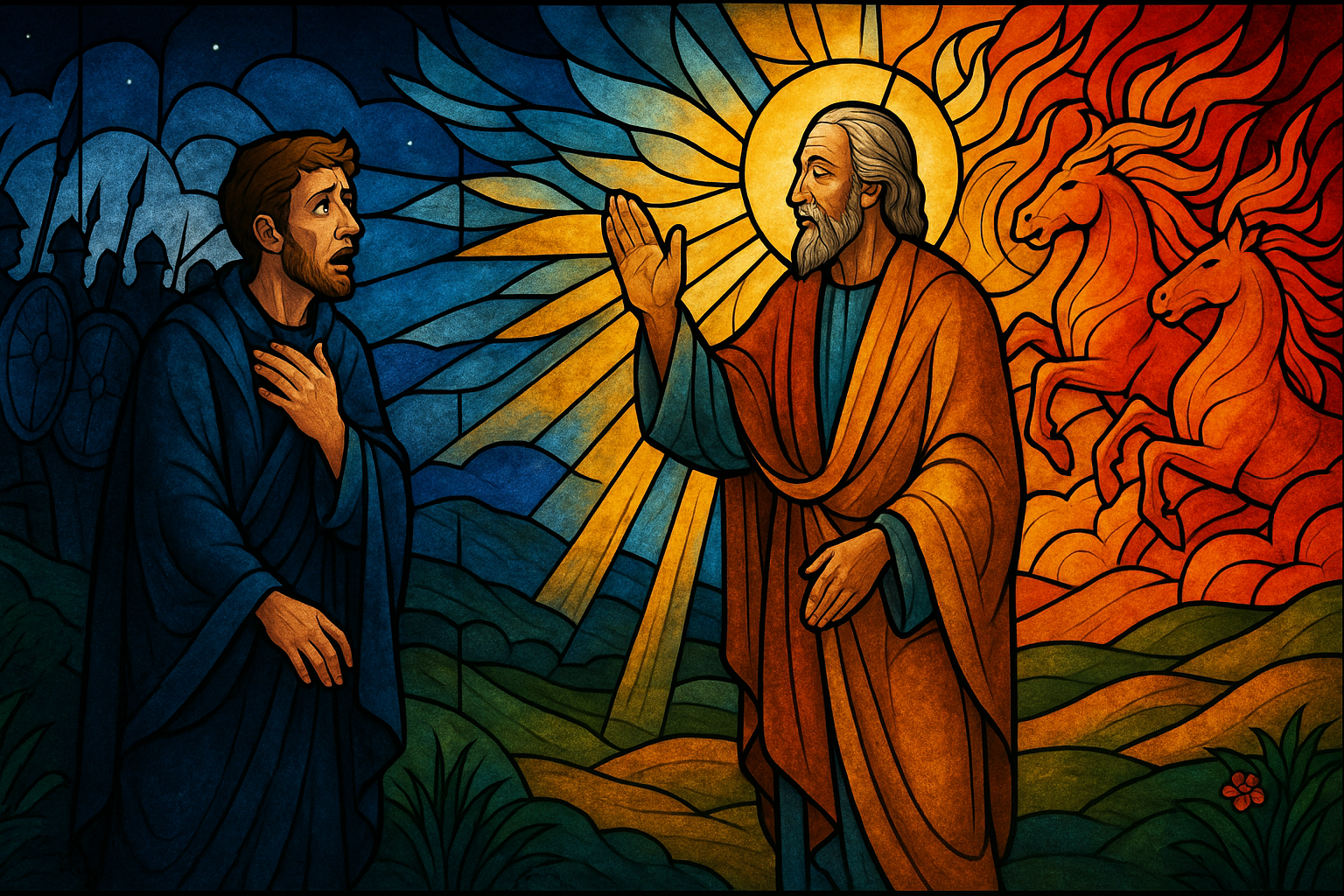
The next morning, when the young servant of Elisha woke up and went outside, he was greeted by the sight of the Syrian army, who had encircled the village and were poised ready to pounce. He froze, unable even to cry out. Talk of being traumatized, right at the beginning of your day! Here is the ultimate symbol — a group of Syrian soldiers with knives flashing and blood in their eyes
I don’t know about you; you may not have fantasized much about Syrians, but the picture of waking up and feeling surrounded by enemies, or weighed down by burdens, or just that vague feeling of being frozen to the bed when we think of all the problems that will face us through the day –‘ that kind of feeling is not an uncommon experience for me. Incidentally, it is that kind of traumatized waking that makes us feel tired and worn out before we even start the day.
Have you ever had that feeling? Instead of bounding out of bed and saying, “Good morning, Lord,” have you ever turned over, held tightly to the pillow, and said, “Good Lord, it’s morning”?
If you have, then you know something of what Elisha’s servant was going through. In a minor way, your experiences are a mirror image of the young man.
Yet the story doesn’t end there. Elisha comes out a few minutes later and looks about at the encircling enemies, and quietly says, “Fear not, for they who are with us are more than they who are with them.” Then Elisha bowed his head and prayed, “a God, open the eyes of the young man, that he may see things the way they really are.”
And the prayer was answered. Suddenly, Elisha’s servant looked about him and, as the Bible often puts it, “his eyes were opened.” In other words, he saw much more than he had been able to see a moment before. Scripture describes it this way: “In back of the Syrians, the young man saw horses and chariots of fire that far outnumbered the enemies. ”
Here was an electrifying discovery, which turned the whole world upside down for Elisha is servant. It was not that the enemies disappeared; that’s what we hope for when we think of our bun. dens: Just let them go away, disappear, get transferred, go to another parish, job or town. But that’s not what happened here. The basic miracle for Elisha’s servant was found in his perspective of the situation. Suddenly, he was amazed that what was going for him was far greater than what was going against him. Suddenly, he got in touch with some resources that he had not been aware existed. They who are with us are more than those who are with them. Therefore be not afraid. it is the perspective you bring to your burdens that makes all the difference.
Let me be specific or, as someone said, let’s stop preaching and start meddling. And let me start by raising this question: Do you feel your burdens are increasing and your resources are decreasing? if you do, maybe you have forgotten about your primary resources for coping. Maybe your eyes are not fully opened.
From Elisha to Paul, it has been said again and again: Somehow, the resources of God are greater than the burdens we carry. The promises of God for all who are weary and heavy-laden are there. He will refresh us. The question is: Do we believe in that resource? Can we see our problem from that perspective? The way we view our burdens makes all the difference in our ability to cope.
I received a letter recently from a parishioner with whom I had talked just before a difficult experience. After the experience, she graciously shared some thoughts and feelings on how she had coped. Let me share a few of her sentences:
“This afternoon, I felt my burden was going to be too heavy, and then the recurring miracle appeared. The courage and strength came, but only when I let go –. let go of feeling that it was all up to ‘me.” She ended her letter with a question: “Why is it that we still suffer periodic forgetfulness that causes such fear?”
We are forgetful, and sometimes our fears take over. The burdens become too heavy. There seems to be no light at the end of the tunnel. Hope is just “a four-.letter word. Fear becomes the dominant motive.
Yet our eyes can open, and there is a possibility — the saving possibility *-. that we can hear Elsha’s words: “Be not afraid! Those who are with us are more than those who are with them. ” Or, as the Psalmist said, ‘Even though I walk through the valley of the shadow of death, I will fear no evil, for Thou art with me.”
Jesus is called Emmanuel- “God with us”. The Holy Spirit is called the Comforter, which is the one called alongside of, to bring us strength. That is our resource, as it was from Adam to Paul, from Elisha to Luther, from my friend who was ordained 27 years ago to you who sit in your pews. God is with us, Christ walks ahead of us, and the Spirit warms our hearts.
My friend was right in remembering those words said at his ordination. Everyone you meet is having a hard time. In every life, some sort of struggle is going on. In one way or another, we all have an enemy encircling us. But wait — that is not all. In addition to everything that is working against us, there is also that which is working for us. As Martin Luther put it:
Did we in our own strength confide,
Our striving would be losing;
Were not the right man on our side,
The man of God’s own choosing:
Dost ask who that may be?
Christ Jesus it is He;
And He must win the battle.
Let us pray:
0 God, open the eyes of all of us, that we may see the way things really are, and not be afraid anymore.
Amen
To Those With Burdens
To Those With Burdens
March 22, 1981
Scripture: II Kings 6:15-17