St. Philips Day
John 4: 21-22
May 7, 1995
In a book called “One Hundred Years of Solitude,” a Colombian novelist by the name of Gabriel Garcia Marquez tells a story of a strange disease that invades a village. The sickness starts with insomnia and then spreads to a loss of memory. The infected person becomes unable to recall the names of simple things. As the disease progresses, they forget memories of childhood and eventually even the names of the people around them. Finally, they sink into a state where they lose awareness of their own selves. Eventually, this leads to idiocy.
In the novel, one of the villagers conceives of an imaginative way to stave off forgetting. He takes pen and ink, and marks everything in his home with its proper name – table, chair, clock, door, wall. He even marks the animals and plants. Soon after, he observes that this alone will not do for people with the disease. He then begins to label everything with a description of its use. “This is a cow. She gives milk. She needs to be milked every morning.” “This is a blanket. It is used to cover a person while sleeping it goes on a bed.” One of the most touching labels was the names and descriptions of the village and the parish church.
Memories are powerful things. If we lose our memories, we are in danger of becoming dysfunctional and rootless. This is certainly why we name things and assign meanings to places. One of the earliest tasks the Bible reminds us of is to become a namer. The job of giving a name is one that God commands us to do at the very beginning of creation.
Listen – in the second chapter of Genesis it says: “And the Lord God formed every beast of the field and every bird of the air and he brought them to Adam to see what he would call them and whatever man called every living thing, that was its name.” Deep down inside of ourselves, we realize that a place or a person without a name can never have much significance. Deep down in our unconscious, we know that if we fail to name things, fail to see significance and meaning in things, we are on the road to idiocy. Let me even take this one step further and say that the process of naming is the beginning of making something special. We might even say it is the beginning of making something holy. Hence, Baptism. Hence, the christening of ships and other modes of transportation. Hence, giving a church a name.
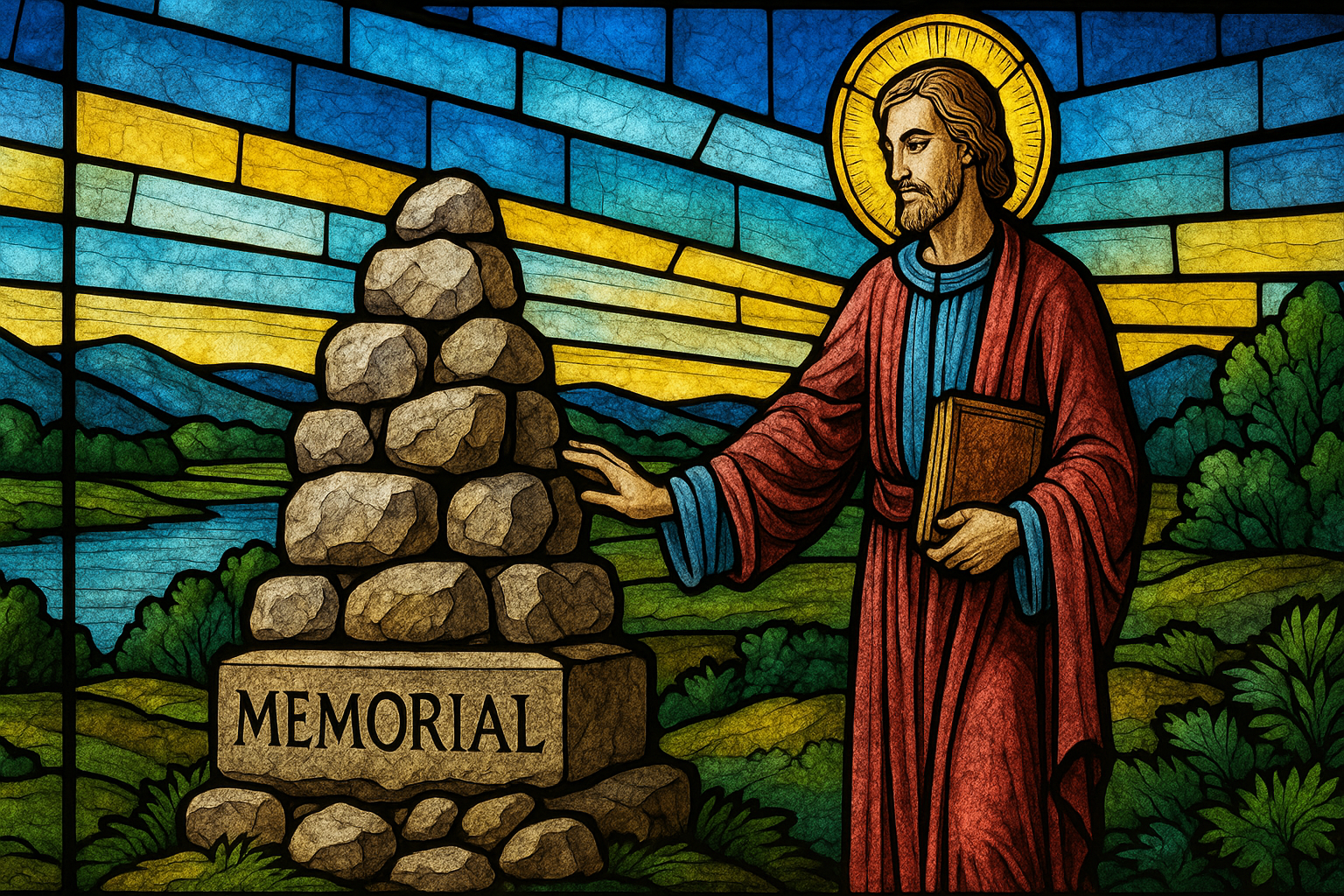
The ancient Hebrews realized this, also. Our first lesson tells how Joshua commanded twelve men, one from each tribe, to find a stone from the River Jordan and bring it to the priests at Gilead so that they might build a monument and name the place
Let me set this request in its context. The Hebrew people had just crossed the Jordan River. They had been wandering as a nomadic people in the wilderness, and now, finally they have come into the promised land. But they were also very much aware that they were surrounded by potential enemies. Enemies who were like giants. Doesn’t it seem strange to stop whatever they were doing – just to build a monument?
The explanation that Joshua gives is worth noting. “This shall be a sign among you, that when your children ask their fathers in time to come, saying, ‘What mean these stones?”, then you shall answer them “that the waters of the Jordan were cut off before the ark of the covenant of the Lord, and these stones shall be for a memorial unto the children of Israel forever.”
On the surface, it might seem as though Joshua were crazy. Imagine taking time to collect stones at a critical moment when there were fortifications to build, crops to place, enemies to face, and a thousand details in establishing a new homeland. But, you see, Joshua understood that memories were of equal importance in building a homeland. “This shall be a sign to you, that when the children ask their fathers in time to come, What mean these stones?’, then you shall answer them-.” Those twelve stones of Joshua pointed beyond themselves.
We might say they had transcendent meanings. They had the ability to speak to the inner souls of future generations. I don’t know what the stones looked like. I’m only certain they were not functional; that is, they were not able to be used for another reason, like as markers directing people to the nearest filling station. These stones, in themselves, contained power and meaning as well as a sacred name for a place and an event. They were there to guard against the Hebrews lapsing into amnesia, or a kind of idiocy that thinks the world begins and ends with the people present.
Recently, there has been a fascinating series in the New York Times on the megachurches of the country. A megachurch is one that has between five and fifteen thousand people attending worship on a given Sunday. The third article in the series was on church architecture. The writer indicated that many megachurches looked more like shopping malls than houses of God. The rationale was that they were there to comfort and entertain people rather than provide them with symbols of spiritual meaning. I wonder what Joshua would say on viewing one of those megachurches that look like a shopping mall. Would he ask: ‘What mean these stones, this wood, this glass???”
One of the reasons I love this special church of ours is that it is filled with symbols reminding us that we are debtors to the past. There is no question that these stones, this wood, this glass, are God’s house, and not simply a convenient building for getting together. Every time we come to worship, the name hits us – St. Philip – the place – jogs our memory and we join a divine human conversation which began long before any of us were born, and will continue long after all of us are dead.
Having said all that I’ve said so far, I feel compelled to issue a sole warning. Places of memory can lead us into all sorts of trouble. Memories are like the roots of a tree. They can give life. Without them, you can quickly descend into a kind of idiocy- But memories, like roots, can also hinder growth. Like roots, they can choke a tree or keep other trees from growing in the same vicinity. On a human level, memories can become addictive, a presence that blocks movement into the future. The difficult task for churches that are proud of their links to the past is how to preserve those precious memories and still be open to possibilities in the future.
Today is our patronal festival day. A day in which we recall those special memories of St. Philip and all who have worked in this parish under his banner. We are reminded that our faith lives on memory, as well as hope and promise. Our faith is based on the reminder that God has acted throughout history. . . hence, we celebrate a day like this lest we forget, or begin to think that everything started with this generation.
Joshua also suggests that our role is not only to name, but also to interpret the memories. Our task is to not only care for the stones, but to interpret the memories lest they become ends in themselves. ‘When your children,” Joshua says, “shall ask their fathers in time to come, saying, What mean these stones?’, then you shall let your children know.”
It is not enough that we have magnificent adobe and wood, and glass. We need to constantly interpret, to preach, to tell the world the meaning of this community that bears the name of Philip. This is a never-ending task that we often forget is so important for our growth as a community. Every Sunday, when I enter this pulpit, I am thankful that right behind me stands a picture of Philip. I don’t know if he looked that way. But this I do know. Those eyes seem to drill into my back, and I am reminded that I am accountable for all that I say to Philip and all who have gone before. Let me tell you, this is a scary feeling for a preacher – to suddenly realize that you are accountable not only to those in the pews and to the Vestry and to one’s Bishop, but to all those who have come and gone before you.
The bottom line for me on this patron saints day is to look at this building, to look out at you who are the living stones of this parish, and look around at the magnificent artwork and architecture, and know that here is a place that honors memories without being chained to the past.
Today, we give thanks for this place called Philip. We give thanks that someday, somewhere, there will be people who might have been afflicted with cultural amnesia – and they will say: ‘What did the Christian church look like in the ’90s???”
And someone will answer: Here is a place called Philip – whose stones are a memorial unto the church forever.
AMEN.
St. Philips Day
St. Philips Day
May 7, 1995
Scripture: John 4:21-22