Lessons Learned from the Acts of the Apostles
Act 6: 1-9
May 10, 1998
Sometimes, preaching can get you in a whole lot of trouble. I’ve never stirred up a group of people to the point that they wanted to do away with me. (The best I’ve managed to do, on rare occasions, is have someone cut his pledge, or walk out of church shaking his head.)
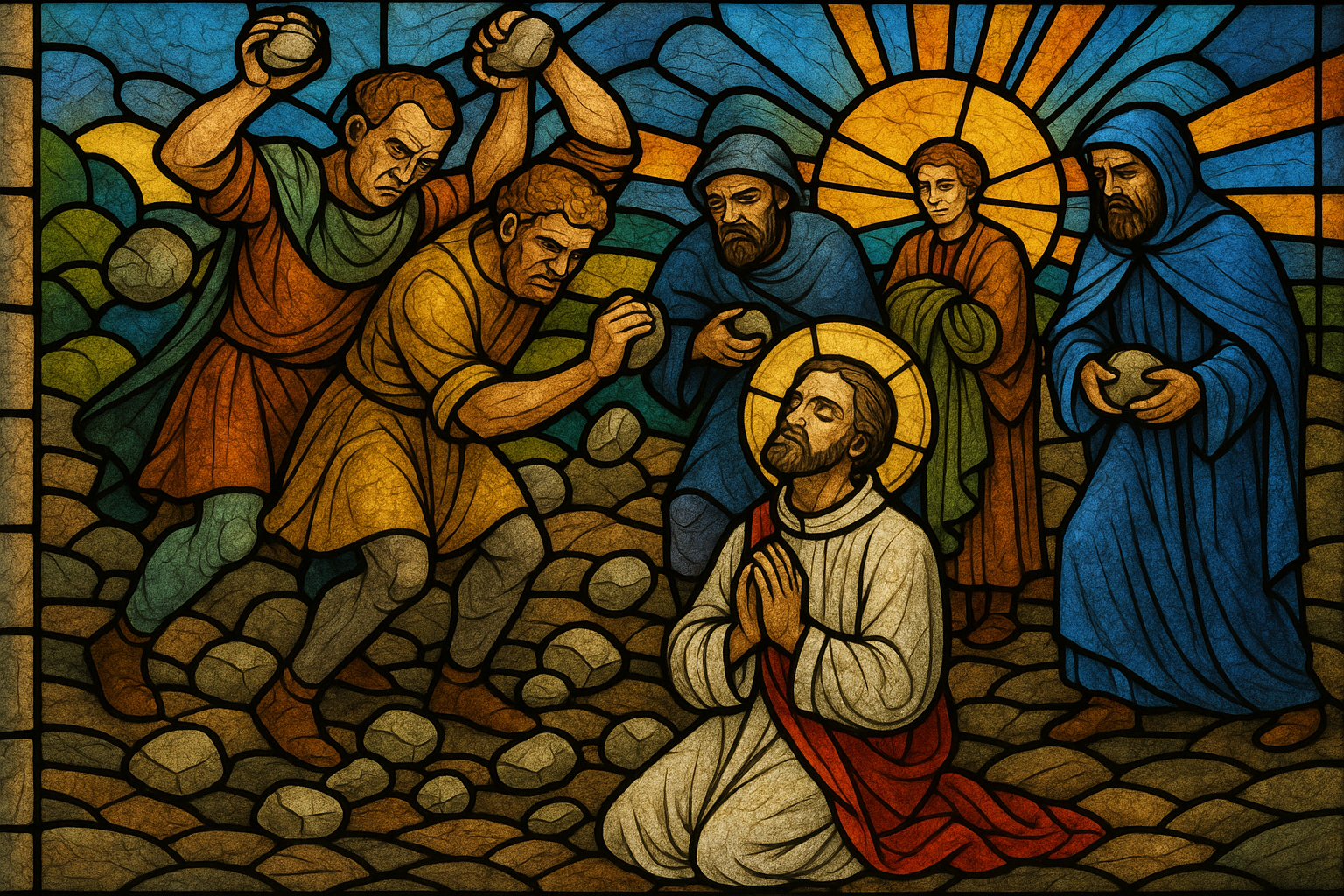
But on that day, many years ago, it was a different story. The young preacher began to hear murmurs of blasphemy, which escalated into a bloodthirsty mob. Finally, they chased him from the pulpit, and in a rage, they began to throw rocks. (Now that’s feedback the likes of which I have never experienced.)
But let’s start the story from the beginning. For there is a lot here from which we might benefit.
It began with another type of feedback. The feedback came to the Apostles soon after the church was established.
The Apostles were being hassled by some young, come-lately, out-of-towners – church members – Greeks, who were upset over the distribution of food. It seems, or should I say, the Greeks perceived that the locals were getting more, or better food, at the common meal. And when these complaints became a groundswell, the Apostles set a new pattern for church life. One that has been followed in every generation. They formed a committee and found someone else to deal with the problem.
It was this feedback from the Greeks that encouraged them to have a reorganization. And the solution was to invent a new order of ministry – the role of the deacon. This new grouping had as its job description to look after the food distribution. Some of you may recall when we last had a deacon present, that he wore his stole over one shoulder. This was to symbolize the way a waiter might wear a napkin for serving. I think it was also implied that these new deacons would look after the widows and orphans. This was done this re-organization – so that the Apostles, the really important ministers, would not have to do the pedestrian tasks, like calling on shut-ins and being concerned over administration. A tradition that also seems to have continued to this day.
One other thing we might learn from this story is that the new deacons were all Greek, establishing another well-honored principle of church life. The ones who complain the most, are the ones who get the job of solving the problem. In those days, there didn’t seem to be any lack of volunteers. And the Greeks, being the newest group to be converted, were also the most eager to step forward when volunteers were needed. They hadn’t yet learned to say, “Oh, I’ve done that all before. Let a younger person take over.”
Among the number of Greek deacons was a youthful, eager beaver named Stephan. We really don’t know much about him, except that he was filled with the enthusiasm of youth. He also felt that serious changes were needed right now. (It’s always interesting when a new deacon comes on board. Immediately, they want to make changes. And the changes usually are to the time-honored traditions.)
Well, a group from this one congregation began to feel threatened, and they started to argue over the changes. We are told that they had a public discourse and began to be angry with Stephan. Finally, a group began to say, “This guy has to go.”
In those days, there wasn’t any such thing as a golden handshake, pension plans, or IRAs. The method of getting rid of the preacher was through stoning. (Congregation, do not take notice of this fact.) And stoning was hard work. It was not everyone scrambling for a baseball-sized rock and throwing it. Or, some disturbed people hurling insults. What happened in the stoning was that someone dropped a very large stone, which immobilized the victim. And then the others finished the job by dropping huge bone-breaking rocks on top of the person. It was hot, hard, difficult work. And the people needed to take their coats off to do it. And then we read that they wanted to leave their coats with someone trustworthy, in order that they would still be there when they returned. In short, they needed a “coatholder.” And we read that the participants found someone named Saul to do the job.
Now let’s take a moment and look at what a coat holder does. For this, too has become a time-honored tradition in the church. A coatholder is someone who stands away from what is being done, but holds the coat of someone doing the job. A coatholder is, therefore one who makes it possible for someone else to do evil. It is someone who participates, but doesn’t get their hands dirty.
The church is full of coatholders. They occupy a special place on the moral landscape. It is a particularly dangerous place because coatholders fool themselves into an assumption of innocence. They convince themselves that they are not actually doing anything wrong. Paul could have said at the end of the day, “I did not stone anybody. I merely stood around and watched.” It’s the same way we often say, “I did not tell the joke. I just laughed to be polite.” Or, “I do not hate anybody. I just don’t have the time or money to spare for those in need.” Or, “Certainly, I did not agree with that direction. I just did not want to get involved.”
All of us are coatholders in one way or another, making it possible for others to do evil. Some play an obvious role at home, or work, or at church. Others of us have simply made peace too easily with racism, poverty, injustice, and corruption.
But all of us are coatholders to a certain extent.
In our complex society, where it’s so easy to be uninvolved and feel impotent, where we seem to be unable to make a difference, it is easy to look clean and be dirty by association, to look innocent, and at the same time be guilty. Coatholders, that’s what most of us are. And it’s because of that that martyrdoms take place.
We return to the story. Stephan, even when he was being stoned, managed to forgive his murderers. His last words were, “Lord, do not hold this sin against them.”
People outside the religious establishment often tell me that the church is made up of hypocrites. I usually don’t argue with them, for I know better than most what lies underneath our masks of respectability. But I also know that God doesn’t hold that against us. That we can rise to great heights.
GK Chesterson once said, You can look at a thing nine-hundred and ninety-nine times and be perfectly safe. But, if you look at it the one-thousandth time, you are in danger of seeing it.” Pray God that we may have the one thousandth look and see lessons for life in the story in Acts.
Amen
Lessons Learned from the Acts of the Apostles
Lessons Learned from the Acts of the Apostles
May 10, 1998
Scripture: Acts 6:1-9