Family Connections
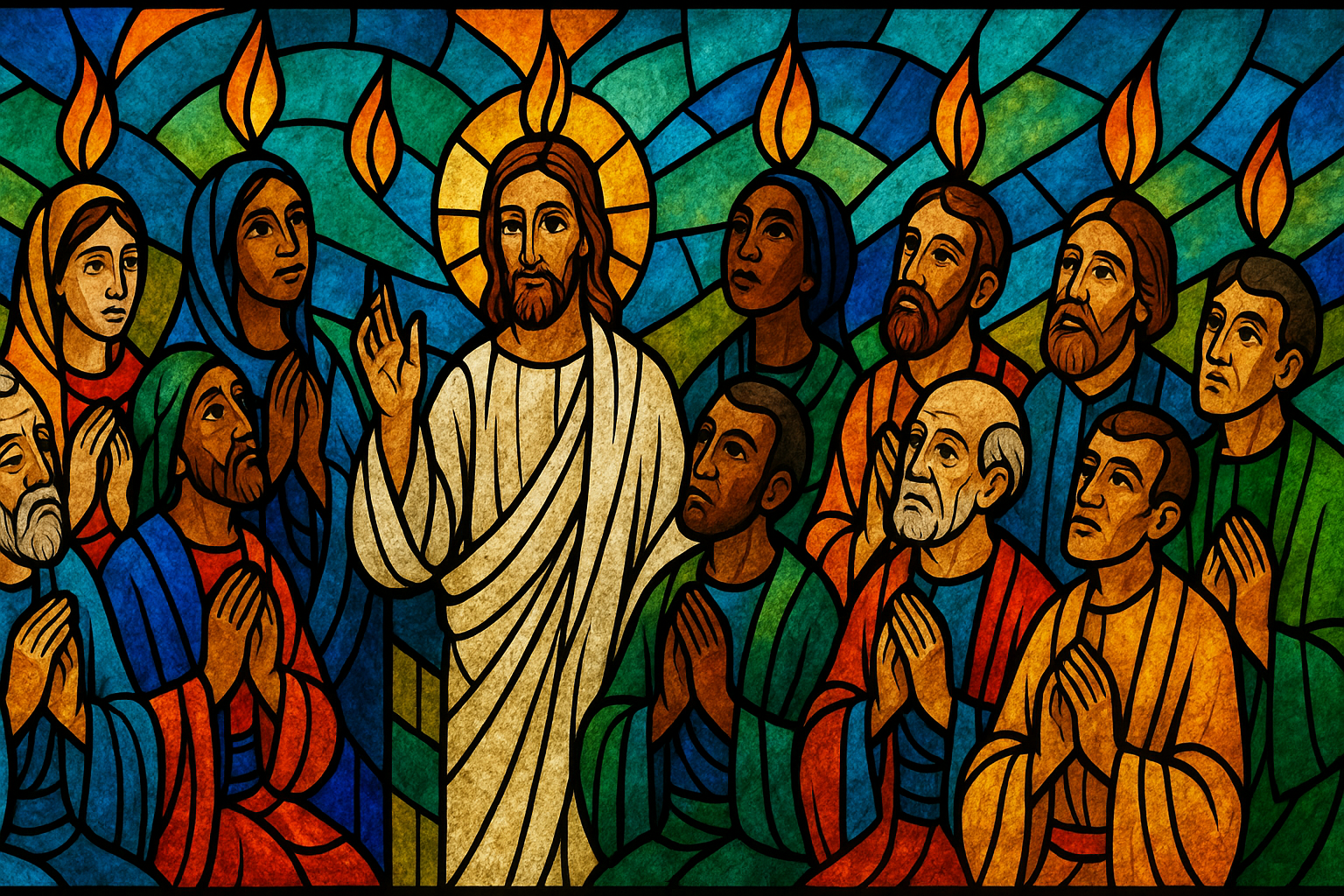
Acts 2: 1-11
May 11, 1997
I once had an Uncle, Uncle Donald. Uncle Donald was my mother’s brother, but more than that, he was the black sheep of the family. I don’t think he ever did anything very wrong. He was just a wanderer, a dreamer who borrowed a lot of money for get-rich schemes that never quite worked. Uncle Donald married a succession of women and fathered a number of children around the country. The last I heard of him (30 years ago), he was about to set sail for Australia to start a new life as a sheep rancher. All I can remember about Uncle Donald was my mother’s constant admonition: “You certainly do not want to grow up to be anything like your Uncle Donald.”
I suspect most of us have one or two Uncle Donalds in our family trees. Those black sheep whom our mothers said, “Watch out, you might grow up to be like Uncle Donald.”
And furthermore, I suspect if we have family pictures in an album or on a wall, someone will ungraciously say to us, “You certainly look a lot like your Uncle Donald.” Or maybe even hint that you often act like the black sheep. My point, and I don’t want to press it too hard, is that often to our dismay, the family connections seem to stick. Our connections to the so-called black sheep are sometimes painfully evident.
One of my favorite novels is William Faulkner’s Absalom, Absalom. In the novel, Quentin, the main character, flees from his native Mississippi to Harvard in a desperate attempt to rid himself of his history. He can’t do it. Alone in his room overlooking Harvard Yard, voices from the past come back to haunt him. Dead ancestors from a dark Mississippi era seem to stalk him. Eventually, Quentin takes his own life. Just before dying, he says, “You can’t escape the ghosts.”
Today we are celebrating Pentecost. It’s an ancient Holy Day intertwined with the ghosts of Israel’s past. For Jews, it’s the festival where they come together to give thanks for the gifts from God, which unified the Hebrew people. For some, it’s a time when they gather and thank God for the harvest, which allows them to continue as God’s people. In ancient times, pilgrims from all over the world used to come together in Jerusalem to celebrate what God had done for them and for their ancestors.
The author of Luke uses this celebration as a basis for telling a story – a story of the beginning of the Church. Because it’s Pentecost, it seems natural that there would be pilgrims from all over the world.
One of the principal emphases in Luke’s narrative is that every nation on earth is represented. Even some really strange places with hard-to-pronounce names like Mesopotamia and Cappadocia, and Elamites and Medes. Places most of us haven’t ever heard of, but places that tell us Luke believes that whatever it was that happened, happened to people of every tribe and tongue. The point that he is attempting to make is that every ethnic group, every religious background, was represented at the beginning of the Church. In present times, we often try to make the same point by inviting people to read in different languages. I’ve got to admit that if we were really going to understand Luke’s point, we ought to have a Hindu from India, a Buddhist from Tibet, and a Muslim from the Middle East participating in the service.
Getting back to the story, it seems to me that Luke has more at stake than ringing the bell for an ecumenical gathering, even if it were a worldwide celebration.
One of the scholars I read in preparation for today made this observation. The Pentecost story not only contains a diverse ethnic grouping, Medes, Elamites, Cappadocians, but it was also a historical impossibility. For example, the Medes would have had a tough time traveling to Jerusalem from Mesopotamia. Not only because of the hundreds of miles, but also because they would have had to travel hundreds of years forward in time. The Medes, we are told, had been extinct, long gone, from the face of the earth. They had ceased to exist at least two centuries before the story was told. And then there were the Elamites. They are only mentioned in the book of Ezra and are never heard from again. Elomites are somehow lost in antiquity. So you see, Luke’s Pentecost story is not only a gathering of people from all over the globe, but he also has people living and dead, the present and the past represented.
What then can we say as we read the story of the first Pentecost? It seems to me that this is Luke’s way of declaring that God’s spirit is poured out, not simply to those who speak Hebrew and who were living in the first century – the Holy Spirit comes to people living in every generation and every place. Fast and present, Hebrew and Christian, living and dead, American and Bosnian, we were all there.
One further reflection on Luke’s story of the first Pentecost. We might recall that the spirit of God was poured out indiscriminately. Not only was everybody present, but also everybody received the gift of the Spirit.
A pet peeve of mine is that church people are always concerned with orthodoxy. One of the favorite indoor sports of church people is to decide on who is right and who is wrong, or who is in and who is out. For instance, in many Episcopal churches, the invitation to participate in the spiritual banquet of Holy Communion, which is a recreation of that first Pentecost, (this invitation) is done by saying: “All who are Baptized, and who believe what we believe about the Sacrament of Communion, are welcome to come to the rail.”
I think Luke would have had trouble with such an invitation. He might have said, “Go back and read the Pentecost story. No tests of orthodoxy, no admission criteria, not even a check as to whether you have been good or bad. God’s spirit is poured out on everyone… very indiscriminately.
Do any of you recall the movie Places in the Heart? Particularly, the last scene. It’s one of the few times I’ve seen Hollywood make a profound Christian statement.
In the movie, which is filled with violence and injustice, we come to the final scene. Everyone is gathered in a little country church for communion. As the service proceeds, the camera pans over the faces of the congregation. There kneels the man who was murdered years earlier. And next to him sits the murderer. We see all the good guys and bad guys from the film kneeling together. And suddenly we’re caught up in a Pentecost experience… everyone is there.
Places in the Heart never won an Academy Award, but for me, it showed what the church is like as it comes together for Holy Communion. In the Eucharist, the Pentecost experience is duplicated. We are joined to everybody. All who have gone before, people from all parts of the earth, the good and the not-so-good.
And so the Church was born on Pentecost. The church, that group of people who gather as a family to break bread, share some of their lives, and tell stories. Stories that may not be factual, but are filled with meaning and are always true.
Today at Pentecost, everyone is here. And you are invited to come forward and join not only the people in the next pew, but also people from your past. My Uncle Donald is here, as well as your relatives. We are all part of this communion, this banquet, where God’s spirit is poured out upon us. We were there at the first Pentecost, and we are all here today.
Amen
Family Connections
Family Connections
May 11, 1997
Scripture: Acts 2:1-11