What is the Meaning of Life?
May 14, 2000
You are only young once, but you can be immature forever. And when, we might ask, when do we become mature? is it in the afternoon of life, or do we have to wait until the evening of life?
For those of you in the evening of life, I have some bad news. Because you are past sixty-five, because your children are grown, because you are retired, that doesn’t make you mature. Wrinkles and gray hair are not signs of maturity. Experience and longevity are not the same as wisdom.
Now this is a heck of a way to start a Mother’s Bay sermon, but the truth is that motherhood, fatherhood, and even grandparenthood are not a necessity of maturity. Age, experience, and learning all count for naught when we are talking about maturity.
So, when do we become mature? I was at a meeting a few days ago and someone said, “When are you people going to grow up?” All of us spontaneously admitted we still had a long way to go. When do we approach maturity? When can we say we are getting wiser, gaining true understanding, “growing into the full stature of Christ,” as our Baptism urges us to become? When can we simply declare that the passing of years doesn’t merely mean that we’re getting closer to dying?
TS. Eliot once put it this way, “All our knowledge leads us nearer to our ignorance. All our ignorance is near death. But nearness to death is no nearer to God. Where is the life we have lost in living?”
All our knowledge leads us nearer to ignorance. Where is the life we have lost ,,, living? In school, you can find out everything about the world except the deeper questions of meaning. As you get older, you learn how to cope and maybe how to die, but never about why you are here. Finding out about the meaning of life and why you are here are the types of questions that only seem to be asked within a religious context.
Eliot suggests that in the business of living, we have lost the questions that lead to maturity. Today, I want to raise those kinds of questions with you.
Robert Fulghum, the author, who has become so popular with self-help books, suggests that the question of meaning is always in the back of Is mind. He says he raises it at every opportunity “Usually,” he says, These chances occur at the end of a lecture, when the professor turns and asks if anyone has any questions.” if there is a little time left and there is a silence in response to the invitation, Fulghum will jump in and ask, ‘What is the meaning of life?”
Generally, everyone laughs, begins to pick up his or her things, and the class is over. He writes this doesn’t stop him from asking because at some point, someone just might blurt out the answer. He says he would hate to have missed it simply because he was too socially inhibited to ask.
Fulghum reported that once, and only once, did he get a serious answer. It happened on the Island of Crete, at a seminar on human understanding and reconciliation. The Director of the Institute, Alexander Papaderos, had just finished a lecture and asked, ‘Are there any questions?” Silence greeted the director. Finally, Fulghum found himself asking Dr. Papaderos, “What is the meaning of life?” The usual laughter followed, and people started to go out. But the director had heard a serious question and decided to answer it.
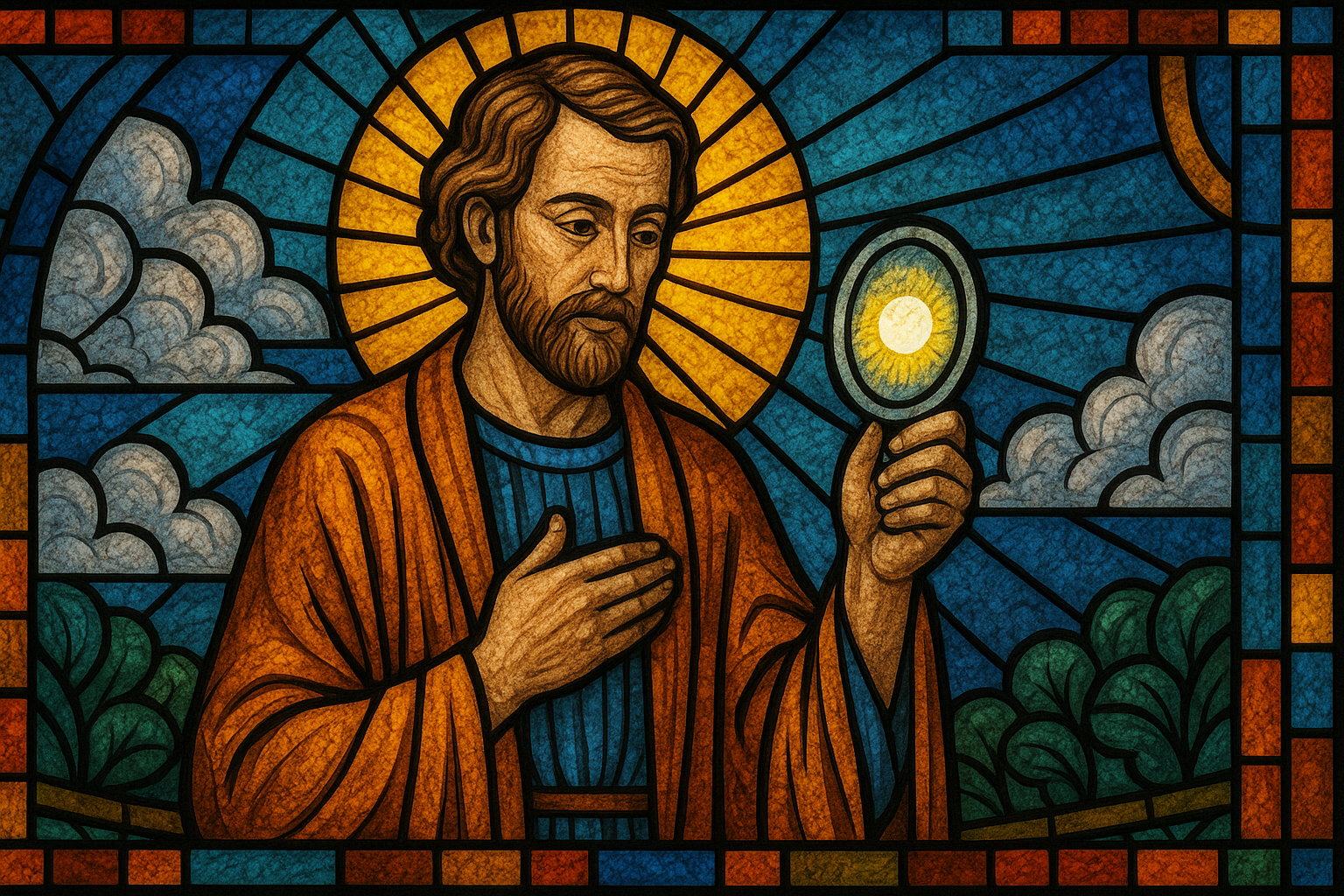
Taking his wallet out of his hip pocket, he fished into a leather billfold and brought out a very small, round mirror about the size of a quarter. What he said went like this. When he was a child during the war years, he had found this piece of mirror on the road where a German motorcyclist had been killed by partisans. Papaderos had not been able to find the whole mirror, but he had kept the small round piece as a souvenir.
At first, it was just a toy, but as he grew older, he found he could use the mirror to reflect light into dark places where the sun would never shine. After a while, it became a game, a challenge, to see if he could get light into the most inaccessible places. Finally, he said, “As I became a man, I realized that this was not just a child’s game. This was a metaphor for what I might do with my life.”
Papaderos went on to say, “I came to understand that I am a fragment of a mirror, whose design and shape I do not know. Nevertheless, with what I have, I can reflect light into the dark places of the hearts of people and maybe change some things.” And then he said, “I understand that I am not the source of light. But light is there, and it will only shine in many dark places if I reflect it. Perhaps others may see and do likewise. At any rate, this is what I am about. This is the meaning of my life.” “Then,” Fulghum tells us, “Papaderos took the small mirror out, and holding it carefully, caught the bright rays of daylight and reflected the light onto my face.”
Marcus Borg, a Yale scholar, often refers to Jesus as a teacher of wisdom.” Wisdom teachers were those rabbis who counseled their disciples on how to be mature and wise in a world where most people were childlike. Wisdom teachers were the ones who constantly reminded us that we were to seek enlightenment. In the Gospel, Jesus reminds us that we are the lights of the world. For people who think less highly of themselves, this is startling. “You are light,” he says. “Don’t hide your light under a bushel.” A simple teaching, you might think, but the implications are profound.
The rabbis tell a wonderful story about a teacher of wisdom who asks his students, ‘When can we tell that we are mature?” None of the students can answer. And so he says, “Let me give you a hint. When you realize that you can be a reflection of the light of the Creator, then you are on the road to maturity.
One student then says, “How do we know that we are on the road, good teacher? Is it when we can distinguish right from wrong?” “No,” says the Rabbi. “It is when we are autonomous, making our own choices?” “No,” says the Rabbi. “It is when you can look at a man or a woman and know that he or she is your brother or your sister.” And then he went on to say, “Until you can do that, no matter what age you are, no matter what time of day it might be, it is always evening and you will always be childlike.”
Jesus said it. “Don’t hide your light under a bushel. Treat each person as a member of your family, for we are all related.” Let’s take the last word from our children. One of the favorite Sunday School hymns is “This Little Light of Mine.” And do you recall the ending? “Let it shine, Let it shine, Let it shine.”
Amen
What is the Meaning of Life?
What is the Meaning of Life?
May 14, 2000