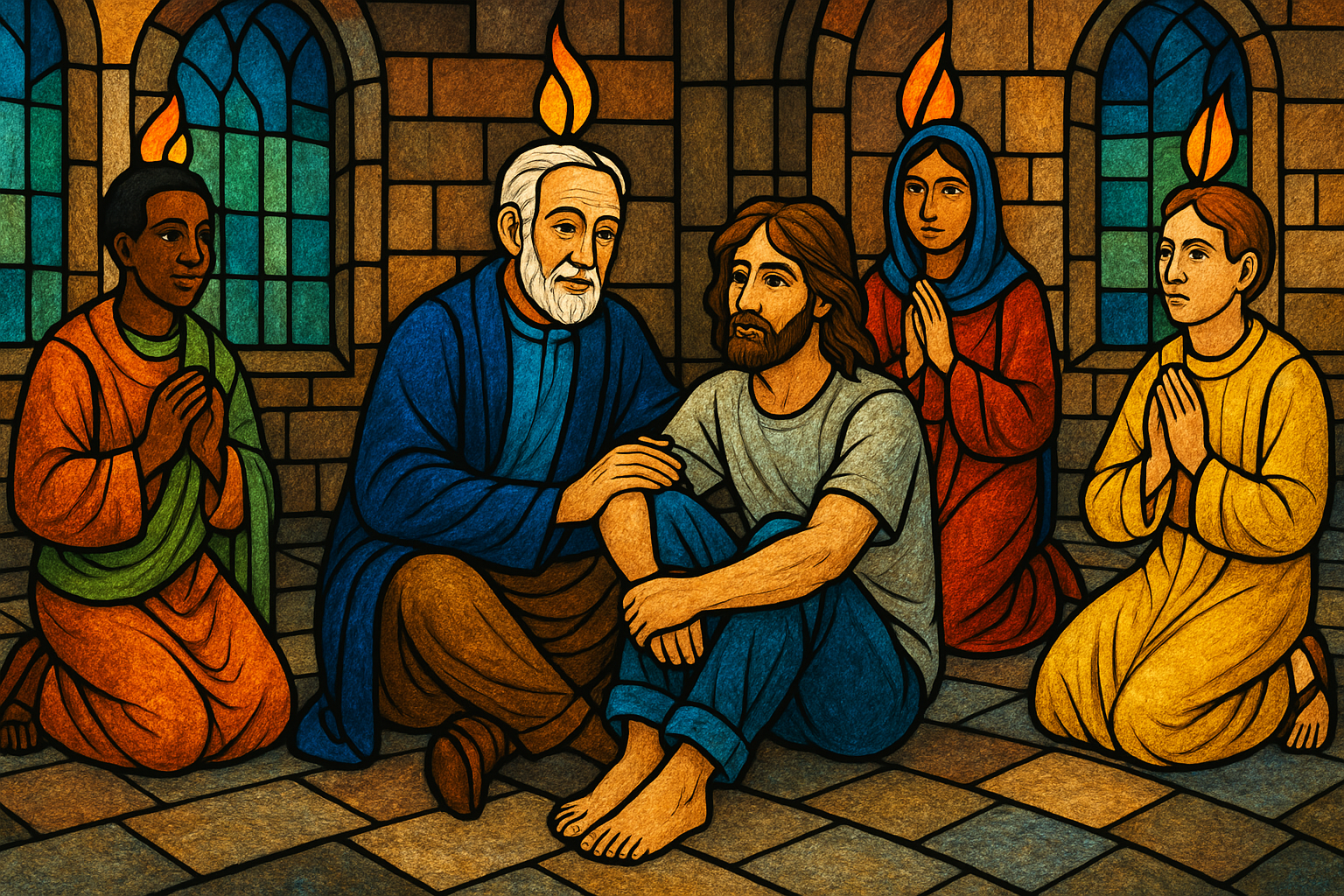
Pentecost
May 23, 1999
In this week’s paper, Tucson was listed as one of the ten model cities for retirement. I’m not quite sure how we were chosen, but it’s a good exercise to ponder what the marks are of being a model community.
A few years ago, Neil Postman wrote a book about communities. He speculated how the model of top cities changed depending on what Americans think is important.
“In the late 18th century,” Postman said, “Boston was the Model City for it reflected the values of freedom and decency.” In the mid-1901 century, New York became the model, for here was the center of commerce. Later on, the model became Chicago. Here, the spirit of building and inventiveness seemed to reside, and it was the center of new wealth and was westward-looking. And now, Postman wrote, the model community for America is Las Vegas. A community devoted almost entirely to entertainment, where the expectation is to have fun and feel good. I don’t know what you want to make of his analysis, but it does speak to how communities change when our values and expectations change.
But today, Pentecost, we’re here to focus on the church as a community, and I would ask you to focus on how the model has changed through the years for churches. In the early days, the model community was the gathering at the first Pentecost (about which we just read). The characteristics of that community were diversity, chaos, and anticipation. We are told there were people of different ages, different countries, and different languages. And the service, if we can read between the lines, was messy and didn’t go according to any set plan. And finally, we read that there was a sense of anticipation. Everybody there anticipated that something momentous was going to happen – and so it did.
Later on in history, the model church was the great architectural giant of a cathedral. Here, the model was more of a place, a place of majesty where pilgrims found hospitality, and magnificent liturgies were performed, with great preachers and fabulous choral works. Today, the model community is of a parish church. Maybe a mega-church, but still much smaller in size from the first two models, influenced by the Las Vegas model of entertainment, more staid and predictable. We’ve replaced excitement with predictability, chaos with order, and anticipation with routine. We come knowing what to expect on a Sunday and are rarely disappointed. We go there to feel good and usually do.
The wonderful message of this day is that God’s spirit can somehow slip in unannounced and change our models. God’s spirit can move us closer to the original community, even when we insist on holding on to our comfortable model. I don’t know whether the spirit can transform Las Vegas into Boston, but this I do know that the spirit can change a parish church into something like the original Pentecost community.
I would like to tell you a story of one such small change. It may not be as dramatic as Pentecost, but it speaks to what the Holy Spirit can do on a very small scale, and how the unexpected can sometimes be a vehicle for change.
The church was in a large city. It was directly across from one of the campuses in that community. It had a very well-dressed, conservative congregation. They always wanted to develop a ministry to the students, but were not sure how to go about it. One Sunday, a student by the name of Bill decided to go there. Bill had become a Christian while attending college, but had never been to a regular church service. So, Bill walked into this church. Now, I forgot to mention Bill looked a little different than the average person. He didn’t wear shoes. He was dressed in jeans and an old T-shirt with holes. His hair was wild, he didn’t shave, and if you got close to him, you could tell he hadn’t bathed in a while.
Bill came in late, and the church was fairly packed. He went down the center aisle, but couldn’t find a seat. By now, people were looking a bit uncomfortable, but no one said anything. As the Gospel was read, Bill walked closer and closer to the pulpit. When he realized there were no seats, he just squatted down on the carpet. (Although this was acceptable in college, it had never happened in this congregation.) By now, the people were really nervous. The tension in the air was thick.
About the time the minister got to the pulpit, he realized that from the back of the church, an usher was slowly making his way toward Bill. Now the usher was in his eighties, his silver gray hair, his suit, and pocket watch all proclaimed him one of the old guard, and he was walking with a cane. As he started walking toward the young man, everyone was saying to themselves, “You can’t blame him for what he’s going to do. I hope he doesn’t swing the cane. How can you expect a man of his age and of his background to understand some college kid on the floor?”
It took a long time for the old man to reach the boy. The church was utterly silent except for the chinking of the man’s cane. All eyes were focused on him. You couldn’t even hear anyone breathing. The people were thinking, “The minister can’t even preach the sermon until the usher does what he has to do.”
As they watched, this elderly man dropped his cane on the floor, and with great dignity lowered himself and asked, “May I sit with you?” And he sat next to Bill and worshipped with him, so that he wouldn’t be alone on the floor.
When the minister gained control, he said, “We’ve just had an experience of the early church. What I’m about to preach, you’ll probably not remember. What you have just seen, you will never forget.
The spirit of God happens in surprising ways. But it’s the spirit that can transform us. Even St. Philip’s can be like the early church. Expect Pentecost to happen. Expect God’s spirit to touch us, and God willing, we too shall be transformed.
Amen.
Pentecost
Pentecost
May 23, 1999