Pentecost
John 20: 19-23
June 11, 2000
The other day in a clergy meeting, the Bishop told us of a television ad. It had a man sitting in bed, reading a Sunday paper. He was exclaiming, “This is where I love to be on a Sunday – just sitting here, reading the paper, relaxing in my favorite place.” The Bishop admitted he began feeling angry and defensive. He didn’t like the sound of the person’s voice or what he was implying. The ad finished up with the man in bed saying, “The reason I can do this is that I went to church Saturday evening at such and such a church.”
Well, that started us thinking. What kind of ad would we use if we were to have a TV spot? What would we say about ourselves to the public? Might we say that we have four or five services so that you can stay in bed most of Sunday, and still and a convenient time to worship? Or that we have such beautiful architecture, or wonderful music, or great preaching (the other clergy made me say that)!
I read the other day that Bob Schuler, of Crystal Cathedral fame, is supposed to have said that the most important attribute of a church is whether it’s got a large, fully available parking lot. Maybe that’s what we ought to advertise. “Come to St. Philip’s. We have convenient hours of services and fully accessible parking.”
But seriously, what do you think we ought to put in a church advertisement? On this Pentecost Sunday, where we celebrate the birthday of the Church, maybe we ought to say, “Come to St. Philip’s, because we are like the early church.”
But wait. In today’s Gospel, we are given a picture of the early church which is somewhat different than our own. Here is a gathering with no pipe organ, no choir, and no pulpit. For God’s sake, not even a clergy person leading. In fact, from our point of view, it’s a church at its worst.
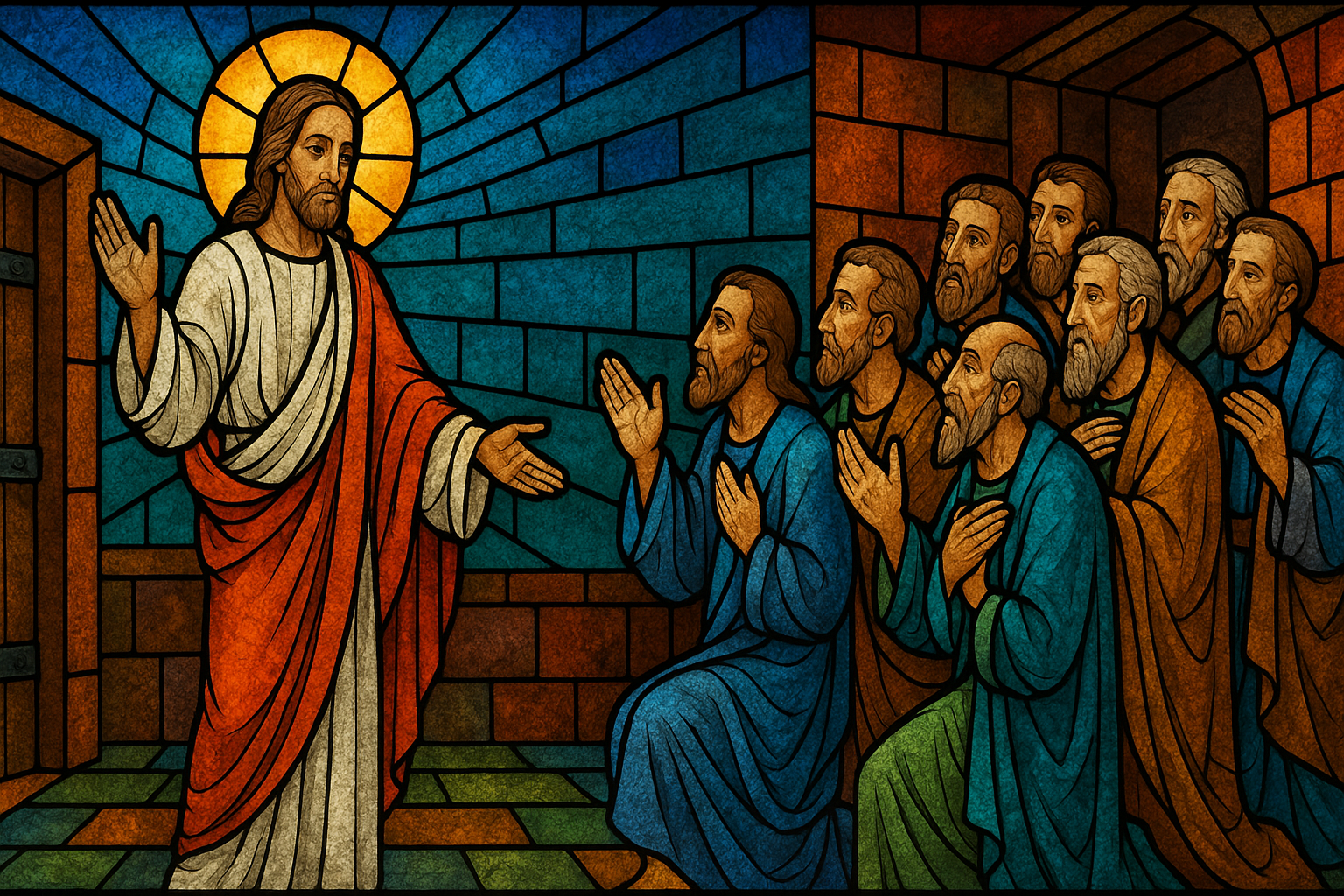
St. John presents us with a picture of the start of the Christian church as a small group huddled behind closed, locked, bolted doors, in fear of being arrested. Here, at the beginning of the church – the church that we often look upon with feelings of nostalgia, the church that we are often exhorted to emulate – here we read of a disheartened, defensive, and depressed group. It’s a group that hides behind locked doors for fear that some of their fellow religionists might come and disrupt the service.
It’s amazing what nostalgia will do for us. It allows us to put on rose-colored glasses and forget reality. Judging from John’s record, what do you think an advertisement for the first church of Jerusalem would say? “Come to the most dynamic church in town, where all are welcome?” Hardly, locked doors and fearful parishioners are not a sign of hospitality Or, “Come to a church that has a clear mission and will inspire you to be a better person.” Forget it. If we believe in John, this is the church of the sweaty palms and shaky knees. You probably couldn’t get in even if you wanted to.
Not long ago, a questionnaire was distributed nationally to members of the Methodist Church. They asked what the laity were looking for in a church. Most people said friendliness. The second highest response was bold, courageous, interesting preaching. No one, to my knowledge, replied to locked doors and fearful members. But there it is, according to St. John.
Here is a church that has nothing going for it, except that as they gathered for worship, the risen Christ pushed through their locked doors and spoke to them.
Each Sunday, I come out before the opening hymn and, to use the language of TV, do a warm-up. There are usually a few announcements, but my main purpose is to raise your level of expectation. And this is why, as repetitive as it might be, I almost always end by saying, “Prepare to meet the Lord” or “Prepare to meet the risen Christ.”
The Chinese have a saying, “Most of what we see is behind our eyes.” I think this means that we see what we expect to see. We see what we are ready to see. Our expectations shape our perceptions. My warm-up before worship is an attempt to make us ready, prepared, and expectant to encounter the living God. There are many who come to worship who hide behind locked doors. I want to remind the people on Sunday that God can slip into our worship, even if we are worried, anxious, or fearful. Believe it or not, the Holy Spirit is not bound by our agendas.
Annie Dillard captures this wonderfully in one of her lines. She says that to participate in the worship of the church, you ought to put on a crash helmet, because you just don’t know what’s going to happen. We forget that God can break into the confines we place upon him. “It’s incredible,” Dillard says, “how Christ can break into and accost us in the very worship we seek to manage and manipulate.”
One final word. When Jesus does come to us in the church, when He pushes through our locked doors, what do you think He is most likely to say? Do you think He was angry with his friends for deserting him and said to his friends, “Where have you been?” Do you think He scolded his friends for not being religious enough? No, we learn from John that He said, “Peace. God’s peace be upon you. God’s healing gift be upon you.” And then He sent them out into the world to spread that peace.
We model that moment, every worship service, when we pass the peace. And, parenthetically, this is why we clergy try to convince you that passing the Peace is a much bigger deal than turning to your neighbor and saying, “Good Morning.”
The great danger for the moment is that it becomes content to stay behind locked doors. The great danger for all of us is that we receive peace and we don’t share it. In effect, we become couch potatoes in our worship. We used to have a colleague who always said the dismissal this way, “Now the service has begun.”
Jesus said something like that at the first church service. “Even as the Father has sent me, so I send you.” Go out, exercise your calling, and bring peace to the world.
A friend of mine ended one of his sermons by inviting his congregation to come forward and take the communion wafer as a sign of God’s peace. But he also warned his parishioners that even though the wafer had no calories and thus would not go to one’s hips, the wafer can still cause damage to one’s heart. If you do not use the wafer to bring peace, your stomach will not expand, but your soul will shrink. So on this Pentecost Sunday, I urge you, a little later, to come forward, take the wafer, and then go into the world where the service will begin.
Amen
Pentecost
Pentecost
June 11, 2000
Scripture: John 20:19-23,