Who Has the Power and Who Has the Authority?
June 23, 1996
It is a rare individual who can eat a fortune cookie and resist reading the message. It is an unusual person who doesn’t walk around a ladder that is resting against the wall. And most of us, if we are to be honest, feel a little anxious when we go out on Friday the t: thirteenth. For all our sophistication, we have not been fully emancipated from superstition and the spooky world of the occult.
The occult dominated the popular view of the world in earlier days. I guess we might say that it was as difficult for a first-century person living in the Roman Empire to disbelieve in the power of magic as it would be for us to disbelieve in the power of science. With this understanding, it does not seem unusual to have an incident similar to the one found in the nineteenth chapter of the Acts of the Apostles. It could only have taken place, though, in a world that took seriously demons, evil spirits, and faith healers.
The central figures in the mini-drama were the seven sons of a high priest named Sceva. “The Seven Sons of Sceva’ – it sounds like the name of a high-wire act in a touring circus, or a vaudeville team. In one sense, this is close. The seven sons were performers. They toured the country as professional exorcists. By weaving spells and pronouncing names, they supposedly cured people of diseases and demon possession. The nearest analogy that we might recall, at least as our grandparents told us, was of the old-time snake oil salesman, who rode through the West.
Looking back at the book of Acts and entering into the mindset of the occult, we hear that the seven sons of Sceva came to Ephesus, a cosmopolitan city, a city that St. Paul had spent a great deal of his time evangelizing. While they were there, busily plying their trade, the seven sons were told of a man who was so sick that he was unable to attend one of their performances. And so they made a house call.
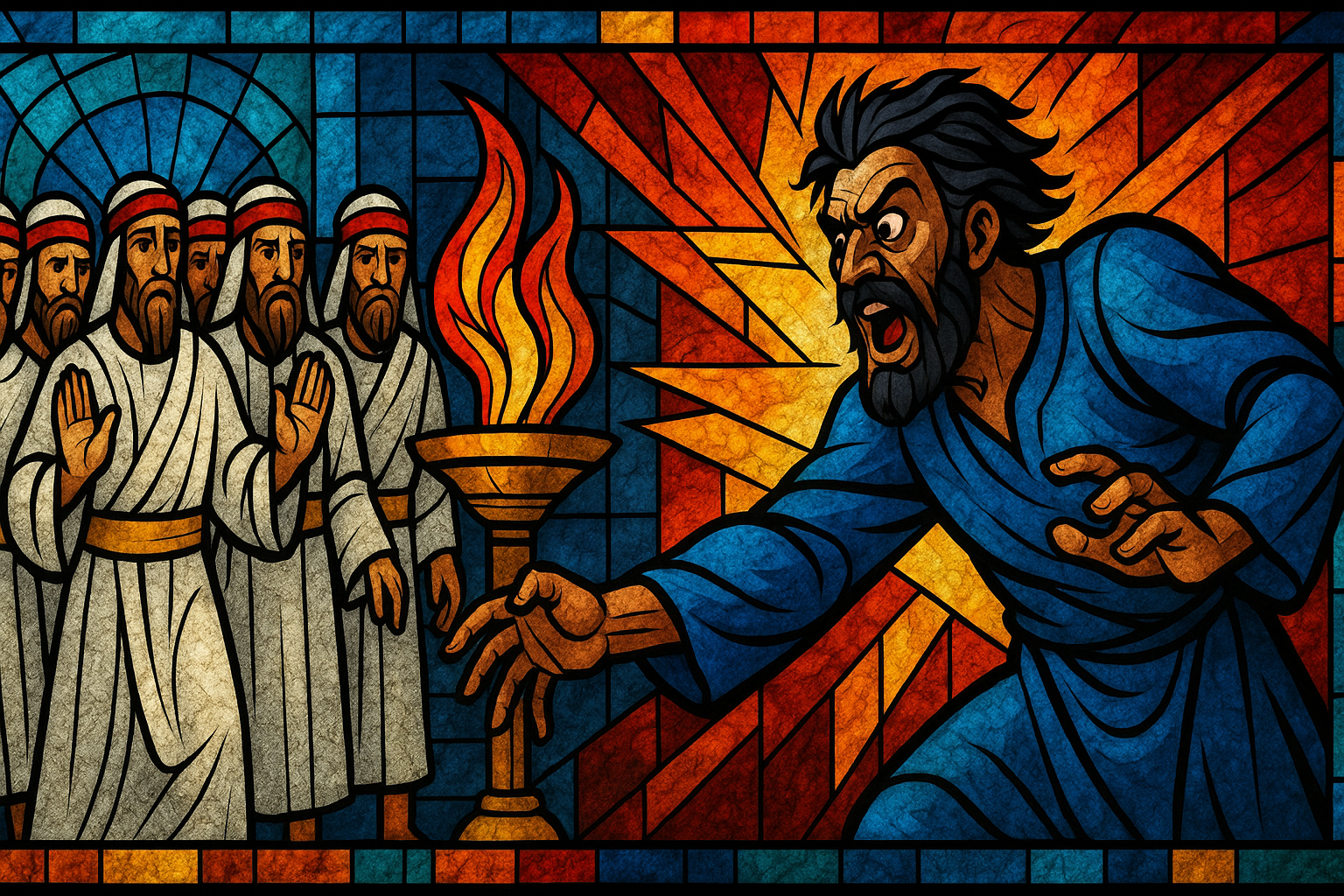
There was the man, f: frothing at the mouth, believed to be possessed by demons. The seven sons began to do their thing. Nothing worked. Finally, out of desperation, they invoked some names that they had heard recently from people who had been healed. All together they shout, “In the name of Jesus, in the name of Paul, demons, leave the body of this man!”
The brothers were not prepared for the result. The demon within the man cried out, “Jesus, I know, and Paul, I know, but who are you?” And then the sick man got out of bed and started to flail at his would-be healers. And all the onlookers were amazed. They saw the incident as a learning experience about their faith.
“Jesus, I know, and Paul I know, but who are you?” It is an intriguing story, and brings to mind these points that I would underline.
First, it is a story of power and authority, or lack thereof. The seven sons of Sceva find they have neither the power nor the authority to perform this healing. Let me, at the outset, make the distinction between authority and power. They are not the same.
The Greek word exousia is the word for authority in the New Testament. The word for power is drmamis. Exousia, or authority, means “official right,” whereas dunamis, or power, has to do with personal force, influence. Authority is extrinsic, whereas power is intrinsic. Authority is in the office; power is in the person.
“Jesus, I know, and Paul I know, but who are you?” As I thought about this story of power and authority, it struck me how tragic a tale it was. How tragic it must be to look for power, maybe even expect it, and find yourself lacking anything resembling it!
For a moment, let’s give the sons of Sceva the benefit of the doubt. Let’s assume that they were not totally unscrupulous. Let’s believe that they sincerely wanted to help the sick man. And so they reached back and joined together, in the best way they knew, to bring some healing power into the ill person’s life – and they found themselves to be impotent.
There is nothing more tragic to watch than to see a person, an institution, a nation suddenly become aware of how little power it possesses. That was one of the horrendous learning s from the black church fires. President Clinton says this must stop. He has all the authority as President, Commander-in-Chief. And yet it continues. He is helpless – when individuals have the power, and he only has the authority. When people have authority but no power, nothing happens. Or in the same way, if you have the power but not the authority, little can be done
I am reminded of a man with whom I had a conversation several years ago. He was a big, hulking, macho-type person. He came to the office and was literally crying, with tears of frustration as well as being hurt. The story is a common one. He had tried to run his family like his business, and found that it didn’t work.
First, he told me how successful he was, then how much he had done for his family. And then with tears, he told me how his daughters had left home, never to return, how his son completely ignored him, and how his wife was contemplating a divorce. No matter how much he did for them, no matter how he tried to use all his persuasive powers, things seemed to go from bad to worse. The man had the power, but his family had never conferred on him the authority of parenthood.
“Jesus, I know, and Paul I know, but who are you?”
My point this morning is a simple one: power without authority, or authority without power, is fairly common in our society. It is also fairly tragic. But if one finds them combined, great things can happen. Great healings can take place.
Last week in Time Magazine, there was a feature on power and authority – it was a fascinating analysis of people with influence. But what interested me more was that this feature was followed this week with a focus on faith healing.
Incidentally, this week Time had a good word for religion. It said: People who regularly attend church have been found to have lower blood pressure, fewer heart diseases, lower rates of depression and generally better health than those who don’t attend. So you see – how lucky you are to be here.
The next finding – I hope they will tell us is that churchgoers who pledge significantly are happier, healthier, and wiser. But that is for another sermon.
But seriously, the article takes note that these people with authority – doctors, ministers, community people – can do something. It is recommended that if they combine authority with the power of prayer, healing can happen.
As Christians, we have all been given authority. Through baptism, you are a priest, you are a minister. The tragedy is that we rarely realize we also have the gift of power. When authority and power come together, healing can happen.
The challenge for each of us today is to use our authority and power. Use it with discernment and love. Use it in the name of our Lord. Use it to heal the world. Use it to heal the brokenness of society symbolized by burned churches.
And where you combine your power and the authority you have been given at baptism, you will not be like the Sceva brothers. You will hear the words – “Jesus I know, and Paul I know – and you I also know.”
Amen
Who Has the Power and Who Has the Authority?
Who Has the Power and Who Has the Authority?
June 23, 1996