Series on Forgiveness
Genesis 1:8:20-33
Luke 1 : i-13
July 26, 1992
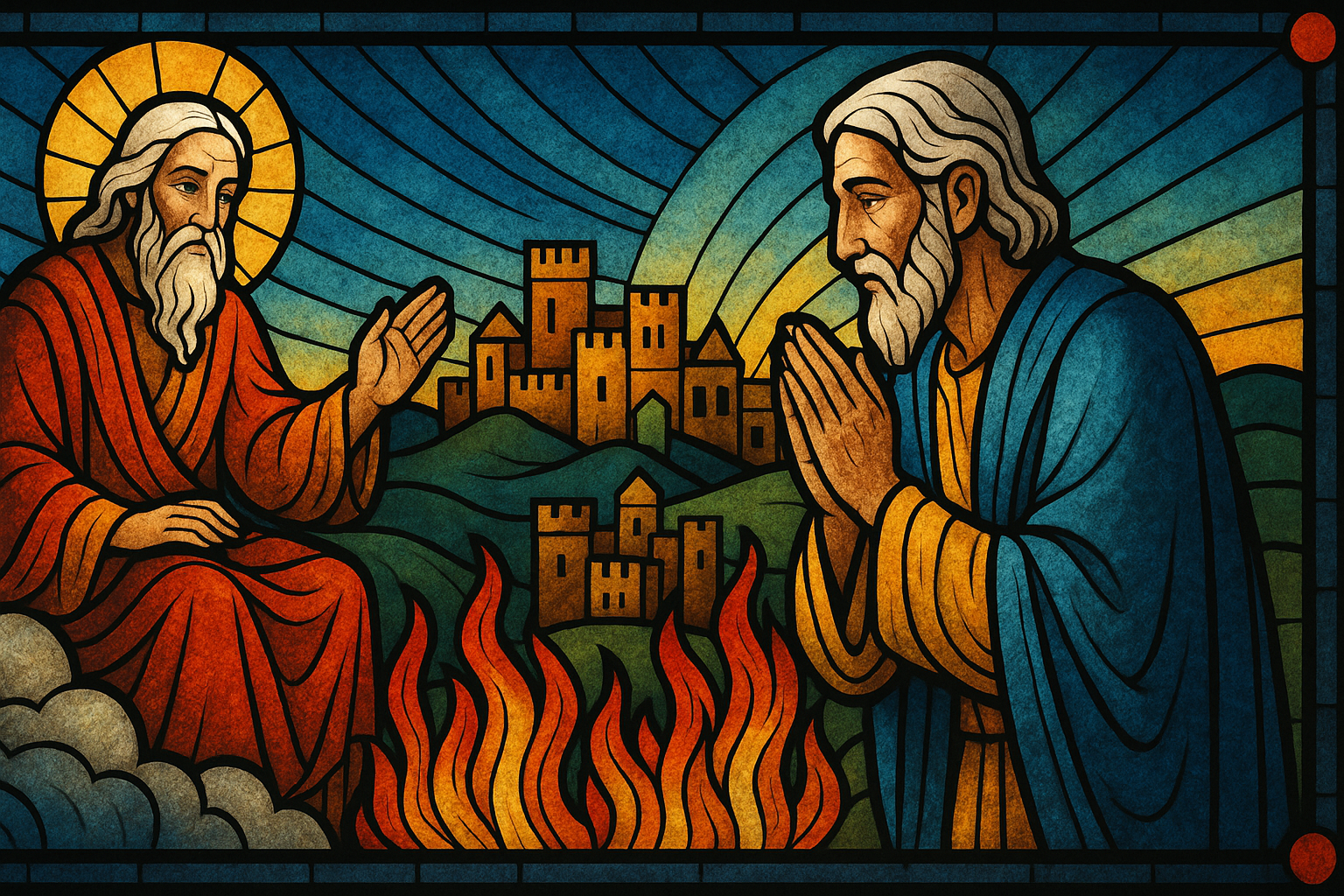
Scripture is not only instructive for our religious life. It can also teach us about management skills. For example, the first recorded instance of collective bargaining can be found in the 18th chapter of Genesis. The dialogue between Abraham and God that we just heard can be seen as a model for present-day negotiations.
Let me set the stage: Abraham has just entertained some people who have turned out to be messengers from God. They have predicted an amazing happening. Abraham learns that God does the unexpected. He and his wife Sarah, are surprised by God’s nature. An old woman, Sarah, who has been hagen is to conceive. An old man, Abraham, is to become the father of nations, God acts differently unexpectedly. Abraham has learned that God’s ways are not our ways.
And then we are presented by this delightful dialogue between Abraham and God. (Actually, this conversation can be seen as an internal dialogue within God or within Abraham.) The Hebrew writers heighten the sense of drama by making it a two-way conversation.
God starts the conversation by stating his anger, his disgust for the inhabitants of Sodom and Gomorrah. It’s interesting that many people have bought into the false notion that God’s wrath is a result of Sodom and Gomorrah’s sexual abuses. This simply attests to our ignorance of the Bible or our hang-ups with sex. If one reads the 18th and 19th chapters of Genesis, one can quickly identify the sin of Sodom and Gomorrah, which is a lack of hospitality, not welcoming the stranger. (But that’s for another sermon.}
Today, we focus on collective bargaining. God says “! will destroy these towns for their wickedness.” And the angels or messengers or travelers, whoever they were reply, “Okay, you’re God and you can do whatever you say.” But Abraham the negotiator says, ” Not so fast, God. Let’s talk this over. Will you destroy the righteous as well as the wicked?” I think what Abraham is telling us is that in every place, every situation, every person, there is a mixture. Good and evil lie side by side. There is something worthy of redemption in every country, every agreement, and in every human being, and therefore, one ought not to foreclose judgment too quickly.
Moving back to our parish lesson, Abraham asked, What happens if I find the righteous people in that city? Will you spare the inhabitants? And God responds, if I find 50 righteous people, I’d spare the whole city for their sake. Abraham has made the first inroads into divine justice it’s not that there isn’t judgment, but it’s highly colored by Divine Mercy. Justice and love are both virtues that are intertwined in God’s nature. No that isn’t so for the most of us. Justice and love are completely separated. We talk a lot about justice, and know little about love in this country everybody is a lawyer, knows a lawyer, or acts like a lawyer. We’re unconcerned about justice. We’ve ceased thinking about redemption, we don’t want new starts, we want are just duos and we want them now!
You know that story of the woman who was having her portrait painted. When it was finished and she complained, it didn’t do me justice! The artist replied, It isn’t justice you need, lady, but mercy. So do we all need mercy, forgiveness, and a new beginning more than justice? Judgment without mercy is like a cereal without milk. You can eat it, but it doesn’t go down well. This was Abraham’s issue in the collective bargaining. Sodom needed something more than judgment; they needed to be able to begin again. Divine Mercy and forgiveness are what bring space shoots from dead stones, a people from dog bones, babies from barren woods, redemption from a sick situation, and then new life from a crucified savior.
Looking at this dialogue in Genesis, Abraham’s negotiating skills are a delight to behold. Having established the fact of God’s mercy coming, he keeps reducing the boundaries. If you we’ll spare the city for 50 people who are righteous, how about us, 40 and 20 on downward? He’s a real bargainer. What’s the bottom line for mercy? We never really told what the bottom line is until the coming of Jesus. He answers that question by his life and teaching. The good news of the gospel is that God’s mercy is greater than all our sins. And God is concerned for each individual. I think each of us you needs to hear the bottom line message time and again. There is more mercy in God than sin in any one of us.
I can’t tell you how often I’ve heard people say, I know God is living but he couldn’t possibly accept me. I’ve done too many wrong things. Or I can’t tell you how often I encounter people who are more aware of God’s judgment than God’s love or don’t feel God is for little sinful me. Remember, remember, there is more mercy in God than sin in us. His mercy extends to every individual. He won’t foreclose on any of us. I want to finish this sermon on collective bargaining by sharing a story from the Jewish tradition.
The scene is the last judgement. You are in a courtroom and you are to be judged. Your defense counsel enters the room with a small pile of good deeds. It hasn’t been a banner year for you. He places them on one side of the scale of justice and the prosecuting council comes in with two assistants. They carry piles and piles of misdemeanors, sins, bitterness and taunts. Your howling emptiness, your darknesses, and your spikes are laid on the scales. The prosecutor says, this isn’t 110th of the evidence. They all go out and bring back more and more weighing down the scales. They are worn out by all the carryings and they take a break and go out of the courtroom. Meanwhile, sitting off to the side is an old man called Abraham. He hangs around the door of paradise because he has sworn he will not neglect the plight of the living.
While the defense counsel and the prosecutors are outside, Abraham begins to take the bundle of sin and throw them out the door into hell. It’s an exhausting job. Just as he is about to toss the last bag so that the scales will be balanced and you can go safely to heaven, disaster strikes. The prosecutor comes back in and catches the old man.
Since this is a court, the prosecutor invokes the law and asks for justice. The law says, a thief shall be sold for this theft. There is to be an option in the courtroom. The group of angels comes from heaven, and the demons from hell. Each gathers to bid on Abraham’s soul. The angels can command a great deal of merit as they have the treasures of the patriarchs and matriarchs of Moses and the prophets. They’re accumulated treasure looks wonderful, a great outpouring of love for Abraham. But the demons have more resources, the treasures and the depths of the earth. Alas, the side for condemnation gets heavier and heavier. Eventually, the prosecuting counsel says, we’ve bought him! He comes up to Abraham and takes them by the scruff of the neck and is about to throw him into the pit where there comes a voice from the throne of heaven above the court, above the law, and says, Stop, I buy him, I own the heaven and the earth. All things are mine. And should I not buy back the ones who have had such love for my people?
In that ” I buy him,” God shows us the very essence of his nature. This is the mystery of his love, of God’s mercy, and of God’s forgiveness. it isn’t that God ceases to judge our actions; it is simply that his mercy is greater than our sins.
Jesus puts it very directly. If you then who are human (tainted with sin) know how to give good gifts to your children, how much more will the heavenly Father give his love, his mercy to those who seek it.
Amen
Series on Forgiveness
Series on Forgiveness
July 22, 1992
Scripture: Luke 1:1-13, Genesis 1:8-20