“Interpreting Our Story”
Luke 12: 4-6
August 9, 1999
Jonah is found in the belly of the whale… (Jesus walks on the water and invites Peter to do the same.) Do you believe these stories? Are they true? What do they have to do with you? For the most part, we take them with a grain of salt and simply say these are myths. And by this we usually mean: a myth is a story that is fanciful, not true, and can’t be verified. But when we say that, we often miss the point. Myths do not try to tell us about events. Regarding facts, they are seldom accurate. Myths tell us about ourselves. And what they say about us is usually very true.
Myths in the Bible, as well as fairy tales (told to us as children), are there to help us interpret our present realities. And we ought to listen closely to what they tell us. Last week, John started his sermon retelling a popular fairy tale. The stone soup story helped to illuminate the Gospel passage. Today, I will try to follow in his footsteps and begin by recounting another story that you may recall from your childhood.
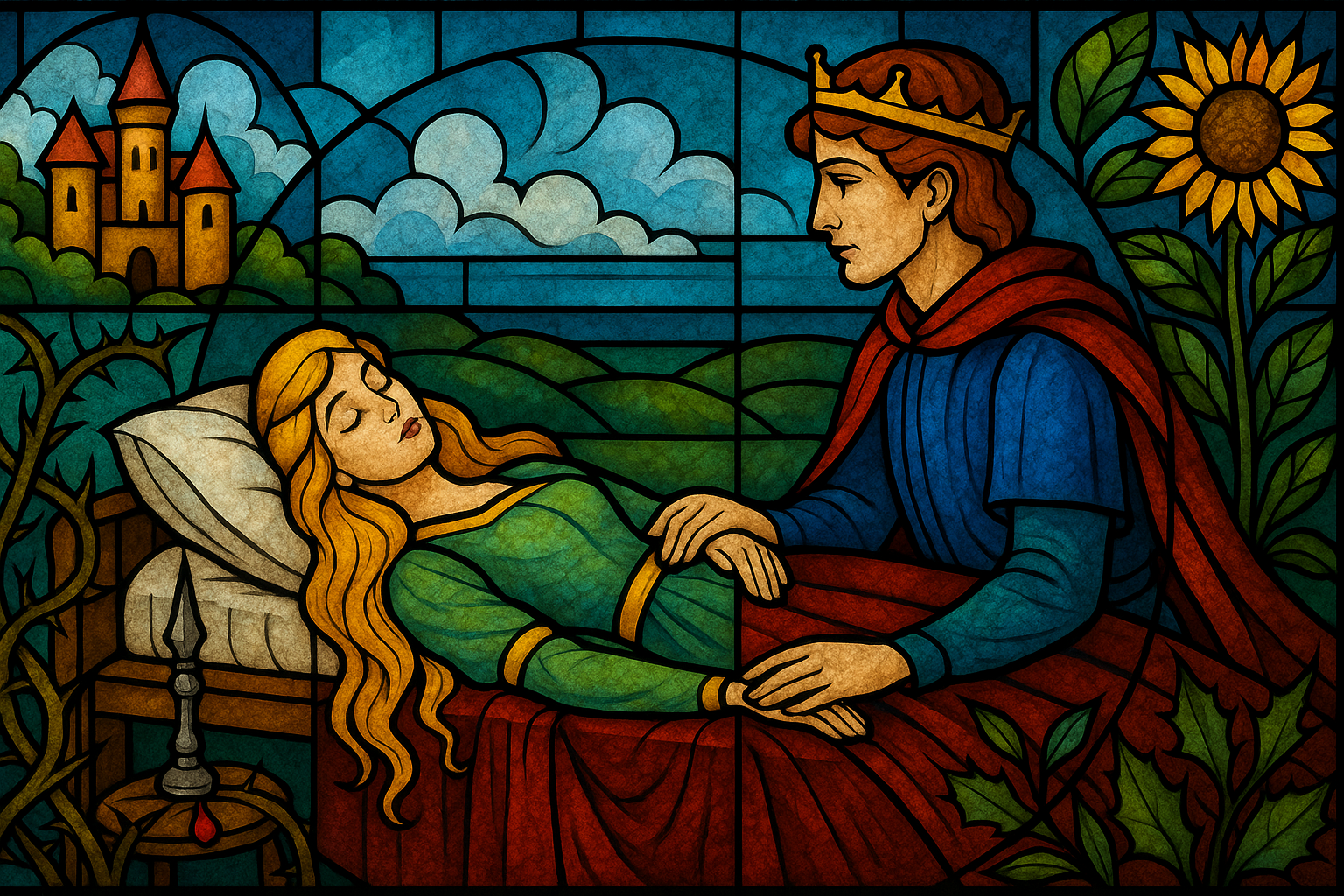
Once upon a time, a time that never was, and always is, there lived in a far-off land, a king and his devoted wife. Now the king and queen were much loved. They lived in a magnificent palace, surrounded by many servants. However, all was not as satisfying as it appeared. (It hardly ever is.)
We tend to look at the outside of people’s lives and think, “Wouldn’t it be nice to live like that?” Behind the facade of many people often lie untold tragedies. And so it was with the king and queen. Behind their successful life lay the specter of dashed hopes. They were unable to have children.
One day, though, a miracle happened. The queen found that she was pregnant, and nine months later she gave birth to a beautiful girl. Everybody was overjoyed. They immediately began making plans for a huge christening celebration. In that kingdom, the most important people to invite to a christening were the thirteen wise women. These women had the power to bestow upon children gifts of unsurpassing value.
As the king was giving orders to invite the thirteen wise women, he suddenly realized that he had only twelve golden plates for the banquet, which was to follow the christening. Because of this, the king made a quick decision about his scarcity problem. He told his servant to deliver invitations to the first twelve wise women encountered
Have you every found yourself making hasty decisions like that? Sometimes when we believe that we are living with scarcity, we look for quick easy answers to difficult problems.
But back to our story. The great day arrives. As the service begins, each wise woman approaches the altar, announcing her gift in ‘3£lowery verse. The princess’s baby received such virtues as a kind heart, good looks, health, and a good mind.
Finally, when the twelfth wise woman was about to approach the altar, a loud bang shook the church. Everybody turned, and a gray mist swept through the doors. Out of it appeared the thirteenth wise woman. She marched right up to the altar and said, “She will have beauty, peace, and joy. For fifteen years without alloy. But that’s the end. A spindle dart will pierce her finger and your heart. Oh red the blood and white the bed, and there’s your darling daughter, dead.”
With a loud laugh that rocked the pillars, the thirteenth wise woman swept out of the church and disappeared. It was, you may recall, the twelfth wise woman who had been interrupted, and who now proceeded to offer her gift. Although she could not change her sister’s curse, she was able to counter the results. This is what she said. “For fifteen years without alloy, she shall indeed have peace and joy. And then fall not to death but sleep. Silent, still, and fathom deep, and so the sun shall not rise upon this house until a hundred years are gone.
The next part of the story, most of you know by heart. The princess grows into a beautiful young girl, and then, by chance, the dread curse happens. She pricks her hand and falls asleep with the rest of the kingdom. One hundred years later, a handsome prince appears, and it is his kiss that awakens the sleeping beauty. The two fall deeply in love, are soon married, and live happily ever after.
Even though you knew that part of the story, you may have forgotten or never heard the last chapter. Actually, this is my reason for telling this story today. The last chapter has the king and queen sitting down after the happy couple has gone off, and they begin to reflect on what happened.
The king says how foolish his hasty decision had been. If he had been wiser, he would have ignored the twelve gold plates, and the whole mess would not have happened. If he had believed that he lived in the kingdom of abundance, he might have acted differently and here is where this fairy tale intersects with the Gospel.
The Gospel and the last chapter both speak of interpreting the times. And the queen suggests that the king missed the whole point. If he had not done what he did, had there been no curse by the thirteenth wise woman, the story could not have happened. The prince and the princess would not have found each other.
This is the heart of the fairy tale for me. Here we see two contrasting ways of interpreting life. If we are like the king, we may choose to spend our passion and energy replaying the past, analyzing our moves, figuring out what went wrong, who to blame, and where we could have done something else. If we are like the queen, we will not so much evaluate the past as embrace the present. We will not feel guilty about our past actions; instead, we will find meaning in the present events.
Jesus, in St. Luke’s account, invites us to interpret the present time. He urges us to see all the events, the tragedies, the absurdities, the good and the bad times, in a different context. He calls upon us to define life in the way that the queen did.
The Christian faith enables us to see life in a different way. But it’s a subversive way of looking at life. The vast majority of people interpret life as a “tale told by an idiot, filled with the sound of lurK.” In other words, life itself doesn’t have much meaning. It’s a great giant crap game. But then the Christian faith subversively says, “No. Life is like a love story, an affair of the heart, where we, like the princess, await God. God’s kiss, God’s embrace. And everything that happens to us is a part of that love story.”
There are many within the sound of my voice who have a tendency to keep rehearsing their past, whose past has a grip on their lives, who seem to keep repeating old patterns. Let me just say, the past doesn’t change, but the Christian faith can change our understanding of the past. By putting a new interpretation on our past, we can begin to be transformed.
A few years ago, Bill Moyers addressed the anniversary of the founding of the Peace Corps. He spoke of John R Kennedy’s contribution to its foundation, and what it meant to that generation. He said, “J.F.K. awakened me to a different story for myself.”
A different story! That’s what our faith is all about. It awakens each one of us to a different story; it sets our suffering, our longings, the good and bad experiences of life in a different context. That’s our task Sunday after Sunday. And that’s why we are here!
Listen. Hear. Understand. This love story is your story.
Amen
“Interpreting Our Story”
“Interpreting Our Story”
August 9, 1999
Scripture: Luke 12: 4-6