WHAT DID YOU DO THIS PAST SUMMER?
Genesis 1: 1-13; Mark 6: 30-33
August 30, 1998
When I was the age of some of you registering for Sunday School, I used to agonize through a yearly ritual. In the first week of school, we would be assigned an essay or a speech with the topic, “What did you do during the summer?” I always dreaded it because it was hard to remember what I had done. Also, it seemed so long ago since I had been away. And to tell the truth, I always found it difficult not to repeat what the person in front of me had just said.
This morning, I feel some of the same feelings. My assignment for this “Welcome Back” sermon is to share something about my vacation. But to tell the truth, it seems so long ago.
I wonder if many of us don’t feel the same way, whether we’ve just come back or whether it’s been a month or more. I wonder if the vacation glow hasn’t just faded into the dim, dark past. I talked to a parishioner the other day, who made a telling comment. “I was tired,” he said, “before I went on vacation, and I’ve only been back a short while, and I’m still tired.” Summer vacations. It seems like it’s hard to go on one, and when we do, and come back to the rat race, it seems like we haven’t been gone at all! Apropos of nothing: A friend of mine once reminded his congregation at the end of the summer, as they prepared to go back to the rat race, with this phrase: “Remember, the only people that win in a rat race – are the rats.” Ponder that for a while.
But back to summer vacations. The word vacation means, of course, to vacate; to empty out. As if in some mysterious way, by leaving town, we can get rid of the cares and stresses of the rat race. But it doesn’t really happen that way, does it?
The first problem is that instead of using the vacation to empty ourselves, we use it to fill ourselves up. What happens for most of us is that we expect something to be accomplished on our summer vacations. Let’s face it, we’re productive people. And so, on vacation, we want to take a few strokes off our handicap, or to fix up the garage, or to catch up on our reading. As productive types, we get busy, set goals, and expect to have something to show for our time away, even if it’s only a tan.
The second problem is that when we come back from vacations, we step into incredibly harried lives. On one hand, we tend to brag about our frenetic existence; on the other hand, we tend to complain. How many people do you hear saying, ‘I work, 50, 60, 70 hours a week.” And they tell you this with a sense of pride. It seems to justify their existence. God help us, we are part of a culture that accounts as routine
terrible hours, and glorifies high-pressure work. And it’s not only adults who do this to themselves. We also do this to our kids. And then we put on our bumper stickers, “My child is on the honor roll,” or we tell our kids to win in sports, or at least learn to be better in athletics. Whatever happened to play? Does it surprise you that the most frequent symptom reported to physicians is a feeling of tiredness? We’re worn out from the rat race.
One of my vacation goals was to read some of the old-time preachers’ sermons. I ran across Harry Emerson Fosdick’s words. He was one of the great orators of the ’30s and ‘405. “Those who cannot rest,” he said, “cannot work. Those who cannot let go, cannot hang on. My hours fill up with men and women who have mastered the techniques of activity and aggression, and whose lives are going to pieces because they have mastered no other technique.”
When I read those lines, I wrote them down. “That will preach,” I said. “It’s not just for the ’30s – it’s also for the ’90s.” But wait, my purpose isn’t to make us all feel guilty, or to make us aware of how tired we have become as a people. You all know that. Fm not telling you anything new. My purpose is to try to get in back of our summer vacations, and help us to see them from another dimension.
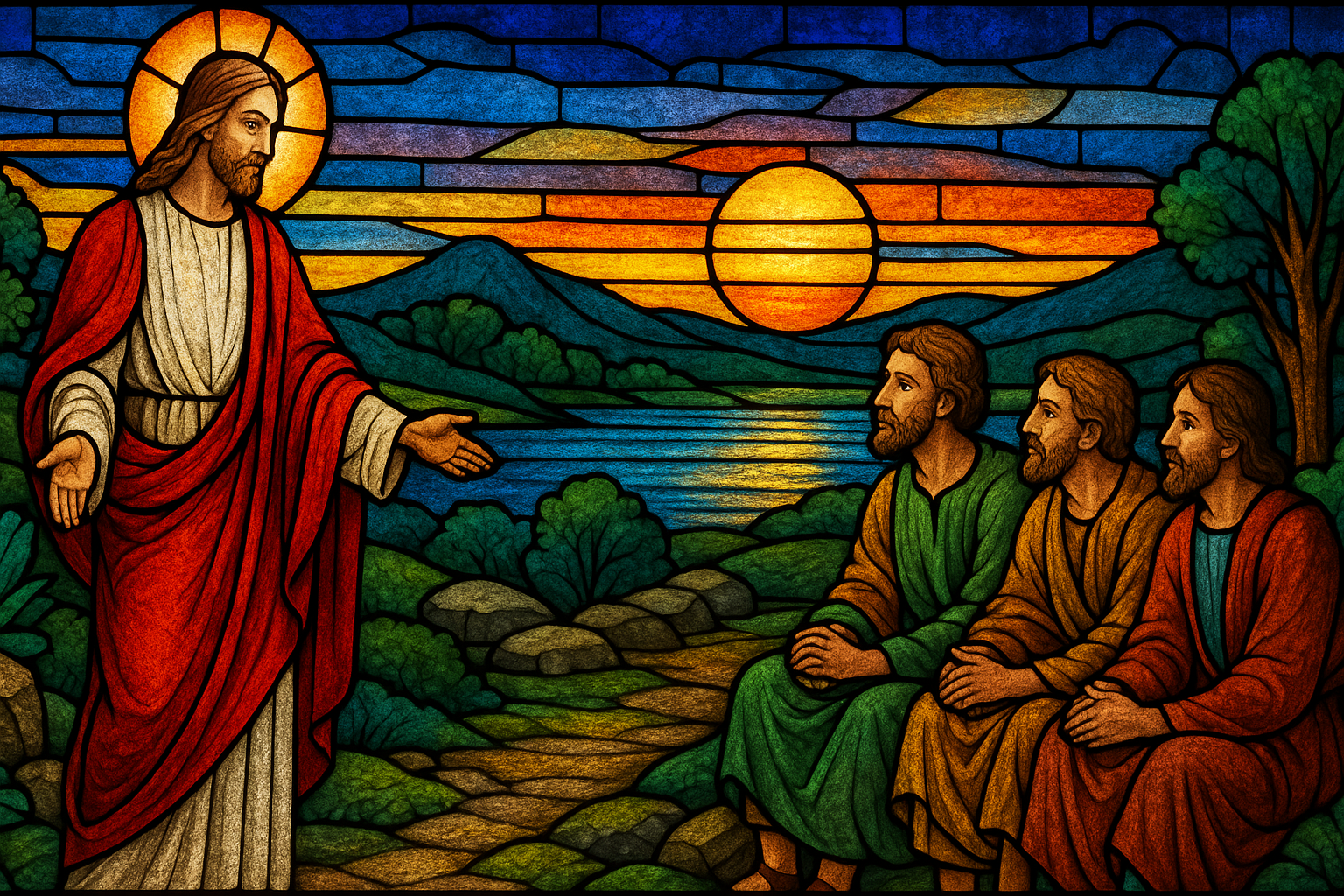
Summer vacations can also be viewed through spiritual lenses. They can be Holy days – the root of all holidays. By this, I am not asking how much of the Bible you have read or how long you have played. If we were to look at our summer as a holiday, we might ask, “What God did you serve while on vacation?” Spirituality asks us to look at what we are doing, and whom we are following. Are we following a God who expects us to accomplish things? Are we following a God to whom we look for approval? This is the God of a workaholic culture. Or are we following Jesus Christ, the God of a Christian society? Jesus Christ, when the disciples came back from a teaching mission all fired up with successes, said, “Let us go apart and rest. Let us go away to look closely at what you are doing. Go away to learn the art of giving up, rather than taking in. Go away to connect with God.”
Another clue to viewing vacations as a holiday is to understand that they are part of the rhythm of life. The Old Testament gives us a hint of what this means.
One of the unexpected gifts, for me, of studying Scripture is that you can lead a passage 100 times, and each time, something new jumps out. The other day, when I was reading the first chapter of Genesis, I suddenly saw that the writer was not so much telling us about creation or evolution as he was lifting us up to the rhythm of God. If we were to look closely at the passage we read as our first lesson, we would notice a curious thing. The day begins with evening and concludes with morning. God’s work takes place, it seems, in the nighttime. Each period of time starts as, “And there was evening, and there was morning of the first, second, third day.”
That’s a strange concept for those of us who see our day beginning with the alarm clock ringing, and then plunging into a busy, overly-scheduled day, falling back into bed some 12, 15, 18 hours later. For the ancient Hebrew people, evening was the beginning of things. In other words, God’s work begins as we drift into unconsciousness. This makes what we are doing during our day-to-day activities fairly unnecessary, or at least secondary.
Some time ago, W.H. Auden wrote a wonderful poem called Epistle to a Godson. In it, he says, “Be glad your existence is unnecessary.” One step in seeing vacations through spiritual eyes as holidays is the realization that our life is not necessary, that God’s work continues with us. This enables us to step back and see that God, in Her/His wisdom, like many women, sees work in a different context than most men. And that God holds the stars and the earth as well as holding us in his hands, whether we’re conscious or not, and continues to do this whether we’re sleeping or waking.
As some of you know, I’ve been preaching against the grain. Or, as I often tell people, most of my sermons are directed at myself. One of the spiritual disciplines I have to master is acknowledging that everything is not dependent upon what I do or don’t do, and to learn to trust that God can do it all, without my help.
Let me end our thoughts this morning by quoting a magnificent Prayer of Quiet Confidence, and I would recommend your saying it before, during, and after all vacations, holidays, and times off. “0 God of peace, who has taught us that in returning and rest we shall be saved, in quietness and in confidence shall be our strength. By the might of thy spirit, lift us, we pray thee, to thy presence, where we may be still and know that thou art God.”
Amen
WHAT DID YOU DO THIS PAST SUMMER?
WHAT DID YOU DO THIS PAST SUMMER?
August 30, 1998
Scripture: Genesis 1:1-13, Mark 6:30-33