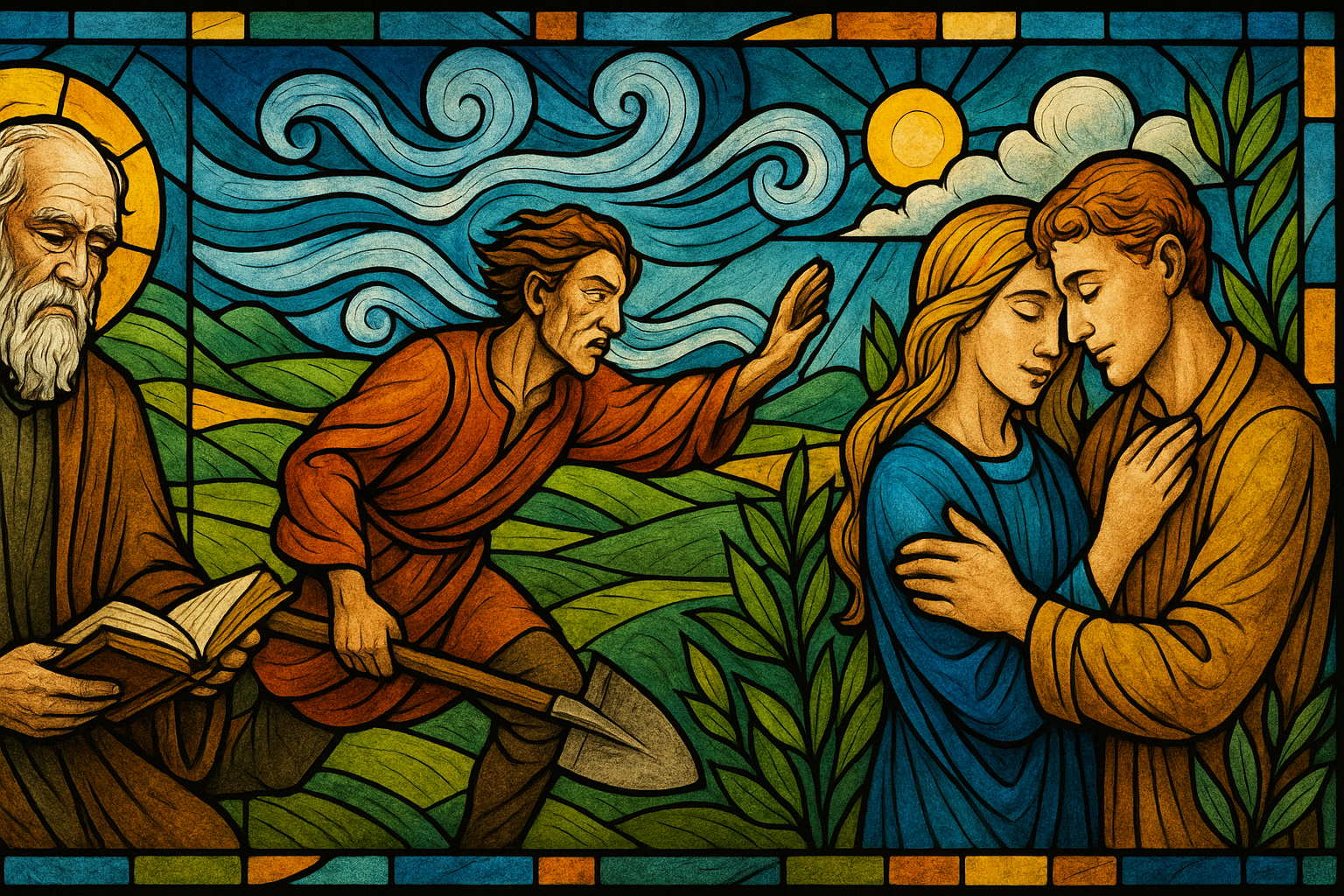
Labor Day
September 3, 2000
First, let me say how pleased I am to be here and see Liz. We miss her, and I really think you are most fortunate to have this talented priest as your first woman rector. I look forward to hearing how this wonderful parish has progressed under her able leadership. I also commend you all for your support during the difficult times during Ernie’s sickness. I know his loss has been extremely hard, but the good news is that a parish like this can actually be brought closer together through such tragedies.
The last time I was here was at Ernie’s funeral, but before that, it was with Leland Jones. How many were here during Leland’s time? How many remember him and remember what he accomplished during his rectorship here? How soon we forget.
A woman I spoke to recently told me about her father. He was head of a large manufacturing concern. He led them for twenty years during some of the most difficult times.
Ten years after his death, she told me that she visited the company and almost no one had ever heard of him. How quickly we are forgotten.
I guess I shouldn’t have been surprised when I returned to Connecticut a few years after I arrived in Arizona. I was walking down the street in Wilton and ran into the husband of an active member. He didn’t attend church, but his wife and I worked closely for about five years, and I had counseled the whole family. Anyway, when I met him, I must have said something about missing the old town. To which he said, “Aren’t you still the Rector here?”
“I’ve moved to Arizona,” I said. But then I was unable to keep some of my disappointment from leaking out. I said, “I can see all of you have been terribly broken up since I left.” How soon they forget.
In four months, I shall be retiring, and so this subject is close to my heart. I’m sure I’ll be saying the same thing in a year or so. How soon they forget.
Most of us, if we haven’t retired, know that we will spend most of our lives at our work. And if you’re a typical American, you will have put a great deal of yourself into your job. So on this Labor Day, I’d like to raise with you a question I’ve been wrestling with for the last couple of months.
Do you think you will be remembered for what you have accomplished in your work?
We have some biblical help with a deep question like this. Let’s turn to the middle of the Old Testament, to the Book of Ecclesiastes. It’s an older man who speaks. We don’t know his name. He’s simply referred to as ‘The Preacher.’ This fellow begins a painful process of looking over all that he has done, all his work life, all that he has accomplished over the years. And, he wonders whether it will be remembered and was it important?
Listen to his words, “I consider all that my hands had done and the toil I spent doing it, all was vanity, and a chasing after wind, for there was nothing to be gained under the Sun.” (Ecclesiastes 2: 11)
The entire chapter of this biblical book is a consideration of the result of work. The preacher tells us we work hard, we toil, creating, pursuing the almighty dollar, building, achieving. But what does it all add up to? In the words of Ecclesiastes, “All our work, despite our best efforts, is mostly vanity, or more accurately, a chasing after wind.”
I wonder if most of us, most of the time, don’t feel that way. Much of what we do is just chasing after wind. And soon it will be forgotten.
A friend of mine, several years ago, was preaching on this text, on the subject of work. And he suggested to his congregation that all work was chasing after wind, and instead of calling in sick, and then sneaking a few days off, they ought to call in well, and then take a few days off and contemplate how much of what they do will be remembered.
I want to tell you that it didn’t go over at all. He was attacking the core of what justified most people’s existence.
Let me probe a little further as we think together about work. I wonder if the preacher’s words haven’t gotten you thinking about the dull, repetitive, boring parts of your work life. We all have those parts – we don’t often admit it. Most of us aren’t involved in an assembly line, but perhaps there is even greater boredom in computer terminals and parts of our jobs that we continue to do year after year with little psychological payoff.
The other day, I ran into a bit of wisdom that could have come from the writer of Ecclesiastes, but actually came from a Divorce Recovery group that we have in our parish.
There on the blackboard in one of our meeting rooms was written, “If you always do, what you always did; you’ll always get what you always got.” That’s true in human relations as well as in the world of work. Most of us always do what we’ve always done, and we often end up bored and restless with what we get out of work. Deep down, we’re scared that the past years of work were simply chasing after the wind. And how soon we will be forgotten.
The writer of Ecclesiastes is cynical about work. He looks at life with a jaundiced eye. But maybe we have to hear that message on a day like this. Possibly, most of us are too attached to what we do. We think our work will last forever. We think our work is what gives us life. But somewhere buried in our subconscious, we know that we soon will be forgotten.
The purpose of this section of Scripture is to remind us that each of us must learn how to live a life that is more than making a living.
Only God knows what we do and what it will finally all add up to. We don’t have to keep anxiously asking ourselves, “What will last?” Time and again in Scripture, we are told that the only thing that lasts is love. In the end, all we can count on is that we have loved and have been loved in return.
Let me close our thoughts this morning by quoting some lines from one of my favorite writers, a man named Raymond Carver. He died in 1989 after struggling throughout his writings with the question of what is important. Finally, in his later life, he conquered his alcoholism and other problems and began to sort out the difference between what was transitory, soon forgotten, and what was lasting.
In the last volume published after his death, at the very end are these words.
And did you get what
You wanted from life, even so, I did.
And what did you want?
To call myself beloved, to feel myself beloved on the earth.
Amen
Labor Day
Labor Day
September 3, 2000