‘Welcome Back Sunday”
I Kings 19: 9-15
September 19, 1993
Welcome, Bill Roberts. Welcome, all who have come back from vacations. Welcome, all who are new or semi-new to our community. Welcome! Today is the day we install Bill Roberts. An installation is simply a public welcome – a public acknowledgment of all. Today is also the day we start our fall season. Today is our day. But-but, it’s more than all that, isn’t it?
I am reminded of the lines from Shaw’s play, St. Joan. Joan has just told the Dauphin what God expects from him. And the Dauphin answers: “I don’t want to be any of those fine things you all have your heads full, I want to be just what I am. Why can’t you mind your business, and let me mind mine?”
Joan answers: ‘Winding your own business is like minding your own body. It’s the shortest way to make you sick. I tell thee – it is God’s business we are here to do – not our own. I have a message for thee from God
‘I have a message for thee from God.” It is really not Bill’s day, or my day, or even your day. It’s God’s day.
And as God’s people, we are being welcomed to the tenor and the glory of this day. We are invited to listen to God’s message.
We begin this day with Scripture, for the Bible is a mirror into our lives. We look into it, and we find people who want to see God as well as people who want to follow God. We see our weaknesses revealed as well as our strengths. We find people who are seeking. security and others who respond to God’s challenges.
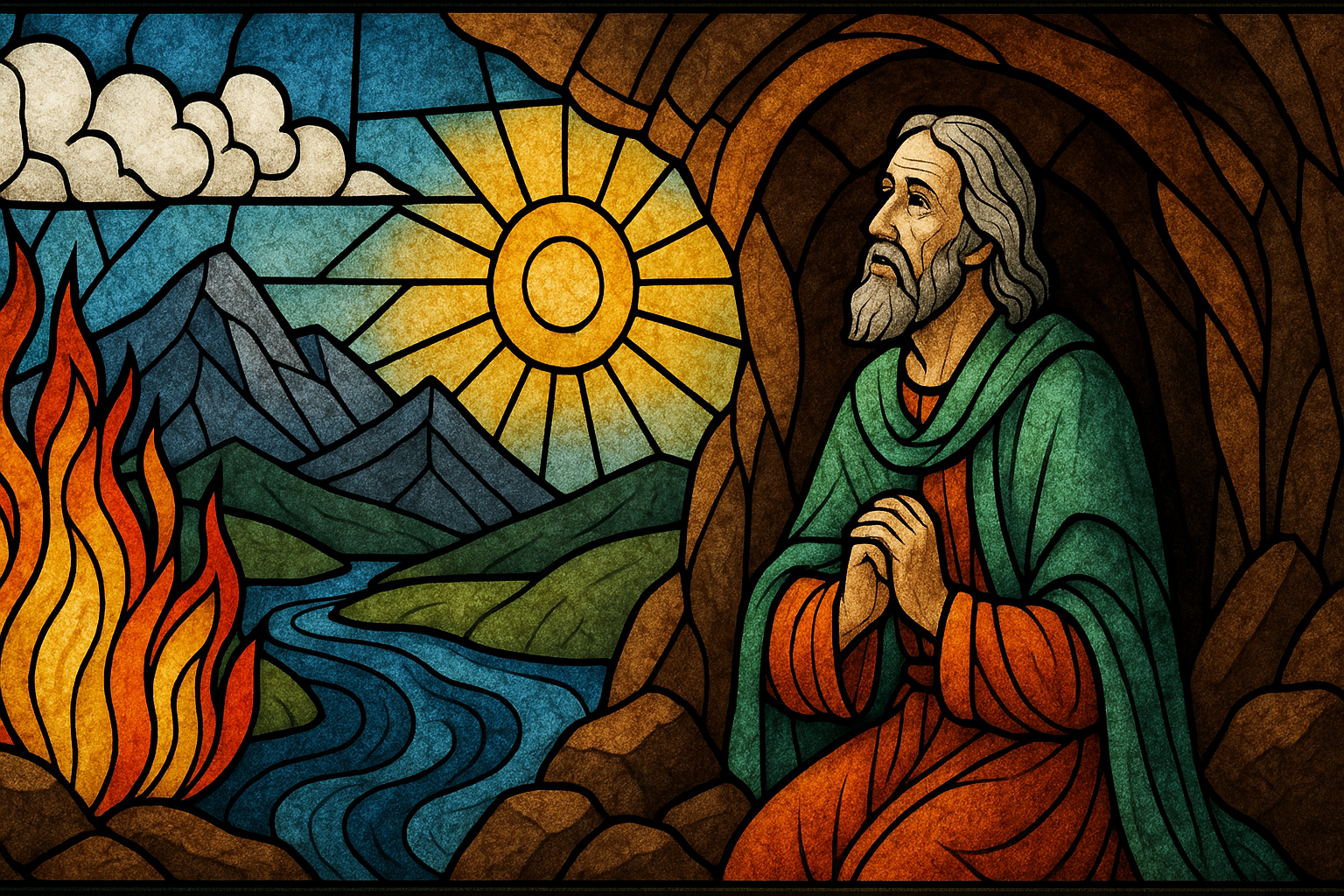
Elijah is such a person. He had responded in a magnificent way to the confrontation with the priests of Baal. Elijah’s contest and defeat of these people earn him a place in the religious hall of fame. But all of this was yesterday. And the Bible is a constant reminder that you can’t live on yesterday’s record. Every day is a new situation. And so, even though Elijah might have been on the front pages as a hero, there still remained a queen in power who wasn’t a big fan of his. Jezebel, this queen, puts out a contract on his life. And Elijah, finding that discretion is the better part of valor, headed for the mountains.
Now these mountains are where Moses met God. They represented security and safety. Elijah has been there before, and they symbolize the place (that religious place) where we often go for renewal and healing, and comfort. A cave in a mountain – with an opening where you can look out into the world, but where you can feel warm and close in a womb-like structure, a structure that is familiar. A place not unlike this church is where Elijah retreats to on this day.
The problem is that when we withdraw to our holy places, we’re supposed to listen. Listening to God can get you in a whole lot of trouble. And sure enough, we read that God speaks to Elijah in a still, small voice. Nothing overwhelming, no trumpets -just a still, small voice that asks a question: ‘Elijah, what are you doing here?” You see, these holy places aren’t resting places, they are launching pads. And if you listen, you’re time to be challenged.
So Elijah gets his marching orders. The order is to come down from the mountains and go into the wilderness around Damascus, where, among other things, he is to do an unprecedented, unheard-of thing for a Hebrew prophet. He is to anoint a King of Syria, which is a dangerous act for anyone, but for a Hebrew, it’s madness. But that’s what happens. Sometimes when you start listening to God, listening can get you in deep trouble, and going about doing God’s business can be risky.
I think most of us would prefer to mind our own business. Somehow, we know – or at least suspect-that if we listen to God, there’s going to be heartbreak and a lot of tears. And so we’ve become past masters at sliding away, plugging our ears, answering God’s questions with questions of our own.
This gives me the opportunity to share the Gogolakian Theory of Church Life. What?!?! You’ve never heard of the Gogolakian Theory? it describes the average church goers reaction to hearing God’s marching orders.
The theory was named for Charles Gogolak. He was not, to my knowledge, a theologian. He may not even have been a Christian. And unless you’re a little long in the tooth, you may not have heard of him. Charles Gogolak was a kicker for the Washington Redskins. Now, kickers for the NFL are normally very small people, in the midst of very large people. Charles Gogolak was no exception. One of his responsibilities was kicking off to opposing teams.
As is the custom with most kickers, when the offensive and defensive teams charge one another, the kicker hangs back, avoiding the mayhem of the much larger people. On one particular occasion, the person who received the kick-off managed to break through the Redskin kick-off team, leaving Charles Gogolak standing alone between him and the goal. Gogolak looked very much like a bug with a windshield hastening towards him. It was a terrible moment. The crash was heard in the top row of the stands. One didn’t know whether to laugh or to cry for poor Charlie. After the game, Gogolak was interviewed by a reporter: ‘What were you thinking – what was going through your head at the time?” he was asked. Charles replied in his immortal words (which incidentally form the basis of The Gogolakian Theory): “Isn’t someone else supposed to be doing this?
Isn’t someone else supposed to be doing this? Elijah must have said this (in the unexpurgated version). But all we really know is that after a while he left his secure place, and went out to do God’s bidding. We well might speculate – why? Why does anyone leave the known, the familiar – the safe – to risk? What motivates an Elijah, a St. Joan, a Martin Luther King, an Albert Schweitzer?
There’s a wonderful line in Leonard Bernstein’s Mass that goes: ‘I believe in God, but does God believe in me?” That gets at the bottom line. It’s one thing to believe in God, to believe in goodness and justice, to believe God cares for us. It’s something else again to be convinced that God believes in us – that God counts on us, looks to us for help. That’s the bottom line.
So the message for this day is to listen to that still, small voice of God. And if you listen, you will hear a call – a call to God’s ministry – to go out and do something beautiful for God. And if you hear that call, don’t say you’re too tired, too busy, too defeated. Don’t ask if anyone else is supposed to be doing these things. For the message of this Welcome Back Sunday is very clear: God has no hands but yours, no feet but yours, no voice but yours. You are the hands with which he blesses us now. Each and every one of you is being called out by God. Listen, listen, listen to that still, small voice. Amen.
‘Welcome Back Sunday”
‘Welcome Back Sunday”
September 19, 1993
Scripture: I Kings 19: 9-15