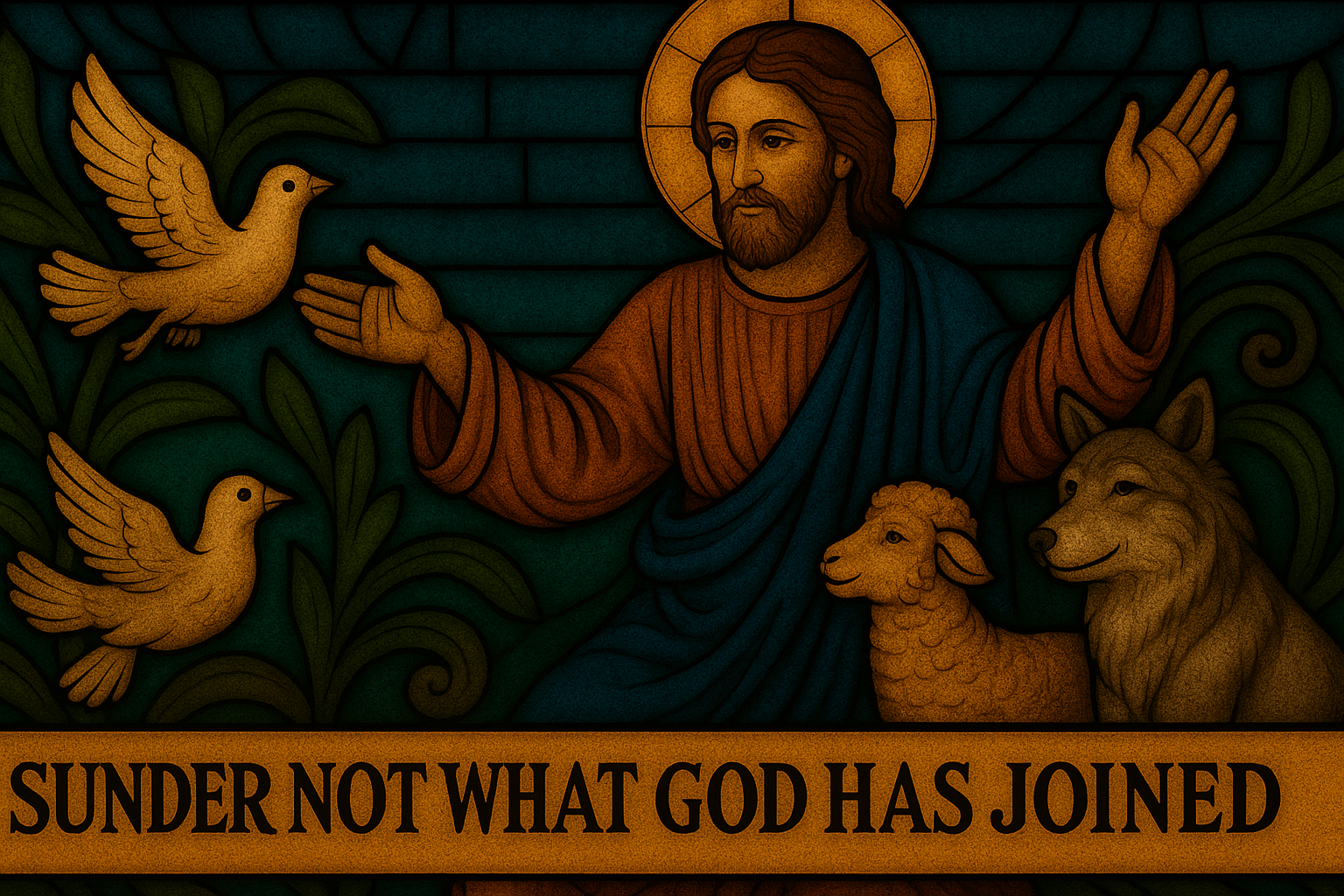
Sunder not What God has Joined
Mark 10: 2-9
October 2, 1991
My text comes from our gospel. We’ve heard it so many times that I wonder if we ever think much about its implications. The text, in its less chauvinistic translation, is this: what therefore God has joined together, let no one put asunder. Whenever I’m called upon at a wedding service to say these words, I often hesitate, and I find myself speculating on their meanings. What is it that God has joined? Is it more than this specific man and woman? And then, sometimes my mind really soars and begins to wonder what it is that would put asunder things that God has brought together. Surely it must be more than infidelity or incompatibility or some of the other pedestrian reasons we tend to give for breaking up relationships.
Those are some of the thoughts that rattle around in my head during a wedding service period Now that I’ve gotten that off my chest, let’s return to our text: what therefore God has put together, let no one put asunder.
The writers of the Bible constantly use analogist thinking, and the marriage relationship is one of the most common analogies used. Jesus was steeped in Old Testament language and therefore whenever he wanted to illustrate the relationship between God and humanity, we find him using a bride and her bride groom, a man and a woman, a wedding feast. But for the most part, these words speak to a greater reality. They are analogies used that are within our own common experience. But they always mean more than the specific. And so, here we speak of individual couples, but we mean all creation. Our very humanity is found in our interconnectedness.
In 1856, Chief Seattle delivered a speech before giving up the Indian lands. Then quoted, and to my way of thinking, it’s the best exposition from a different transition of what it means to be joined together. Here are his words,
This we know, all things are connected, like the blood that unites a family. All things are connected, and whatever befalls the earth befalls the children of the earth. We did not weave the web of light. We are merely strand in it, and whatever we do in that web we do ourselves.
Chief Seattle reminds us we are joined, intertwined strands of creation. In other words, we have a great deal in common with all creatures great and small, we share dependence and interdependence. We share a life and immortality, and we are part of one another. This was true in 1856 as it is in 1991, and therefore we must learn again that an earthquake in Mexico City profoundly affects each one of us in Tucson, AZ. In the last 20 to 30 years, it has become popular to say we live in a global village. Today, we would go further and say we are all connected. God has joined us together.
If this be so, how then can it be put asunder? How can we break our interconnectedness? The truth is that we can never fully break the bond of creation. What God has done cannot be undone. But, and this is crucial, we can act like, choose to behave as if, we were not joined.
One of the books that has spoken to me through the years is Martin Bubers I am. In this poem there are two ways we can relate to each other. The 1st is a relationship of mutuality between two subjects. The genuine alive, dynamic, loving, interconnected way of relating. The second puts us under what once was joined.
Before I read this book, I had assumed that The relationship referred to the way we related to God, and possibly other humans. As I read this essay, I discovered Bieber was Speaking of how we associated to everything around us, humans, animals, plants and of course God.
As the relationship comes apart, Uber calls it an I-it way of doing life. There’s a chasm that exists between a subject and its object. All the aliveness is on one side. Instead of there being a dynamic mutuality, the subject sets himself or herself against the object. There is no dialogue, no connectedness, no reciprocity. There is only a one-way transaction. The subject, or I, does something to the object rather than with it.
Buber points out, in this little book, that we humans are just as capable of adopting a stance of as I-thou. The choice is ours, and the crucial word here is choice. I have it within my power to put asunder what has been created, or to accept the interconnectedness. I can celebrate a web or ignore its reality.
I know of no other person who embodied this understanding more than Francis of Assisi. He was a man who could seemed to brother son and sister moon. Here was a person who wished to make the whole world into a Friary, a brotherly, or a sisterly where everyone had a place and belongs to one family. Here was a St. who included the whole of creation in his loving embrace.
Frankly, I find the inclusiveness of Francis most disturbing. It forces me to consider including even the people I dislike, like the politician who calls all homeless people bombs. It forces me to include, in my concerns, the environment even when I’m worn out and I don’t think I’ve got much caring left. Inclusiveness bothers me because it lacks a certain thing that I reserved for myself.
But today we are asked to celebrate the feast of Saint Francis, to remember, to hold before our eyes, to emulate that crazy troubadour of God. In the earlier service, we bless the animals. At this service, we bless all of creation. Francis found his way to God by realizing that all the world was joined to God in the great web of creation. In his life, he found God by joining his hands to touch, to handle, he took another and saw it as thou and he and I.
In a few moments we will pass the peace. I invite you to repurpose, we look at this common religious practice period for some, it will be the same old right of saying, good morning to the person seated close by. But for others, it could be more, much more. An opportunity to connect with God, not that the next person to you is God, but God has revealed in this encounter. As the web of creation is joined by our hands, so too is God to be found.
I read recently that the word religion literally means reconnecting. Today in the spirit of Saint Francis in this religious service, we are invited to reconnect to one another, to reconnect with creation.
Amen
Sunder not What God has Joined
Sunder not What God has Joined
October 2, 1991
Scripture: Mark 10: 2-9