ON HEAVENLY PORTFOLIOS
Mark 10: 17-31
October 4, 1998
There are certain signals one learns to recognize as you grow up. Signals that indicate the beginnings of a difficult conversation. When I was a youngster, my parents used to use my full name. They would say, “Roger Owen. let’s talk.” This always got my full attention, for I knew that a confrontation was just around the corner. Some of you have the same feelings when you receive a memo from your boss saying, “See me A.S.A.P..” You know that trouble is on the horizon. Or if your child calls up in the middle of the night and begins the conversation with, “No one was hurt.” Or if your stockbroker calls you and starts by asking, “Are you sitting down?” All of these signals provide clues that, in the words of the TV police dramas, “Something is going down.”
The intuitive newcomer and the experienced old timer among us are probably picking up some similar signals. It is the beginning of October. Pledge cards are being distributed. We are going to talk about money. Your intuition is right. The Rector is about to focus on pledging. “Something is going down.”
I tried to put this off for several months. I spoke to David Richardson about the falling stock market, the confusing world economy, and the genuine unease of many parishioners. David wisely replied that no time was a good time to talk about money to Episcopalians. We might as well stick to our schedule (or as he might say, shhhedule.)
The Gospel lesson chosen this morning is almost begging to be used as a launching pad for a sermon on pledging. I wonder how many preachers have hit their congregations over the head with this Gospel. I wonder how many have said, “See. If you want to reach heaven, give all your money away, or a least 10% to the pledge drive.”
Unfortunately, this Gospel is not about donations to the churclh. Jesus is not even talking about economic formulas; nor is he addressing just rich folk. He is declaring some spiritual realities. He is reminding us of how we can be well off, and still be cut off from God.
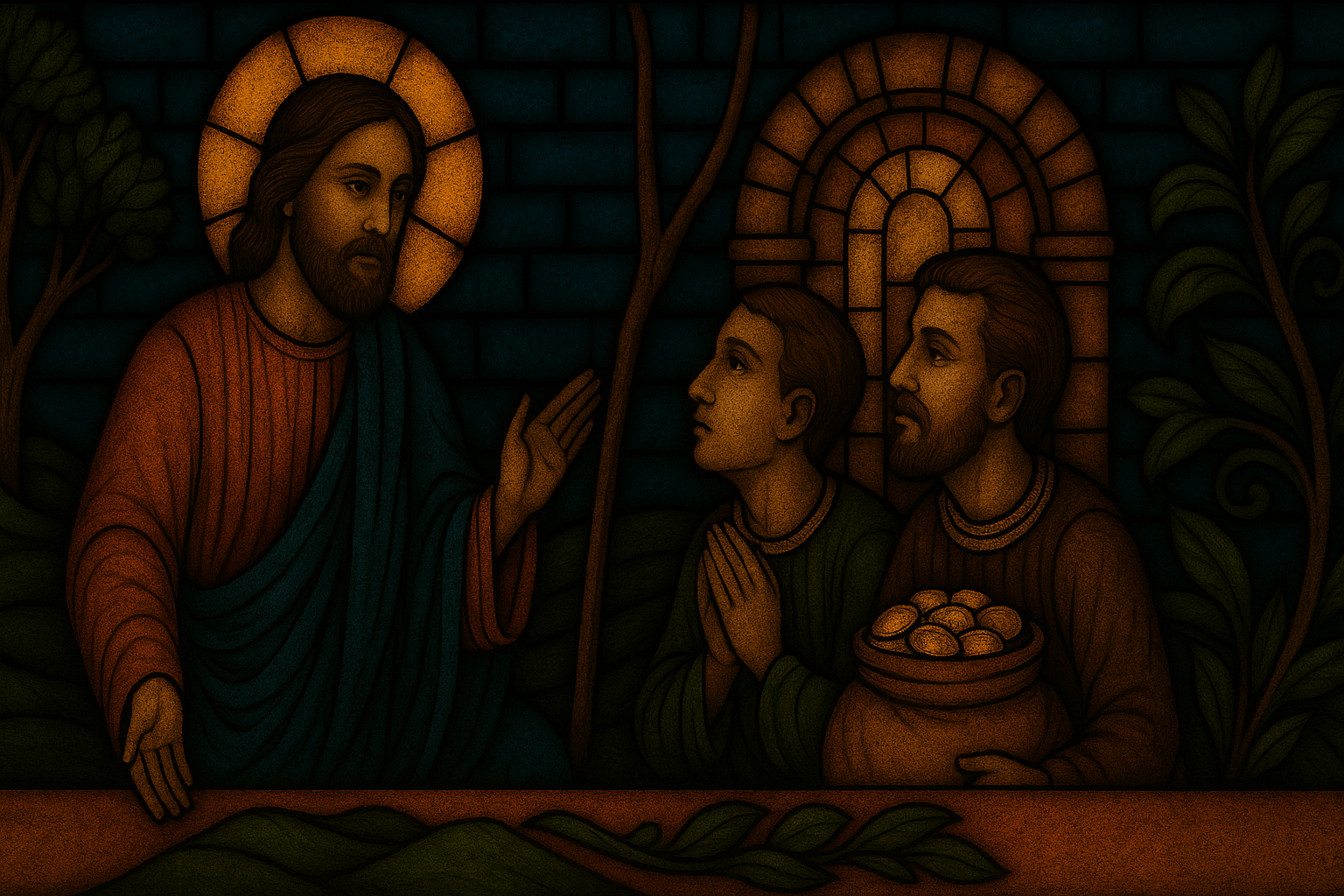
In this incident, a young man comes to Jesus asking how can he increase his “Heavenly Portfolio.” Jesus starts out by asking, “Have you obeyed the Commandments? in other words: In the pursuit of an earthly portfolio, have you been honest, not deflauding people, been ethical?” The young man says, “Sure, ifs not hard to make money honestly. But what do I need for my ‘Heavenly Portfolio’? As the Scripture puts it, what must I do to inherit eternal life?”
Jesus tells the young man to sell all, and come and follow him. This was not what the young man expected and he departs, sadly.
Now, if we focus on the presence or absence of money, we will miss the point. What Jesus is trying to say is: It’s the relationship this young man has to his money that is the key. It/s the meaning money has, that’s at the root. Money had become a rival God, competing for his allegiance. It was not what the young man had in the bank or at his broker’s office. It was the way he related to his portfolio.
Now, I want to stop preaching and start meddling. Let me begin by asking each of you, what does your money mean to you? What does it represent? Security, a hedge against a cruel world, standing in the community, a nest egg (That’s an interesting term. Some day we ought to explore the meaning of that phrase)? Or does it mean simply the equity that you deserve because of the sweat of your brow?
O.K., now that we’ve answered that question, let’s dig deeper into the meaning of your money. And now we would ask, why do you have your money? Normally, when that question is asked, we answer it in terms of how we received the money. But that’s not the question being asked. Whether you inherited it, or worked hard for it, whether you’re smarter than everybody or luckier than most, doesn’t matter. The question is, “Why do you have it? Now, how did you get it. And that’s a difficult question. What is your money for? is it for making more money? Is it for more retirement benefits? Is it for buying more toys (which we often call necessities)? Can you see where we are going?
The young man in the Gospel felt that his money was strictly there for himself. He was in control of his own portfolio, and it was no one’s business but his own. Jesus suggests that his money was there to serve God, and if he didn’t start with that premise, no matter what his net worth was, he was going to be a failure. That’s the secret of eternal life. Not how much you have accumulated, but what is your relationship to what you have? Whom does your money serve? Difficult questions…I know I’m meddling. But remember, rm not talking about pledging to the church. I’m talking about investing with God.
Last fall, The New Yorker carried a story of a Wall Street Venture Capitalist’s last innings in a fight with cancer. Kirk Bains was a tough, ambitious, driven man who over the course of his fight to the end/ began to understand that maybe he had missed some things along the way.
He had lived for “the deal.” And he had been so successful because he was able to know when to get in quick, ahead of everyone else, and when to get out.
That approach spilled over into his personal life. One day, his doctor asked, “Are you affiliated with a church?” “Episcopalian”, he said. “I celebrate Christmas, love the music, and sent my kids to Sunday School. But the religion part, I didn’t buy. Let me put it in my own words,” he said. “I’m not a long-term investor. I like to hold my money and use it for a quick return.
I don’t believe in working for dividends paid only in Heaven.”
Near the end of his life, Kirk Bains said, “I had no interest in creating anything lasting – except to make more money. And now I have no spiritual equity. Nothing to show in my portfolio. I was a self-absorbed, uncaring jerk.”
This morning, I am inviting each of you to invest in something that will not change with the Federal Reserve interest rate.
Sure, we need more money this year to run the Church. It doesn’t take a rocket scientist to know that with a new building, expenses are going to be higher. But that’s not the issue. Something is “going down” today. And it concerns your life. What our Gospel is suggesting is that you need to invest in something more substantial than the stock market. We are being invited to invest in heavenly futures. A portfolio for eternity. Your investments are more important than you think.
He, She, who has ears to hear, let them hear. Amen
ON HEAVENLY PORTFOLIOS
ON HEAVENLY PORTFOLIOS
October 4, 1998
Scripture: Mark 10: 17-31