How are You?
James 2: 14-24
October 5, 1980
I went east by plane this past spring. As soon as I boarded I picked up a book and became oblivious to the rest of the world. I’m afraid I was not listening as the stewardess went through the routine instructions on exit and crash landings. But all of a sudden, a few of her words filtered down and this is what I heard, in case of emergency your mask will appear.
I wrote these words down on a leaf of paper for my book and all through the summer they echoed in my head, in case of emergency your mask will appear. The one discovery I have made is that we don’t need an emergency for our masks to appear. Most of the time we wear masks whether it is an emergency or not
how are you, hello and goodbye, thank you, are simply buzzwords declaring that the masks are in place. This series we have been exploring how we might redeem these common sayings and thereby get beyond the mask to the person who lies in back of the polite chatter let us pray.
Lord give us a tender heart, let us do loving things that surprise even ourselves. Let us stop to talk to people who need a good word and fix what is broken, and touch with needs to be loved. Amen
do you remember the old rhyme that went this way? People stop you on the street, don’t talk of your digestion, remember, how are you is a greeting, not a question.
Do you believe the sentiment behind the rhyme? What does it mean when people stop you and say how are you? What do you mean when you say it to others? Is it as simple greeting? Does it signal that the masks are to appear? Or is it more?
Lately I have been responding to people’s how are you? By saying, do you have an hour or two? Then we both smile with our masks on and go our way.
For the most part, how are you? Is a greeting with the expectation that the conversation will go no further. A few banalities, a polite handshake, perhaps even a hug and the two ships passing in the night. No one is hurt, nothing happens and we simply miss another opportunity for reaching beyond the mask.
Several years ago I ran across a letter from a 17 year old boy. It expressed so well the cost of wearing masks and the frustration of 1 youngster who was denied the opportunity to go beyond the flight round, I have kept it as a reminder of the terrible price we pay. Let me share a part of it with you:
Thank you for everything, but I am going to Chicago and trying to start a new life. You asked me why I did those things and why I gave you so much trouble and the answer is easy, but I am wondering if you will understand. Remember when I was about 6 or 7 and I used to want you to listen to me? I remember all the nice things you gave me for Christmas and my birthday. I was really happy with the things for a week but the rest of the time during the year I really didn’t want presents. I just wanted you to listen to me like I was somebody who felt fabulous. I remember I even when I was young I wanted to share some of my feelings, but you said you were too busy. Mom, you are a wonderful cook. You had everything so clean, and you were tired so much from doing all those things that made you busy. but you know something? I would have liked crackers and peanut butter just as well if only you could have sat down with me and said how are you doing? Tell me about it so that I can understand. I think all the kids who are doing all the crazy things are simply trying to say will you listen? Will you treat me as a person? If anybody asks you where I am tell them I’ve gone looking for somebody with time because I’ve got a lot of things I want to talk about.
The terrible cost of not listening! It’s not that we don’t want to listen to our kids or our friends. It’s just that other things seem to have priority. I just have too many things to do, to buy, to remember, to write, to arrange Donald bills to be paid, people to be met, kids to be sheltered houses to be kept up, too many things, too many demands, too many pressures for high priority. And then we become too busy, too tired, too hurried, and we pay the cost.
Even industry is beginning to understand this cost. At least reading between the lines, I can tell that they are busily trying to play catch-up and teaching their employees to listen. If industry is doing this, should not the church be even more concerned? Every Sunday, we are admonished in one way or another to listen. Let me show you what I mean by paraphrasing our epistle this morning.
If a brother or sister is hurting, and you say to them peace, or how are you, or some other greeting without really listening to them, what does it profit you? Even so, faith by itself, without real love, is dead.
Can you hear what Jesus is saying? Love means listening. Caring means going beyond the mask. Concern more than polite gestures. There is a wonderful story suggested by Martin Buber, the late, great Jewish theologian. Bieber has a profound effect on much of contemporary theology. The story is a little parable on love.
Once there was a rabbi renowned for his piety and wisdom. One day a youthful follower came up to him, and a burst of feeling the young disciple exclaimed, master I love you! The ancient teacher looked up from his books and asked his fervent disciple, do you know what hurts me my son? The young man was baffled. Composing himself he stammered, I don’t understand your question rabbi I am trying to tell you how much you mean to me how much I care for you and you are confusing me with strange questions.
My question to you is not all that strange or irrelevant, said the rabbi, or if you do not know what hurts me, how can you truly love me?
Maybe when we ask a simple question like how are you? Maybe we are asking where a person hurts. Are your joys? Where are your sorrows? Remember, if you do not know what hurts me how can you truly love me?
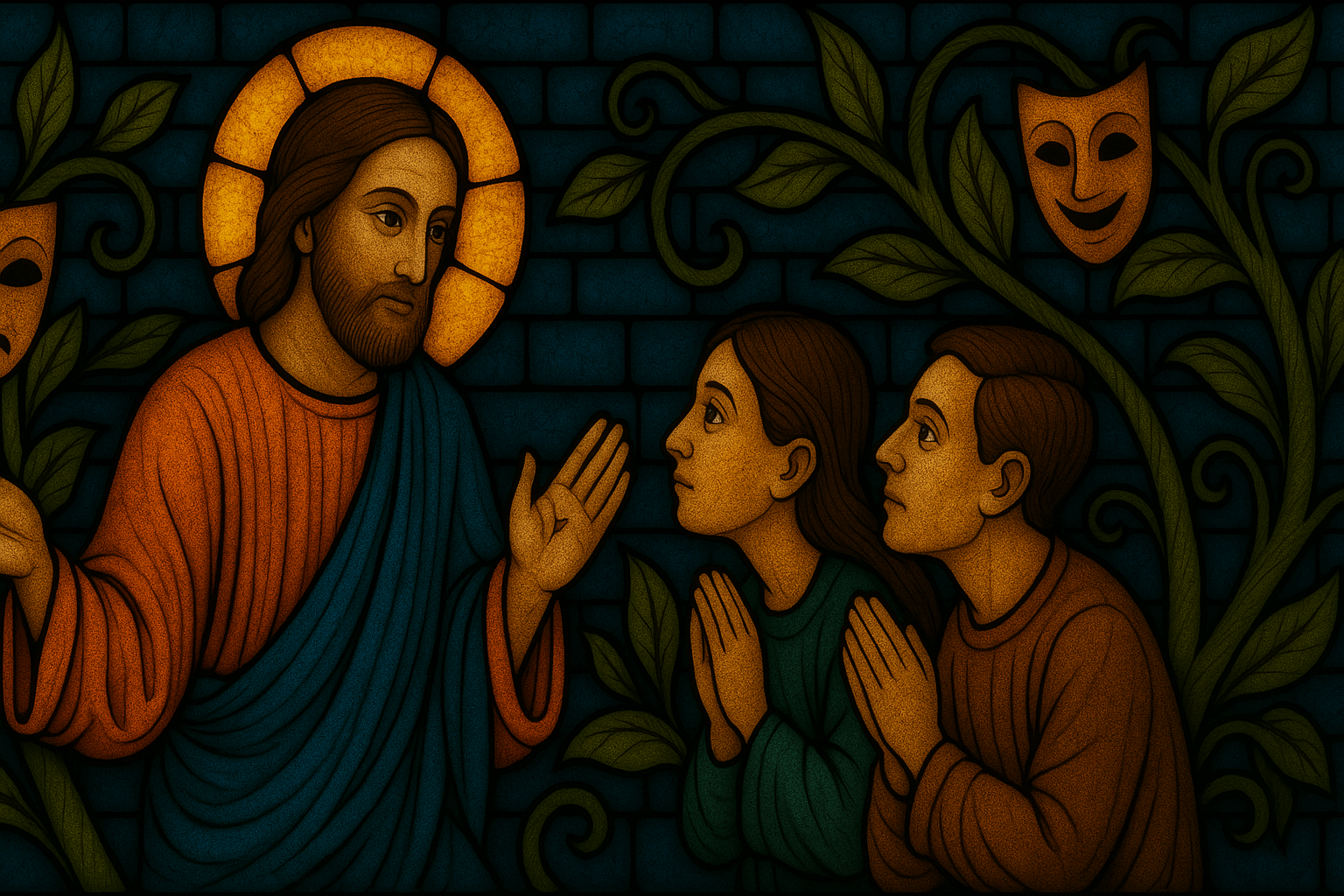
Our gospel lesson this morning uses a fascinating analogy. Jesus is asked to describe the relationship between people. He uses the image of a vine with many branches, all connected, all intertwined with one another. How different that is from the typical picture of life as we know it. Polite, separated, alienated people all wearing masks going through motions, but no connections!
But let me challenge you as we draw this series to a close, I challenge you to go beyond the masks and make some connections. I guess This is why I have preached this series. My purpose was not simply to redeem the common sayings, not simply to sensitize your listing. My purpose was to begin the awesome task of connecting one to another period for that’s really what the faith is all about, connections. The connections between God and man, between man and man. John Fletcher tells a remarkable story which I can readily identify. It was an unforgettable occasion in the church in Washington DC. The Bishop was there for confirmation and as he began to preach, people became bored, restless and confused. His sermon was a vague theory about worship, and in 5 minutes, he lost everyone. Finally a young man stood up and quietly interrupted him with the words, Bishop I’m not sure if I’m alone, but I have not been able to follow a word that you have been saying.
A chorus of support and amens broke out all over the congregation. With that, the Bishop said, “I should have known better than to stay up until three this morning and come here today, especially when I am not prepared. Now let me tell you about my life and some of the pressures that I am under,” Then he began to describe the agonizing conflict he suffered, and as he preached he asked help both human and divine,
The extraordinary part of that story is that the young man who spoke out, the audience itself reached out beyond the masks of the Bishop and flock. Those masks are there so that we may feel sympathy, but rarely do we take the risk to go past that point. Rarely do people’s hurts become our hurts. Rarely do we more than observe.
John Fletcher’s story is about one branch of the vine awakening to the fact that another part of the same vine is in trouble. It has to do with sensing the oneness of the vine that binds and feeds us, it has to do with making connections, putting aside the masks.
For remember, remember, the words of our Lord: I am the vine, you are the branches. As the Father has loved me, so have I loved you. Abide in my love. These things I have spoken to you, that my joy may be in you, and that your joy may be full.”
Let it be, Lord. Let it be.
Amen
How are You?
How are You?
October 5, 1980
Scripture: James 2: 14-24