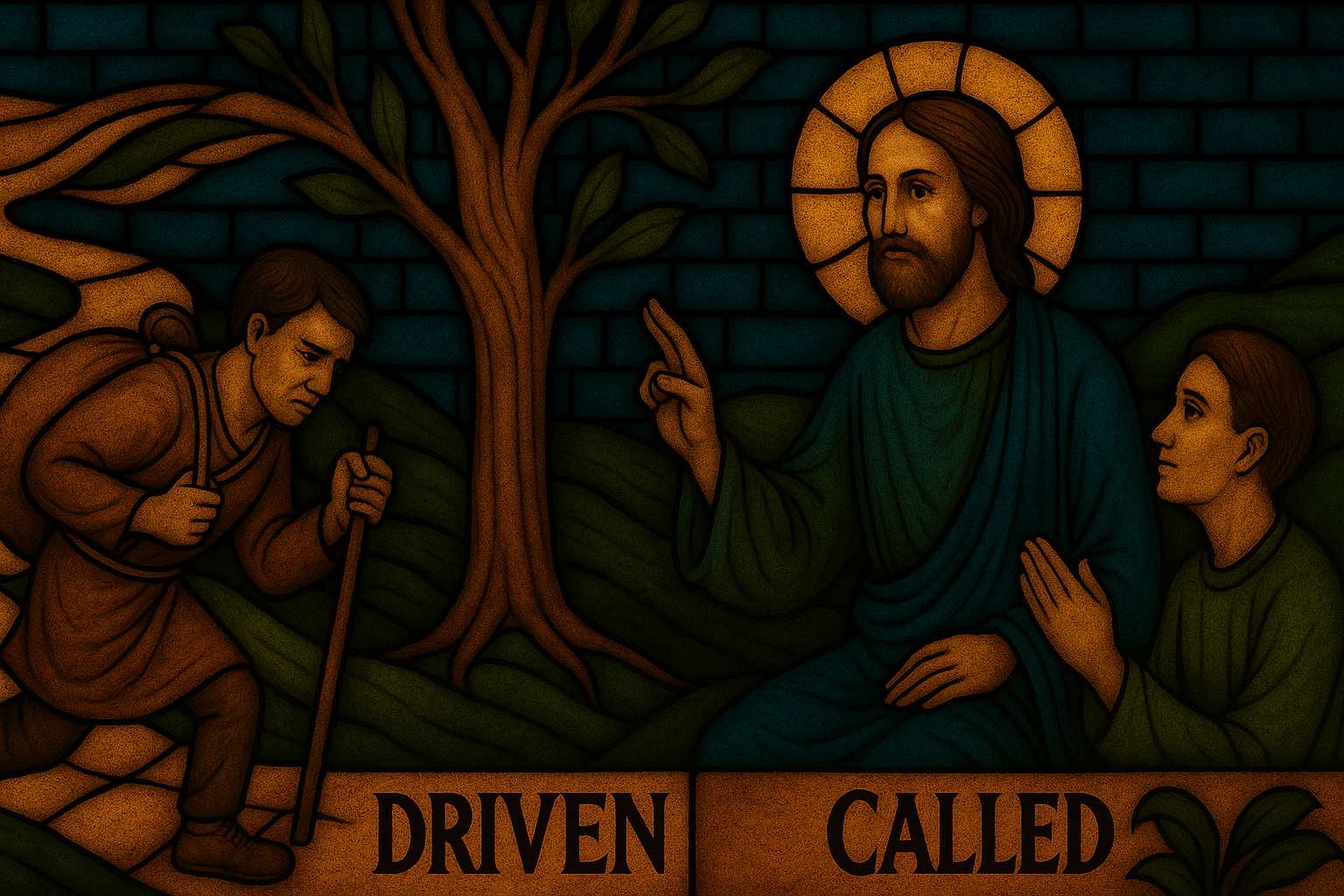
Driven People vs. Called People
October 5, 1997
There is a sign in an office I recently visited: “The people that work here who don’t have a hernia aren’t carrying their share of the load.” I could have written that sign.
There is a saying jokingly used by some: “Thank God it’s Monday.” I’ve often thought that way.
There is a type of person constantly on the go, wanting to do more, accomplish more, accumulate more. I know the type.
Some time ago, I heard of a man who went fishing. By the lake, there was a sign: “All the bait you can use – one dollar.” The man went up and said, “I’ll take two dollars’ worth.” I know that man.
Driven people aren’t hard to spot. They always seem slightly uncomfortable. They usually look harried. They tend to be worn out, and the people around them are often also tired
John D. Rockefeller was once asked, “How much does a person need?” His response was, “A little more than he has.” To those of you who can understand Rockefeller’s reply, this sermon is dedicated.
Now, let’s admit at the outset, it’s easy to see others as being driven. It isn’t easy to discern it in oneself. How do you recognize the difference between normal striving and being a driven person? How do you know the difference between doing a demanding job and losing your soul on a job? How do you recognize when you are making schedules and when schedules are making you? Some of us have spent so long and put so much energy into putting a good face on our drivenness that we actually have come to believe God wants us to be constantly in motion, striving, over-committed, and often exhausted. It isn’t easy to recognize one’s own drivenness.
Last Spring, I cut out an article from the newspaper that identified the driven people of the ’90s. It called them “Time Stackers.” Time Stackers, the article said, are busy people who juggle two or more tasks at once. It’s a sign, the paper said, of why many Americans feel they are racing full throttle through life and so often run out of gas.
Maybe some of you have found yourselves talking on the telephone and going through the mail at the same time. When you do that, you probably also have the television on and you’re planning the next day’s agenda. If you catch yourself acting that way, chances are you’re a “Time Stacker” – one of the driven people of the 90’s.
The problem with being driven, starting out working 40 or 50 hours a week and quickly moving up to 60 or 70 hours, is that it’s addictive. It’s one of the socially acceptable addictions in our society. The harder and longer you work, the more you are praised. Is it any wonder that the heroes of our culture are the ones who are most driven?
So, what do you do about it? How do you overcome this socially acceptable addiction? How do you kick the habit?
Probably the most common answer is to turn over a new leaf and begin to rearrange your life. We often try to convince ourselves that if we build in more time for recreation, for leisure, for family, we can suddenly become less driven. Some even believe that if they retire, they will be able to put aside their drivenness. (It’s strange, but most retired people I talk to tell me they are busier than ever.) Rescheduling, re-prioritizing hardly ever handles the problem. We can be just as much of a “Time Stacker” at home as we can on the job. Driven people don’t stop being driven, even on the tennis courts or golf courses.
The problem is not one of scheduling; its roots are more spiritual. Drivenness is a spiritual disease way before it becomes a physical or psychological issue. And the answer lies closer to seeing yourself in a different light, rather than rearranging your priorities.
We begin to approach the treatment of drivenness when we can see ourselves as being called. Our calling is not dependent on our accomplishments, our standings, our successes, or our accumulations. The secret is to understand that our calling happened way before we were born. The Psalmist put it this way: “Before I formed you in the womb, I knew you.” The dialogue we heard between Nathaniel and Jesus highlights the fact that way before they met, Nathaniel was called. Callings are built into us – they are something that has always been there. Right from the beginning, God has called each one of us in a unique way. The real work of life is to discover the shape of our individual caring.
We sometimes get hung up on the word “calling.” We begin to suppose there is only one kind of calling: The calling to go into the church. Not so, there are many callings. More often than not, they have to do with the kind of professional we are, rather than the kind of profession we are in. (I don’t think God is into career tracks the way we are.) Callings are about the way we approach life, respond to it, and understand God’s purpose much more than how we earn a living. Most callings have to do with learning who we are and appreciating the gifts we have, rather than doing anything. Most callings are about doing less, leaving things rougher around the edges, and discovering more about oneself_ Most callings mean resisting the indulgence of our age that says we can do it all if we run our calendars a little tighter. Those who have a calling will worry less, travel lighter, and trust more that God will take care of things.
There is a scene in a novel called Father Melancholy’s Daughter in which a woman staying in a monastery is helping with the chores. One day, she helps the monk do the laundry. As their four-hour work period draws to a close, many baskets of clothes remain. She panics and works faster and faster, until the monk asks her what the rush is. “We’re never going to finish these baskets,” she says, almost in tears. “We don’t have to,” he tells her. “Someone else will finish them. All that is required is that we work steadily and for the glory of God. Our task is not to finish everything, but simply to be faithful to what we’re doing now. And to be open to God.”
The monk describes very aptly the nature of a calling. To be faithful to what we are doing now, and to trust God.
Good people, I’ve been preaching, as it were, against the grain. I have to keep reminding myself that our life’s task is not to accomplish anything, nor to accumulate more of what we have. Our task is to be faithful to our calling and to trust in God’s mercy.
It is simple, putting aside our drivenness. It is simple to choose a calling instead of an addiction, which we sometimes label as a career. It is simple, but not easy. My hope for all of us in the weeks ahead is that we catch a glimpse of our calling and put aside the busyness of our lives. Then, God willing, we will hear with new ears the lines that go, “Take from our lives the strain and stress, and let our ordered lives confess the beauty of thy peace…” Amen.
Driven People vs. Called People
Driven People vs. Called People
October 5, 1997