The Call Of Zebedee
October 15, 2000
The story is overly familiar, and therefore, we rarely hear it fully. The call of James and John is well known by everyone who has attended Sunday School. Jesus comes by where these two people are employed. He then asks them to leave and become followers and join his small band of disciples.
We’ve heard it so many times that we overlook that there are other people involved in the story. All we remember is that Jesus issues a call, and James and John drop what they are doing and join up. Few of us are ready to leave our homes, our families, and our work and become disciples. So, we listen to the story the way we would to a well-known fairy tale. It’s nice, but hardly believable.
Preachers are prone to wax eloquently over this incident. It has become for some the model of how to become a disciple, yet if we were to be honest, the story doesn’t have much meaning. Who among us can clearly hear the voice of God telling us to do something different, to radically change our lives, to pick up and start all over again? Who among us is ready to hear that kind of call?
I suppose that’s why we think that a call was something that happened only in Biblical times. Or, maybe it comes to a few odd ducks now that are willing to wear round collars and dress up in funny clothes on a Sunday morning.
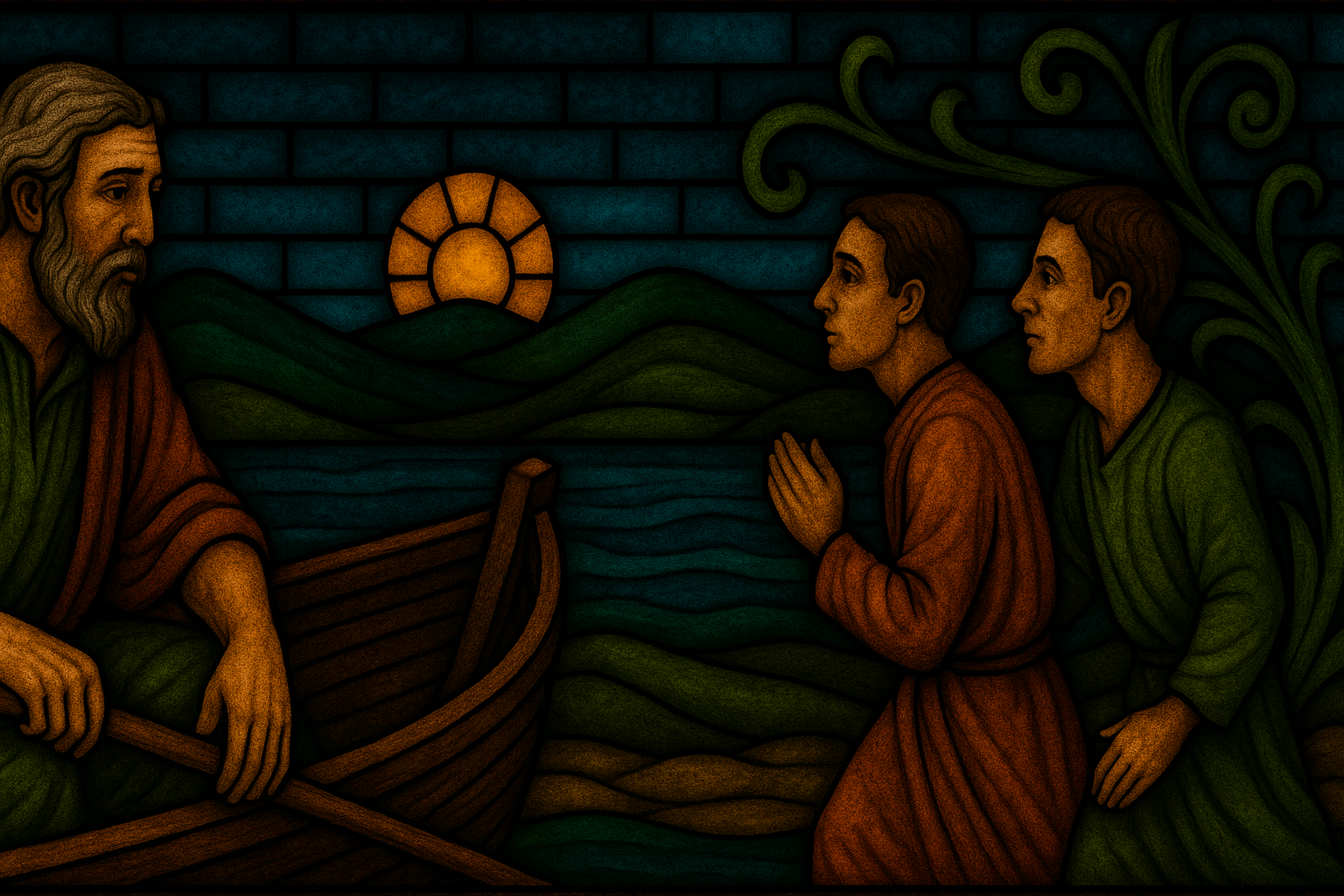
But this morning, I want to draw your attention to another part of the story. There are other people involved. It’s not just a story about James and John. There’s also Zebedee. Who is Zebedee, you ask? He is the other fellow in the boat – the fellow who stays behind, the one who received a different kind of call.
Now listen once again to the last part of the Gospel. “And leaving their father Zebedee in the boat with the hired men, they went off to follow Jesus.
The call of James and John was out of the ordinary. The call of Zebedee was very common. James and John were called to proclaim the kingdom of God. Zebedee was called to live in it. James and John were called to dwell in community with other disciples. Zebedee was left with the hired men, his wife, his friends, and his customers. James and John were called to eat with sinners and religious leaders, to debate and argue fine points of doctrine. Zebedee stayed with ordinary folks – people who wanted nothing more than a ticket to a ball game, a parking spot, better schools for their kids, and the county to fix some of the potholes.
James and John went on to proclaim the good news to the lost. Zebedee stayed to live the Good News with the found. In many ways, Zebedee had the tougher job. In many ways, most of us are more like Zebedee than James and John.
For too many years, we’ve concentrated on James and John and forgotten that the call also comes to Zebedee. I think this is why we’ve associated a call with being ordained. Following in the footsteps of Peter and Andrew, James and John, and the other disciples was thought of as “the higher calling.” It’s only recently that we’ve begun to understand that each of us, in our daily life and work, is also called.
At our Baptism, we are all set aside to be ministers. At that time, we were called (there’s that word again) we were called to live out our ministry, our calling as doctors, or accountants, or teachers, or secretaries, or nurturers of children, or fishermen, like old Zebedee.
No one understood this better than Martin Luther. Listen to his description:
“If you are a craftsman, you will find the Bible placed in your workshop, in your hands, and in your heart. It teaches and preaches how you ought to treat your neighbor. Only look at your tools, your needle and your thimble, your article of trade, and you will sense these words that are written upon them. ‘Use me toward your neighbor, as you would want him to act towards you.’ Remember, you are preaching through your life. There is a calling to serve God through the world of daily work.”
Martin Luther said it, and I believe it. So welcome to the service of God, you who are like Zebedee, who continue to work at your vocation at TUSD, David Monthan, University Hospital, Raytheon, or wherever you are Monday to Friday. Your job is important in the scheme of things. We who work in the church have the lesser calling. We are your support staff It is our job to gather with you weekly, to remind you of your calling. You have the more difficult task.
Moving back to Zebedee, we might still wonder whether or not he has a genuine call. Zebedee doesn’t experience any blinding lights, any thundering voices from heaven, or any warm glows. Zebedee never has the privilege of saying to himself, “For this I was made. For this, I came into the world.” His call is more subtle. Zebedee has to settle for a gentle nudge, a nagging suspicion, a moment of insight, and an intuitive feel. But this is also a part of a genuine call. It’s the kind of call that most of us experience from time to time, nothing big, nothing showy. Just an itch that reminds us that it’s time to change some of our assumptions about life. Just an itch that says we might see the familiar job as ministry, and not just business as usual Does this mean that Zebedee gives up his fishing? Goes off to the Seminary? I don’t think so. But maybe it means that his relationship with his hired hands changes. Maybe it means what happens on Sundays connects with Mondays and Tuesdays. Maybe it tells us that each of us in our own way is also called to minister.
Today we gather, not only to renew our sense of call, but we are here to welcome two members of our parish who were set aside yesterday
Yesterday at Trinity Cathedral in Phoenix, Tom and Beverly were made deacons in God’s church. Now, a deacon is closer to Zebedee than to James and John. A deacon is one who stays in the boat, ministers where they are. The task of the deacon is not to be different from Zebedee. The task of the deacon is to be a reminder that each of us is also called.
The first deacon, in my tenure at St. Philip’s, was Bob Vance, a very special person. Some of you might remember him. In conversations with Bob, I often asked him why he didn’t go on and be ordained a Priest. Bob would smile and say, “I have a most important role here at St. Philip’s.” I’m the connecting pin between the clergy and the laity. I’m the link between you and the congregation. I am here to interpret what the person in the pew is saying, and to communicate what’s on your mind to the people I meet on Monday.” Bob did this in a graceful way for years. And by so doing, performed an invaluable ministry.
We didn’t often see Bob in a round collar. He was more at ease in a sports shirt. But you were always certain that whatever he wore, and whatever he was doing, he knew that he was called.
So, before we bring these two people up front, let me remind each of you, these two individuals, along with Joe King and Bob Hartley, are in the ministry of Zebedee. And you do them harm if you treat them as junior priests.
Their task is primarily to connect us to the world, to serve as a reminder that God calls each of us in our several vocations, and to remind us that round collars have no exclusive pipeline to ministry.
So be open to these two people. Help them to minister. And help them to be linking pins between the laity and the clergy and between God and the people of God.
Amen
The Call Of Zebedee
The Call Of Zebedee
October 15, 2000