What is the Meaning of a Pledge?
Mark 12: 38-44
October 27, 1991
It’s a strange feeling coming back from a holiday and finding the canvas half completed. It’s even a stranger feeling to find that there is no need to urge people to give, it is all been taken care of. And it’s the strangest feeling to see the canvas going smoothly into here, we’re glad to have you attend our canvas meeting rector, but if not, that’s fine. We can carry on without you.
It’s a strange feeling but also a wonderful one period the meta church is working, there are many ministers here not just those with round collars. Canvas people, stewardship people, development people, I salute you. And to those of you who have already made your pledge I salute you too. You have demonstrated your sense of ministry towards our community.
So now that you have made your pledge, what does it all mean? Has it made you feel good or bad? Richard or poorer? Let me suggest that your pledge could be one of the most significant and meaningful acts of your life. It could be a method whereby your very self-image gets renewed, reformed and revitalized.
Why do I say this? I believe a real pledge can only be made by a person of substance. Poor people cannot pledge. They cannot forward to pledge. It takes away from their security. A pledge for poor people is viewed as a loss. A pledge for people of substance is seen as saintly, where they see themselves as philanthropists. Poor people who are viewed as a disaster for they see themselves as needy.
So who’s rich and who’s poor? Who is a philanthropist and who is a loser? It’s not easy to tell is it? Two people can pledge, for one, it’s an act that makes him feel wealthy, for another, it’s simply an act that makes him less able to afford something else.
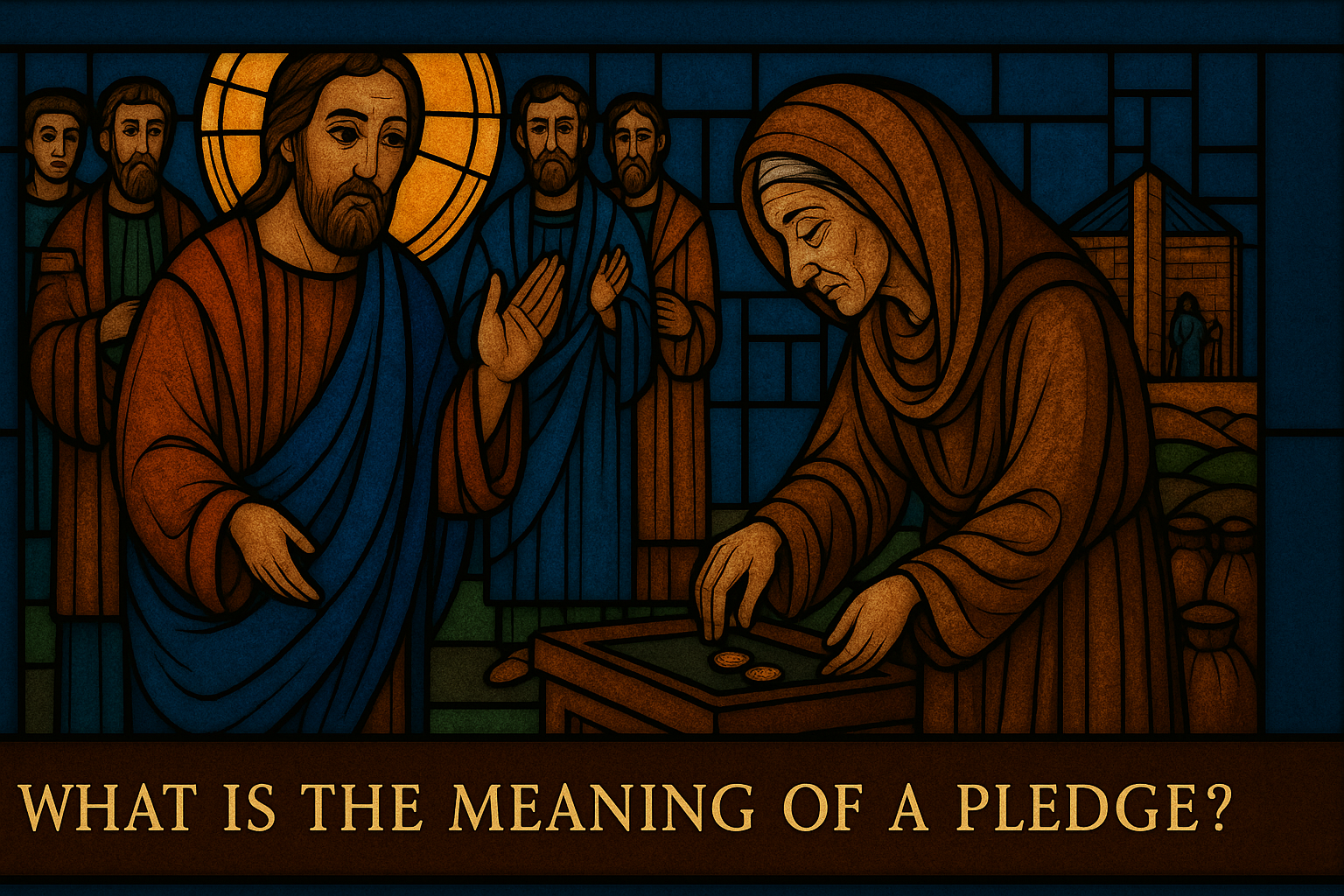
Our gospel lesson, which we just read, is about this same issue. A widow and some so-called rich people are seen giving to the temple, fulfilling their pledge. Jesus points out that some pledges are meaningful and some are not. And you can’t tell by the amounts, or by the way people are dressed, appearances are often deceptive. Yet we are asked to make judgments, to go beyond the superficial, to discern who’s rich and who’s poor in this little vignette.
How might we recognize a person of substance? Can you discern a truly wealthy person? By their bank account, stock portfolio, car they drive, their home? Maybe, but not necessarily. Jesus invites us to go beyond these circumstances and discern real wealth, real lasting substance. So who’s rich and who’s poor? It’s a question that Americans need to stop and ask themselves.
I read recently of a person who was working for a mere pittance teaching English to agricultural students. She wrote about some friends of hers, Jose and Maria. You know, she said, I feel incredibly rich. If I’m ever sick or when I get old, I know for a fact that Jose and Maria would take me in and look after me. What do most people in this country know for a fact about what will happen to us when we get old, or when we get sick? It doesn’t really matter about how much you’ve collected. It’s more about how you feel about yourself and how others feel about you, whether you are of any value or not.
Comparing people in this country to the woman in Central America, we are, for the most part, poverty-stricken. She is well connected, a woman of substance; her wealth is in her relationships, her work, her ability to give herself up, her friends. Our wealth, for the most part, lies in what we have accumulated, what’s in the bag, our net worth, and Jesus would say that makes us incredibly poor.
It is interesting to note that money in the Bible is either associated with mammon or manna. Mammon is the God of greed. When you worship mammon you never have enough, you become attached to material wealth. Mammon in the Bible is the great symbol of insatiable watch. If my mom were to be translated into contemporary English we might use the word consumerism.
Manna, on the other hand, is also a synonym for money and scripture, manna in that sacramental outflow that sustained people in the worst of times. Mana comes from God. It is identified with God in heaven, it is the symbol by which God feeds us and cares for us. When we have mana, we can afford to be generous, give it away or manna makes us people upsets people when we have mammon we are always hungry and never satisfied.
Our whole life, in one sense, can be interpreted by how we perceive our money. Is it may not the manna? Is it a gift from heaven or is it filthy? The wonderful part of this season, the magnificent part of pledging, is that it forces me to reevaluate my money. How do I view it?
Is it mana, a renewable resource because of God’s abundance? Or is it mammon, something that gives me a sense of loss if I part with it? Mana or mammon this is the season to make the declaration. Are you rich or are you poor?
A story is told by Gordon Crosby, the well-known pastor of the Church of the Savior in Washington. He tells of when he was a minister of a small congregation in a railroad town in Virginia. The treasurer of the congregation sent for him one day, and told him that he needed help. We have in our church, the treasurer said, a widow with six children. I have looked at the records and discovered that she is pledging and actually placing in the collection plates $10 per week. I am sure this must be more than 10% of her income. She cannot afford it. We want to go to her and let her know that we release her from her pledge, or at least get her to reduce it.
Cosby said, I am not wise now. I was less than. I went to her and told her as graciously and supportively as I knew how the message from the treasurer. As I talked tears came to her eyes. I want to tell you, she said, that you are taking away my dignity and meaning. My pledge makes me feel like a person of substance in this community.
Well, there it is. Cosby learned the secret of giving that day. A pledge is not based on accumulated wealth banana feeling, a knowledge, and understanding that you are a person of substance and can’t afford to give away mana. And Jesus called his disciples to him and said to them, Truly I say to you, this widow has put more than all of those who are contributing, for she is rich beyond her wildest dreams. She, by her pledge, is a woman of substance.
Amen
What is the Meaning of a Pledge?
What is the Meaning of a Pledge?
October 27, 1991
Scripture: Mark 12: 38-44