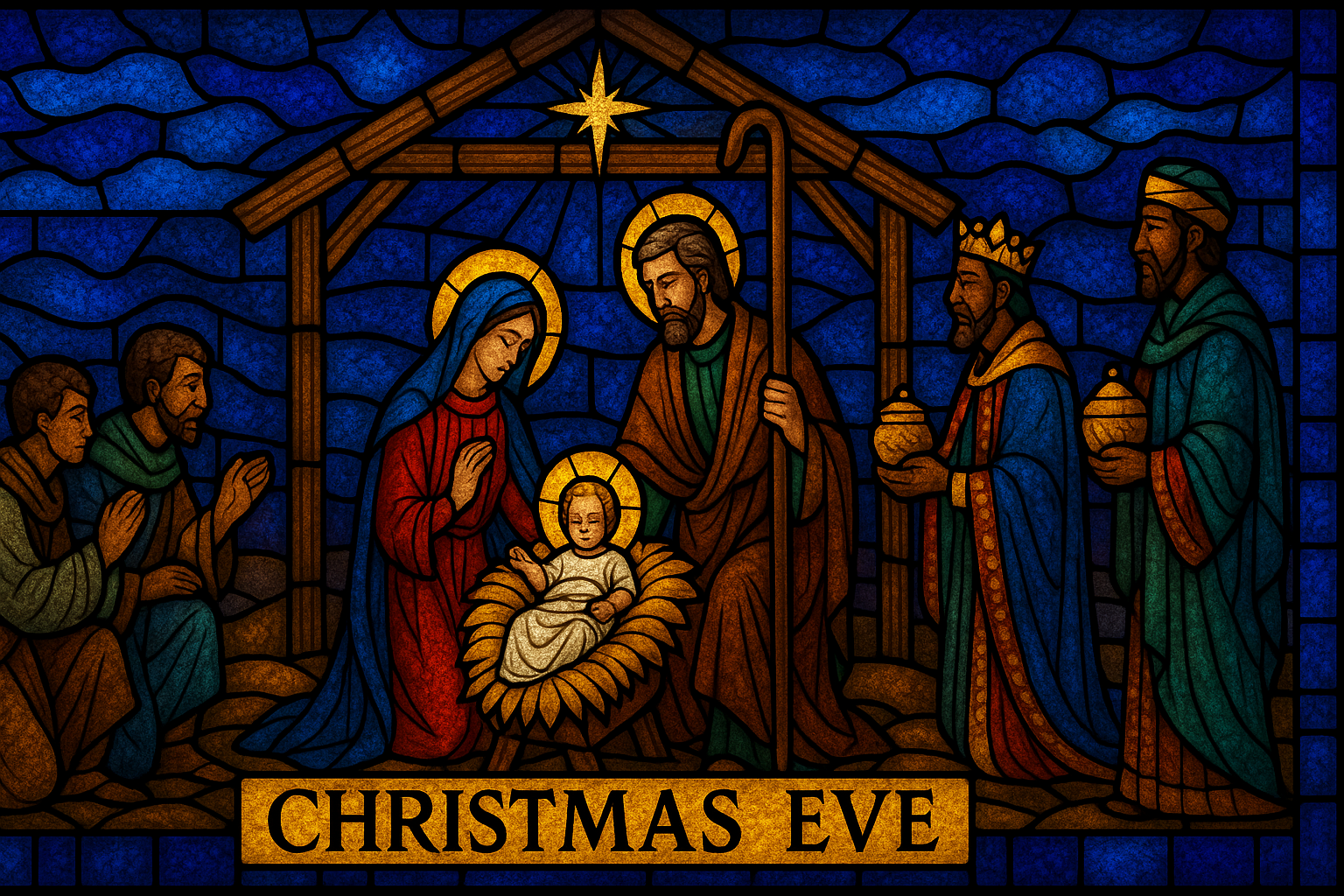
Christmas Eve
December 24, 2000
Of all the crazy, mischievous, hare-brained, foolhardy, cock-a-mammy ideas that Christianity has come up with – and then asked people to take seriously – surely, none could be as catastrophic as the Christmas story. The story of God entering the world as a baby to save the world.
I mean, let’s just make a list of the really weird, brazen, dangerous, unbelievable religious understandings that are clustered around the story. One – that the Messiah would come to us as a helpless baby, that he would be born into a family of non-white, despised, third-world people. Three, finally, the most astounding assertion of all, that the baby could – make a difference in this fallen, dog-eat-dog world.
What boggles the mind is that many people would buy the whole shebang. The birth, the life, the death, and the Resurrection. It’s true, in some places, they have managed to mute the message, obscure the meaning, and trivialize the story. This can be done by placing great emphasis on the holiday season and forgetting the radical nature of the birth story.
Some years ago, the New York Times tried to find some soft news for Christmas Day. They looked around for something warm and fuzzy that didn’t offend anyone. The lead story was of a Muslim gentleman who visited a church on Christmas. The Muslim was quoted as saying, “The religious words didn’t make much sense, but it was a wonderful experience.” He then went on to say, “Couldn’t we just have the spirituality without the theology? Couldn’t we have the greenery, the candles, the good music, and not worry about the meaning of this birth?”
Well, the answer is NO! No, you can’t have the outward trappings without coming to grips with the meaning of this birth, not here, at least, not tonight, in this church, for we celebrate that God has a face, a name, a family. God is not some abstract principle, some good feeling of the season. God has a name: Jesus.
There are groups that try to capture this story for themselves. They would lead you to believe that this God came exclusively for them. There’s a bumper sticker I’ve seen around town that says, “Our God Reigns.” I have a feeling that it’s also saying, “Your God doesn’t reign, but ours does, so there.” They would have us believe that God came to save a certain segment of straight-thinking, Bible-reading, and right-acting folk.
Well, I have news for you. The story of this birth is a demonstration of God’s colossal lack of taste. Jesus comes to everybody. The question tonight is not who’s in and who’s out, who’s allowed to be a part of the feast and who is excluded, who’s permitted to serve and who is not invited. The question is who knows about the birth, and does it make a difference in the way people act towards each other?
The world into which this birth happened was a maze of interpersonal walls and social boundaries. The differences between people were clearly delineated. There were the clean and the unclean, the righteous and the unrighteous, the legal and the illegal, the good and the bad. But God came to break down those barriers. If you look closely, you will and that the birth itself was living proof that there were no outcasts.
Take a moment and observe the people gathered around the baby. Don’t let sentimentality cloud your understanding. Mary was probably in Bethlehem because of her sexual indiscretion, as far as the people in Nazareth were concerned. Joseph would have been looked down upon for having ignored the law and marrying a sinner. The shepherds were unclean by virtue of their work. And the Wise Men were Gentiles, a group considered beneath God’s contempt.
The story we tell at Christmas is a story of God’s mad love affair with all humanity. It’s a story of how God is born and comes among outcasts, and how God has come as a baby to save all people.
A friend of mine, who used to live in New York, tells in one of his books of an incident on Christmas Eve. He was walking through a depressed area on the Upper West Side. There, on the wall of an abandoned building, he saw all the graffiti that is so common in that area. All kinds of things had been written – four-letter words, names of lovers, gang signs, and a lot of scribbling. And right there in the middle were the words, “Jesus Saves.” My friend said his first reaction was profoundly negative. It disturbed him that someone would write his beliefs among the rest of the garbage-type words. But as he walked on and thought about it, he began to feel that here was a wonderful symbol of the Birth Story. Here, on an abandoned building, was the reason for God’s birth.
This is an audacious, crazy claim that we make this night: the claim that God chooses to do the work of human salvation in the form, in the flesh of this baby. It’s a scary claim because God has taken us so seriously that we must take God seriously. It’s a crazy claim because we can no longer feel that God can be the private property of a chosen few. God is forever joined to all parts of creation.
This is our claim, our claim to fame – the only claim that we can make tonight – the only claim that makes a difference to the barriers people set up to divide us from each other. This birth, this incarnation, is the story of God coming to each one of us. And for this, for this tonight, we give thanks.
Amen
Christmas Eve
Christmas Eve
December 24, 2000