A Homecoming
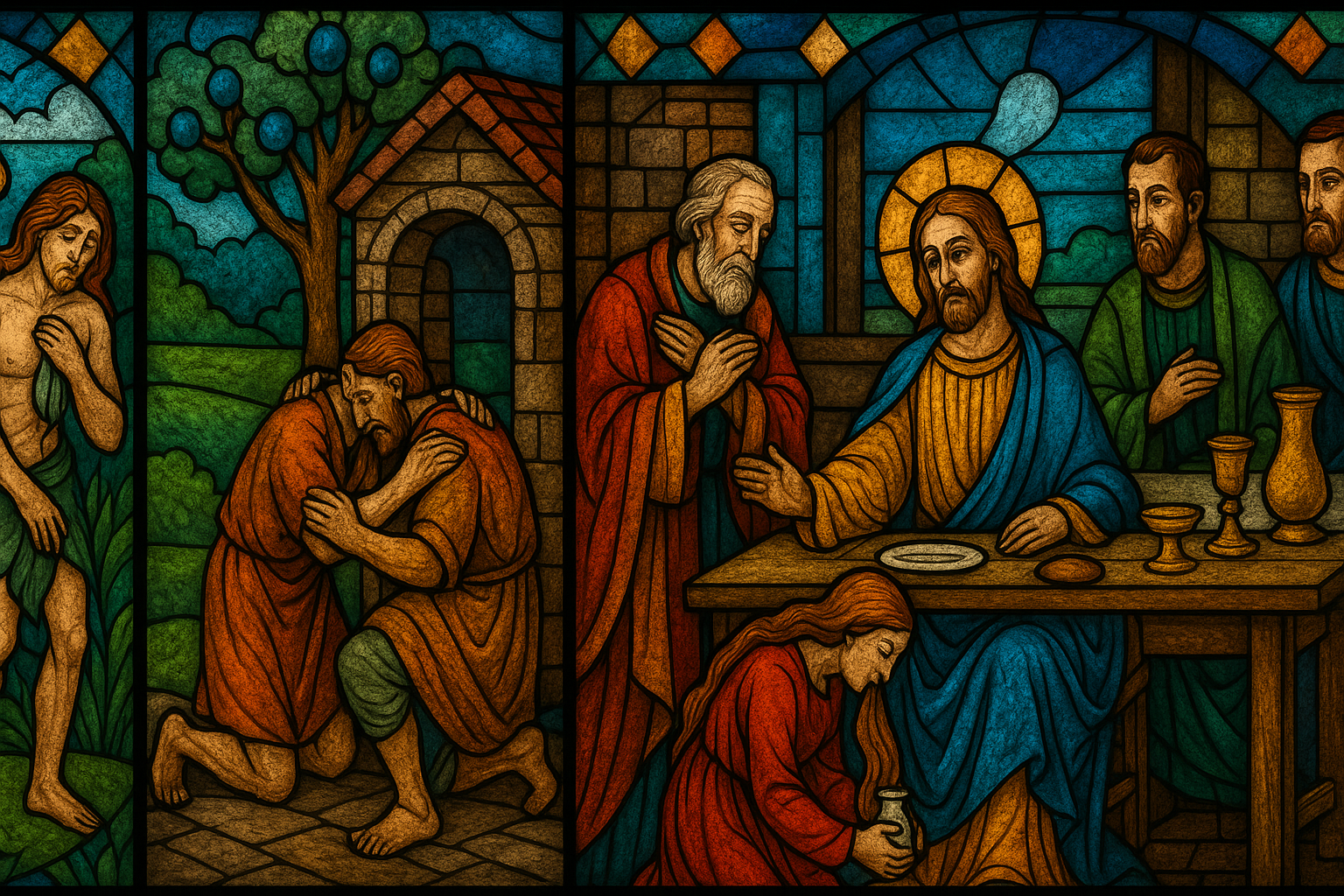
Genesis 3: 22-24, Luke 7: 36-50
May 14, 1998
Scholars tell us that no chapter in Holy Scripture has been subjected to more attention than the third chapter of Genesis.
Countless numbers of people have searched for the garden. Learned books have been written interpreting the actions of Adam and Eve. I can still recall how smart we felt in seminary, where we discovered how this and other chapters were put together by several storytellers over hundreds of years.
Whether you’ve been to Sunday school or seminary, I’m sure you know the third chapter of Genesis is about the fall. The story is absurd if taken literally, but profound if we see it as a myth. A myth, explaining in a story, the human condition.
Adam and Eve stand for all of us, and they have it made. The Garden was the perfect environment. All their necessities were provided. No worries, no cares, no anxieties. Life was good.
And they blew it! They tried to push the boundaries farther than they were allowed. Their punishment, or the consequence of their actions, was that they were evicted permanently. And so we read, “God drove them out, and at the East of the Garden (I suppose this was the entrance), God placed the cherubim and a flaming sword which turned everywhere.”
Amazingly, this myth of the eviction is found in almost every religion. This story, or others similar, is not unique to the Judeo-Christian Scriptures. Parallels can be found in Roman, Greek, and Persian literature. You can even and similarities in Native American lore. But more important for us, the eviction story is deeply embedded in our own psyches. Thomas Wolf articulated it for the 20th century when he wrote, You Can’t Go Home Again. For him, You can’t go home again meant the South, his childhood memories, his roots that never could be recovered after life in Boston.
Well, here we are celebrating the fact that one of our sons is coming home. Here we are saying the possibility does exist – to come home.
Actually, this is the third time our parish has said, “Come home, John, to our desert Garden of Eden.” Three times we have said, “John, come and make your home with us.” The first was fifteen years ago, when we invited John to come from Memphis as our Music Director. The second was to come and be ordained a Deacon after we had sent him to the seminary. And now, we bring him back home again as our Priest and Organist. Thomas Wolf may have had his troubles reclaiming his old life, but we are here to affirm that John can, and is able, to come home again.
But what does it mean that John has come home as a priest? What does it mean that we, this community, have chosen to call him home as a priest? Let me quote an ancient rabbinical tale to help clarify this. Once upon a time, a rabbi was asked how it felt to be chosen as a rabbi. To be chosen as the person who ministers in God’s house. “Well”, the rabbi said, “I understood what it meant to be chosen much better when I worked in the sheepfold. There every tenth lamb was chosen for service in the temple, just by reason of being number ten. In that way,” the rabbi continued, “I was chosen to be a rabbi. No one is chosen because he is better than anyone else. And everyone is chosen for something. Everyone has some internal gifts that suit him or her to be chosen. In some strange way, each of us is that tenth lamb – chosen for service in God’s house.
So John, we have chosen you, or, more to the point, God has chosen you to come home. Not because you are holier, or better, but simply because out of his love He has called you home again.
One further caveat: one of the problems Thomas Wolf had, and we often have when we think of going home, is that we look for Eden- Eden, that perfect spot where all our needs are met and all our dreams of living together are fulfilled. But Dietrich Bonnhoffer reminds us that going home means to accept the reality of our particular bunch of people, and to stop fantasizing that they are or might become some idealized bunch of people. Choosing to go home means some reality checks on both sides. This family, John, is made up of a lot of sinners. We’re a pretty dysfunctional lot. Yet we’re a community that God has chosen – chosen to make His home with us. And we welcome you back, “warts and all.”
But back to our lessons. In the first lesson, God kicks Adam and Eve out. But the good news is that God can change his/her mind. This, for me, is the essence of the God event recorded in Scripture. The God-event, in the Gospel, is God’s choosing to make his home with us; which means that the old sentence of eviction has been lifted.
Have you ever wondered why the Gospel stories are filled with incidents of Jesus having meals with people? Have you ever wondered why the principal sin that Jesus condemns is a lack of hospitality? in other words, not opening one’s home, inviting to a meal? Have you ever wondered why most of Jesus’ teachings surround events of eating?
I think it’s because Jesus’ life is an expression of homecoming. He tells us in so many ways that God welcomes us to the homecoming banquet, where the elder brother and the prodigal son, the exile and the stranger, the straight and the gay, the poor and the rich, the sinner and the saint, the lion and the lamb, will feast together in peace. This is what every communion service should be reminding us about. A homecoming, where no one will be outside; where all will be chosen.
My brother John, you are the living proof that Thomas Wolfe’s words are not necessarily true. The myth of the fall is not the last word. We are here to declare, “There is life after Boston.” You can come home again. John, we warmly welcome you to the community. We are your family, as you are family to us. Amen
A Homecoming
A Homecoming
May 14, 1998
Scripture: Genesis 3: 22-24, Luke 7:36-50