A Two-Part Play
March 31, 1996
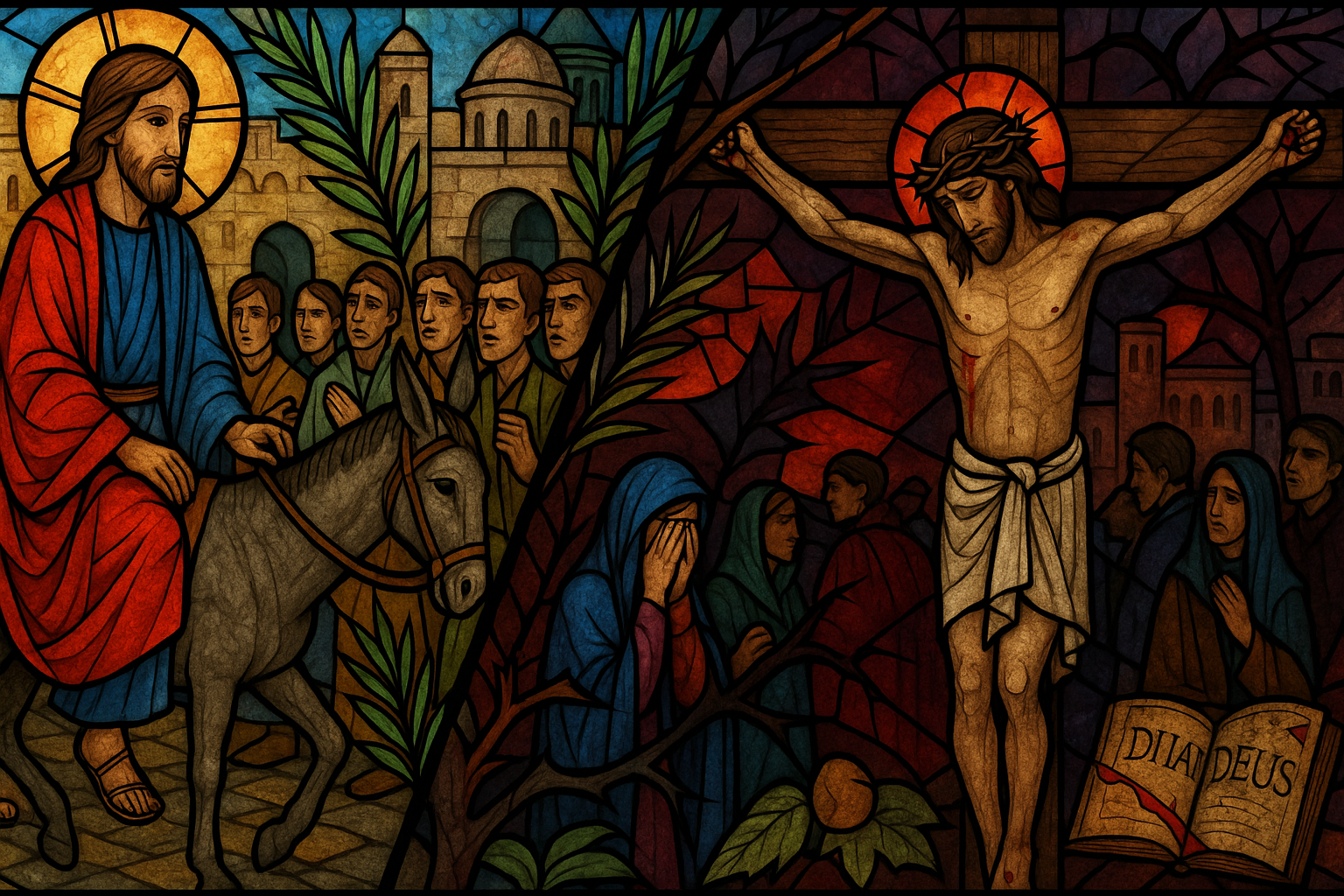
Palm Sunday is a watershed in the great 40 days of Lent – a Sunday of tremendous contradictions. It is a Sunday when we see Jesus leading a parade, and then watch with detached horror as he dies slowly on a cross. It’s a Sunday when we observe people in a festive mood crying “Hosanna,” and then see them turning and yelling, ”Crucify him!”
Every year we come to this Sunday, and every year I am bewildered by the contradictions. Every year, I struggle to reconcile the Jesus who leads a parade with the Jesus who hangs on a cross.
I shared my confusion with the staff several weeks ago, and they made a creative suggestion. Why not have two separate meditations? Separate them like two play acts with two separate readings. When we go to the theater, we do not necessarily have the same feelings about act one and act two. Each contributes to the play in its own way.
Turning now to the first act – the triumphal entry. The question is — What does it mean? And what does it say about Jesus and ourselves?
]Marcus Borg, the Jesus scholar, points out that it’s difficult to know exactly why Jesus chose this way and this time to ride into Jerusalem. But of this much we can be sure – riding into Jerusalem the way Jesus did was a challenge to the Roman Government and the temple elite. It was showdown time. Jesus could no longer be ignored. Either God was going to bring in the Kingdom right now, or the whole enterprise was doomed to failure. This was no ticker-tape parade for a conquering hero. This was an “in your face” demonstration, calling for a response. A response from God and from each person witnessing the scene
So act one is less of a hero’s parade and more of a martyr’s slow march to death. We want to join a parade that ends in a bloodless revolution, but we’re invited to view Palm Sunday from the perspective of the cross. And even more than that, we’re asked to become one with him who: “Rides on, rides on, in majesty. In lowly pomp, rides on to die.” What is the nature of the invitation? He bids us to follow a martyr, not a hero, who is about to have an accidental death. Think about it for a moment. Is this the beginning of a story about a martyr or the story of a victim? A victim we can feel compassion for. A martyr one must either follow or reject.
Andrew Blackwood wrote a poem that says it all on this bleak day, where everybody seems to be confused. Listen, and see if it doesn’t speak to you on this day that begins our Holy Week
Jesus, what have you done to us? We wanted a pet kitten
And you turned into a tiger.
We liked you the way you were. Why couldn’t you leave us alone?
We wanted you to show up when we wanted to make us feel good.
We wanted a pretty church
for weddings, baptisms, and funerals.
We wanted the cute Easter bunny,
hopping around the lawn.
We thought religion
is good for the kiddies.
Palm fronds are such lovely decorations.
Look at all we’ve done for you, Jesus
Why can’t you leave us alone?
We’ve got enough troubles now.
Why do you keep riding into our lives?
What do you want – our hearts?
Here we are in the midst of act two. It’s an ugly scene.
What is happening is that the American fairy tale is being challenged. We, who can’t imagine anything but an all-powerful God, are being presented with a loser God.
Isn’t it true that the great American fairy tale is about winning? Don’t we believe that if we try our hardest, do our best, all will be right in the end?
And so we wonder as we think about what we just heard
What killed Jesus? Was it the hanging on a cross, that Roman way of death for revolutionaries? Was it the rejection from the temple elite? Was it the abandonment by the disciples? All seems to be happening in those terrible two days. But what killed Jesus? Let me suggest something different. What killed Jesus was the giving up of the American fairy tale – the fairy tale that says God will look after us. Big Daddy will provide. We even have it written on our altar hanging: “Ditat Deus.” ”Wait,” we often say to ourselves when we are in the midst of painful situations. “The cavalry will arrive in the last reel. The bad times will soon be replaced by the good times.”
Those who subscribe to the American fairy tale think of the crucifixion as an accident, an interruption, a blip in a triumphant life. Somehow, we think that God will make things right in the end. But wait, this is death in all its horrors. This crucifixion is the ending of a stupendous failure. We would like to skip over that part of the story, or at least emphasize the pleasant, heroic words from the cross.
The Jesus seminar people have said the most historically accurate words from the cross are, “My God, my God, why hast thou forsaken me?”
I think Jesus believed the fairy tale. One last roll of the dice. I think he probably believed that God would not let this happen. Somehow, God would rescue him, bring in the Kingdom, and set things right. And so we come across this gut-wrenching cry: “My God, my God, why hast thou forsaken me?”
C.S. Lewis, after his wife’s death, wrote in his bewilderment, “In a world where Beethoven goes deaf, where the good die young, where the innocent suffer… God, if there is a God, is either a spiteful imbecile or a cosmic sadist.”
The crucifixion is not a Hollywood success story. And so we find ourselves asking what kind of God would permit this? What kind of God allows the very best to be murdered by the very worst? What kind of God allows goodness on the scaffold and evil on the throne? And the answer is – The God who allows his Son to die on a cross.
The greatness of this day is that it does not answer all our questions. It does not give us a supernatural solution to suffering and death. Instead, it presents us with a God who suffers and dies with us. This is the God who says, “I am here, even unto the death.”
Let’s be honest. We can’t imagine that kind of a God. It goes against all we know. A crucified God, a God who feels the pangs of abandonment. A loser God. As Woody Allen once said. “God seems to be an underachiever.”
The struggle with this day is the struggle we have in giving up the American fairy tale. It’s a struggle of trying to imagine a God who identifies more with suffering than with success. Can you hear? Can you hear the crucified one saying, “My God, my God, why hast thou forsaken me?”
Look at all we’ve done for you, Jesus.
Why can’t you leave us alone? Why do you keep hanging there? What do you want – our hearts?
AMEN
A Two-Part Play
A Two-Part Play
March 31, 1996