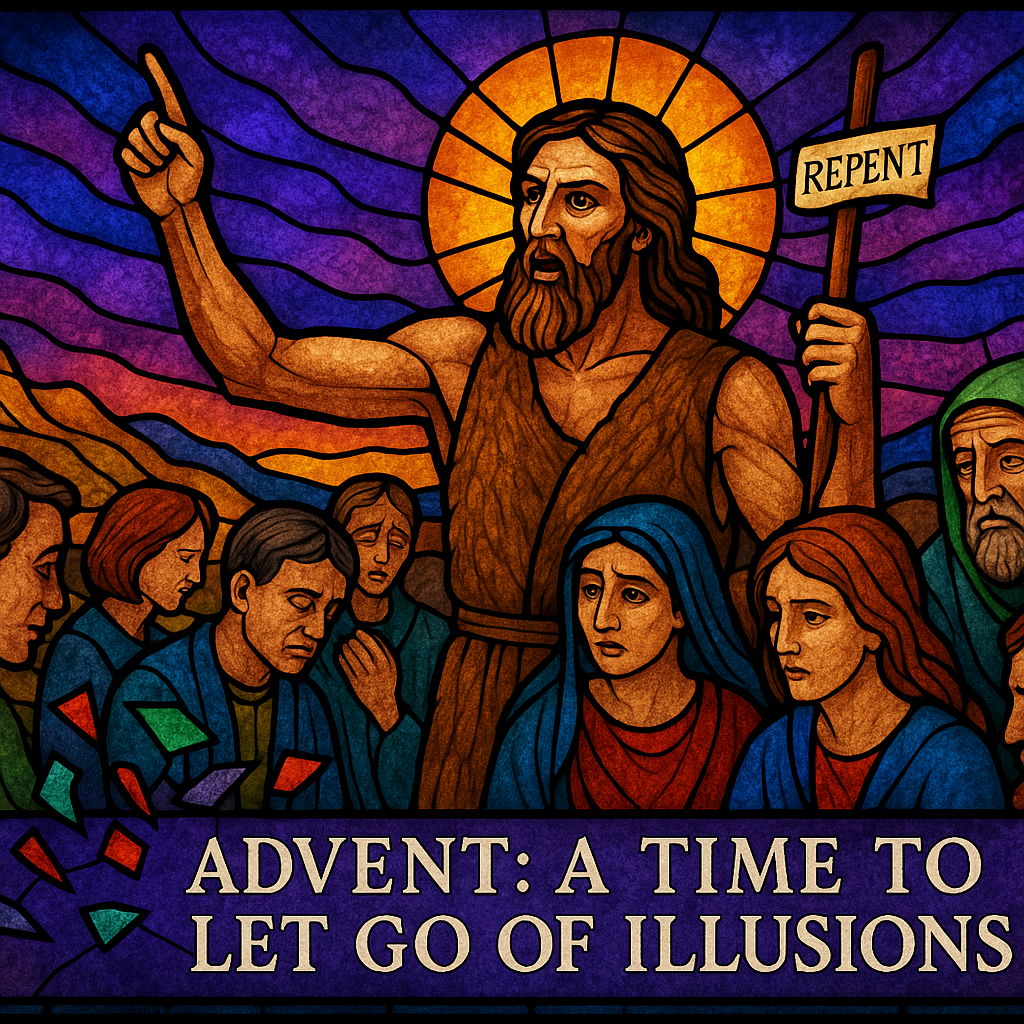
Advent: A Time to Let Go of Illusions
December 6, 1998
For anyone who takes Advent seriously, it’s a rough time of the year. There is a huge disorientation factor that goes on inside oneself. The culture and the church seem deliberately to clash.
Outside, we are assaulted by the culture to buy – to spend money we don’t have. We’re told we will not be satisfied until our households possess a certain product. And unless a certain thing appears under your tree, you are not part of the in crowd.
And then we come into church, and we encounter harrowing figures like John the Baptist, who tells us to repent, and to get rid of all the things which seem to hold our life together. We are told to be prepared to put aside everything that has given us status.
Even sitting here in church this morning, I am overwhelmed by this sense of disorientation. On one hand, I am transported to some faraway place by the magnificent music of Bach (particularly if I don’t listen closely to the words, which are so radical). Then I crash to earth when I hear the words of John the Baptist saying, “Repent, you brood of vipers.” (Not a nice form of greeting towards someone who sees himself as a pussycat.) And then we hear, “Don’t say we have Abraham as our father.” In other words, don’t appeal to your pedigree, or whatever your status symbol may be. It doesn’t cut the mustard. Repent!
A few weeks ago, the magazine section of the New York Times devoted its entire space to the Changing of status in the United States. Status, as defined by the New York Times, is how you fix another person quickly and effectively in her place; preferably beneath you. We were told that status in America is important (as if we didn’t know it). Status makes possible a map of the social territory. It defines who and what we are. It tells us who is in and who is out.
But it is also a form of bondage, enticing as it may be. It is enticing because it seems to protect us and give us a sense of stability. We can so easily tell if we belong or not. It is bondage because we are so dependent upon it.
The magazine then told us how the old WASP values and protective colorations were being discarded and replaced. And then we come to church and hear how we ought to replace even the new status symbols. The only status that John recognizes is that of a sinner. If we were to translate John’s words into modern idiom, we might hear him say, ‘/Don/t say I’m a white Anglo-Saxon Protestant.” As if that will do something for you. It doesn’t mean anything to God. Give up the illusion that God is in his heaven and all is right with your world. Get rid of the notion that you are deserving of God’s grace. Repent!
The problem is, we don’t want to give up our old status. We want to think and act as if we are entitled to God’s favor. Repentance then, for many of us, becomes a dirty word.
Repentance is about struggling to tell the truth about our lives and who we are. And sometimes telling the truth hurts. It strips us of all that we seem to hold dear. We have to get rid of many of our illusions.
Back in the dim past, while in clinical pastoral training, I can still recall a most unsettling exercise. It was called “Life Boat.” I definitely would not recommend it as something to try at your next dinner party.
“Life Boat” is a training game that allows us to look at ourselves. If you’ve ever been a part of it, you are probably having a knot in your stomach just thinking about it. It was many years ago that I played it, but I still remember it vividly.
Six of us from our group were chosen. We were asked to sit on the floor in a circle, and imagine ourselves on a sinking lifeboat in the high seas. We were told that unless we removed one of the six people, the boat would sink. We were not allowed to be martyrs and had to want to stay in the boat. Three minutes were allotted for us to say whatever we wished to each other before a secret ballot would be taken, and one would be voted out. After the first ballot, the game gained in intensity. We were told that we would have to ballot every three minutes. Each time another person would be asked to go overboard, and we could not volunteer to be thrown overboard.
It is incredible how lifelike a situation this becomes. Initially, I managed to stay in the boat by saying how I hurt my back, and how others would have a better chance in the water. (Poor me. I wasn’t up to the rigors of swimming at the time.) I gathered enough sympathy over my supposed weakness that I stayed in the boat for the first ballot. My next ploy was to suggest that we might be there for a while, and I was good company and knew a lot about group dynamics. I would be a real asset in keeping people’s spirits up, and I would help with the religious sensibilities of the remaining group. It worked, and one of the more contentious of the group went in next. After that, I played on my status at home and told them about my children and wife, who needed me. A single person was voted out. Next, I allowed that I had first aid training, not much, but some. And, the group might need that later, and also that I was important to my community back home. It worked, and we were down to three. I sized up the situation and supported a woman because she said she had studied survival techniques. By that ploy, I gained an ally, and then we were down to two.
We faced each other for three minutes and talked about not wanting to die, and how important our futures might be. The vote, I knew, was about living with guilt, or not living at all. I’m not going to tell you what I wrote, but we canceled each other’s vote, and we sat there not looking at each other.
Those few moments in the exercise allowed me to move to church this morning, but I’m not necessarily making brownie points with God. I know that I’m in need of truth-telling, of a radical honesty, of getting rid of the notion that I’m deserving of God’s love. Before one seeks a cure, one must confess the ailment and its symptoms. Advent is a time when we are asked to go inside ourselves, to take a long, hard look at who we are, and what we are. Advent / is a time to move from status to chaos, from permanence to recovery, from comfort to naked truth. Advent is a time to face our flaws. Alan Jones, the present dean of the cathedral in San Francisco, once said, “Years ago, English priests would leave a printed card when people were not at home. It had written on it, ‘The Vicar called today, and was sorry to find you out.’”
That’s what Advent is all about. It’s a wake-up call.
A time to repent, to put aside our status. Most of us want to be found by God this Christmas. But first we have to be found out.
Amen
Advent: A Time to Let Go of Illusions
Advent: A Time to Let Go of Illusions
December 6, 1998