Back to Basics
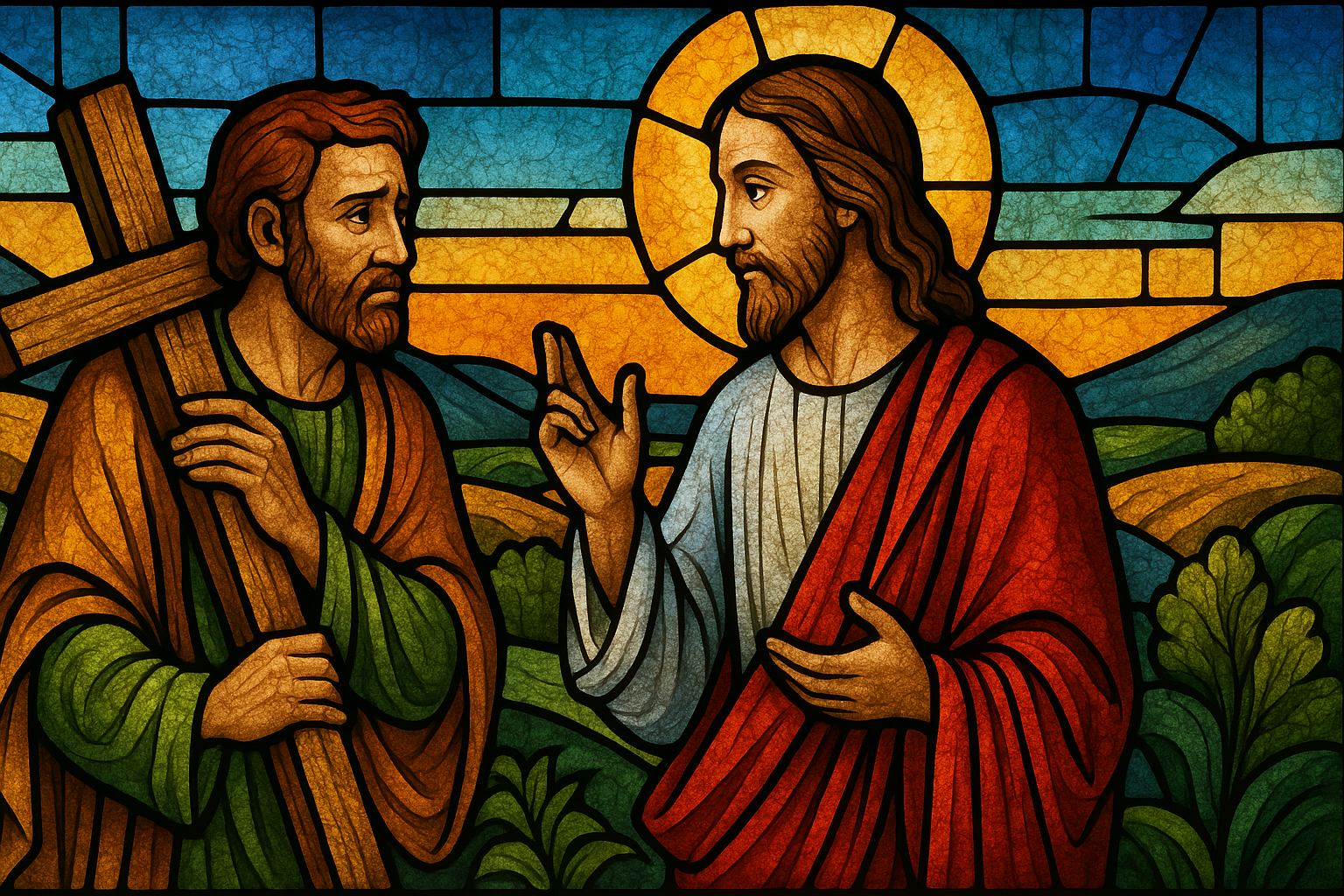
Mathew 16: 21-27
August 29, 1999
In the church’s calendar, this is the fourteenth Sunday after Pentecost. It is not a particularly dramatic moment in the church year, and it is totally overshadowed by the fact that this is also the Sunday after the opening of the Arizona football season. Now that is a date that we can really get our teeth into.
On the Sunday after the beginning of our football season, the coaches are talking about getting back to basics. Blocking, tackling, and running are on their mind. So, in the spirit of the season, I would like to talk to you about some of the basics of our faith. I want to briefly say something about God, Jesus, and the church.
First, about God. Many people in and out of the church have come to the conclusion that there is a God. People have figured out that if there is a creation, there must be a creator. And many non-church people have found some sort of pattern in the universe. Therefore, they are willing to conclude that there must be some hand that shapes it all. But after this step, trouble begins to brew. The next question often raised is, ‘What kind of a God is it that fashions our world?” For some, whose world is pretty secure, this God is all about peace and joy, and goodness. These people often come to church to give thanks to God. But for others who are less fortunate, homeless, or are victims of hatred or deprivation, they have come to the conclusion that if there is a God, he is indifferent or irresponsible, or maybe even downright cruel. They often absent themselves from church. The data on God seems too confusing and unpredictable. We often feel lost and hazy in an attempt to make sense of this God. When we come to church, preachers attempt to tell us that God understands our confusion and therefore has given us a hint. The church word for that hint is revelation. We know that God is beyond our understanding, but we have a hint in Jesus. As Jesus said about himself, “When you have seen me, you have seen the Father.”
All of this sounds really good, except that the Jesus we often are shown has been distorted or made complicated and theological to fit our prejudices. Well-meaning preachers have tended to confuse our picture of Jesus. It’s as if when we come to church, we are looking to learn about the simple multiplication tables, and we are handed a lecture on quantum physics. And we often walk away saying, “Yes, I believe in Jesus. I just don’t know what I believe about him.”
But today we’re going back to basics. And in order to do that, I would share with you three things I have learned along the way about Jesus.
First, whatever else Jesus was, He was a human being. He wasn’t God dressed up as a person. If that were the case, God would have been play-acting, and all the suffering and agonies would have been unreal, a show, and not worth talking about.
No, Jesus was human, just like you and me. Which means he was not in control of the events around him. In today’s Gospel, we see that He sensed that he was headed for trouble in Jerusalem, yet there was little he could do to change the feelings of the religious leaders who resided there. We often think or hope that doing God’s bidding will make us content, successful, or happy, but it didn’t work out for Jesus, for he couldn’t alter the course of some events, and neither can we. God reveals to us that even Jesus was unsuccessful, for he was as vulnerable as we are to events and people.
Second, Jesus didn’t have all the answers to life’s questions. He gave no philosophical explanations to why there is pain and suffering. He was never able to explain the nature of evil – why evil sometimes triumphs on the throne and goodness ends up on the gallows. He didn’t have neat answers to a lot of questions we raise today. You must always remember that many of the issues that we face in our post-industrial age were not part of the thinking of a first-century Jewish man. Even though Jesus didn’t have many answers, this didn’t stop him from growing and expanding as new situations presented themselves. A case in point was his encounter with a Samaritan woman at the well. Male Jews of that day did not talk to women in the streets, and certainly not to a loose-living Samaritan woman. But Jesus did, and through that dialogue, He changed his understanding of God’s love. It’s not so much that Jesus provided us with answers. Rather, we were able to see that He was able to risk struggling with difficult questions of his day. We can also see that as he struggled, he grew as a person, which should give us all hope to struggle with the difficult issues of our day
The third thing I’ve learned about Jesus is that he wasn’t very interested in doctrines or rules, or in being particularly pious. Beliefs and morals have their place. We need to have certain rules, certain boundaries, if we are to live together. This is why the Ten Commandments make sense, even today, when so many people think that anything goes as long as you feel good.
For Jesus, the only rule that had total validity was the rule of love. Others are helpful, but without love, all the regulations, all the habits of piety, all the sacramental rites, all the biblical studies, don’t amount to anything but wasted motions. Loving and being loved, this was at the heart of life.
These, then, are some of the basics about Jesus that I learned later in life. Now, you might be asking (at least I hope you might), how can we learn more about this enigmatic hint of God? And a quick answer might be, “Come to church.” Watch out. We preachers are always slipping in commercials.) But seriously, I’m more interested in warning you that coming to church will not necessarily do it. Jesus and the church are not the same thing. The church is where Jesus hangs out. But this wildly, inclusive, loving, risk-taking person is a far cry from the exclusive, status quo Christianity that often characterized churches.
For centuries, the church has been telling people that God does not love them unless they were baptized, belonged to a particular denomination, understood the Bible according to specific interpretations, and lived in certain ways. And this just isn’t true. When the church does that, it is wrong. It has become a distortion of Jesus. And when it acts in this way, we have to remind ourselves that the church is not Jesus. Yet, we have to say that the New Testament writers saw the church as an extension of Jesus’ life. He said it himself. “When two or three are gathered in my name, I will be in the midst of them.” So, however we may distort the picture of Jesus, this is where we will encounter him.
Well, there you are. Some of the things I’ve learned through the years about God, Jesus, and the church. Some of the basics that often get misinterpreted or misunderstood. Even in the church, we forget whom we have come to meet. Even in the church, we often begin to think we are the creators, and God is our creation.
During the summer, I read a book of meditations by a wonderful, feisty, Roman Catholic nun, Joan Chittister. In one of the chapters, she shares a little parable. “Sister Rachel had a dream”, she starts off. “There was a great mail-order catalogue from heaven. In it, you could order Jesus by mail. Jesus came in two kinds. One in a long golden robe, with a Godlike, serene, holy look in his eyes, and lights emanating from his ethereal-looking body, and another in a blue robe, with a pointed hat that had written across the words, The Answer Man. In this dream, you could send off for the Jesus of your choice. There was, however, a catch. You never got what you ordered. Instead, you got the real thing.” And this, Chittister suggested, is what made sister Rachel’s sleep so restless. Pray in the months to come that we may be made restless and be presented with the real thing. In the months to come, may we gain an understanding of God, Jesus, and his church.
Amen
Back to Basics
Back to Basics
August 29, 1999
Scripture: Matthew 16: 21-27