Consumerism vs. Compassion
Luke 16: 1-3
September 24, 1995
Listen to the words of Amos: “Hear this, you who trample upon the needy and bring the poor of the land to an end.” Who me? Surely, he isn’t referring to me. A church-going, card-carrying, collar-wearing Christian. But then again, it is to the religious person that Amos targets his message.
I have a confession to make. I don’t like prophets. They make me uncomfortable. They have a way of saying things that make us feel, at best, slightly dissatisfied and, at worst, downright guilty. They challenge the status quo and force us to look below the surface of our actions. Prophets call into question our priorities and our values.
Let me introduce you to four prophets. Their words, their actions, and their lives have made me distinctly uncomfortable through the years.
The first is a writer of soul-oriented psychology. his name is James Hillman. In one of his articles, he says, ‘We have become the incarnation of our credit cards. We, in America, know a lot about getting, saving, and spending, but in the process, we have basically developed an impoverished imagination. We have forgotten about giving, sharing, and loving.” And that amnesia, Hillman predicts, is going to make us all beggars at the same time that we are the richest nation in the world. Hillman ends his analysis by saying, ‘We have learned to deal with each other because we are a nation of dealers. But we’ve never learned to love each other – and therefore, we’re rapidly becoming the third world of spite.
When I hear something like that, I feel a certain disease. I find myself asking what’s the most important object on my person – the one thing I could least afford to lose. It suddenly occurs to me that it’s my credit cards. When that realization comes, I want to put down Hillman and pick up a novel – preferably with a happy ending. I want to be alive, but only slightly. And I don’t want some prophet shining God’s light upon my life.
Another contemporary prophet, in my estimation, was Mahatma Gandhi – not a Christian, but a voice that often used Christian metaphors.
As Gandhi looked at our Western culture, he said that we were subject to seven deadly sins similar to the medieval sins, which led people to hell.
The first was wealth without work, which he felt was the root cause of our gross consumerism. The second was pleasure without conscience. Our society, he felt, was on a constant search for happiness that we call fun. This easily leads us to having a good time without weighing the consequences. Knowledge without character is the third sin. We have lots of technical know-how, but we are impoverished when it comes to knowing how to use it.
The fourth is science without humanity. Our technology is way ahead of our capacity to deal in a humane way with the world we are constructing. The fifth sin Gandhi mentions was politics without principle. Over 50 years ago, he predicted that when political campaigns were undergirded by advertising, candidates would ride any horse as long as it meant a good image and thus votes. The sixth sin was worship without sacrifice. And here he questioned the notion that we could relate to God without it costing us dearly. Finally, he mentioned commerce without morality. This was the sin of spending money without a thought of returning it to its rightful owner.
Prophets like Gandhi remind us that our actions do matter. And that there are such things as deadly sins which can lead us to perdition. What these prophets are trying to tell us is that life is not like the Burger King ads, which tell us: “Have it your own way.” Just hold the pickles, and we’ll have a little bit of relish. When I listen to Gandhi’s deadly sins, I begin to get the feeling of that old-time hymn, “It’s me, It’s me, It’s me, O Lord – Standing in the need of prayer.”
My third prophet is a 78-year-old Albanian nun named Teresa Bojaxiu, better known as Mother Teresa. Several years ago, this world-renowned figure came to Washington, D.C., to establish an outpost for nine of her sisters of charity. She could have commanded an airport welcome by a host of government bigwigs, addressed a joint session of Congress, or attracted thousands by preaching at one of the great Cathedrals of the city. Instead, she went as inconspicuously as possible to a troubled and neglected corner of the city. She went to an old red brick church. A reporter followed her into that stark church with its cracked, chipped plaster walls and asked her what she hoped to accomplish in this place. “The joy of loving and being loved,” she answered with a smile. The reporter looked puzzled and said, “That takes a lot of money, doesn’t it?’ Mother Teresa shook her head, “No, it takes a lot of sacrifice.”
In a culture where money speaks – where our self-worth is often judged by our net worth – where appearances are so important that we are taught to dress for success – where we are quick to balance budgets on the backs of the poor and less fortunate parts of our society that diminutive woman with a wrinkled leather face was talking about sharing, suffering, and caring for people who are dying. When I read the paper in the morning, I wonder whether we are living on the same planet as Mother Teresa.
My final prophet is Jesus, who is a part of that prophetic tradition that includes Amos, Hosea, Jeremiah, and all those Old Testament giants who see the world through God’s eyes, and call us to re-evaluate our cultural norms.
Jesus was a prophet. He was more than that, certainly, but never less than that. Many theologians have pointed out that he was put to death, not because he was a teacher, nor because he was spiritual, but simply because of his prophetic pronouncements.
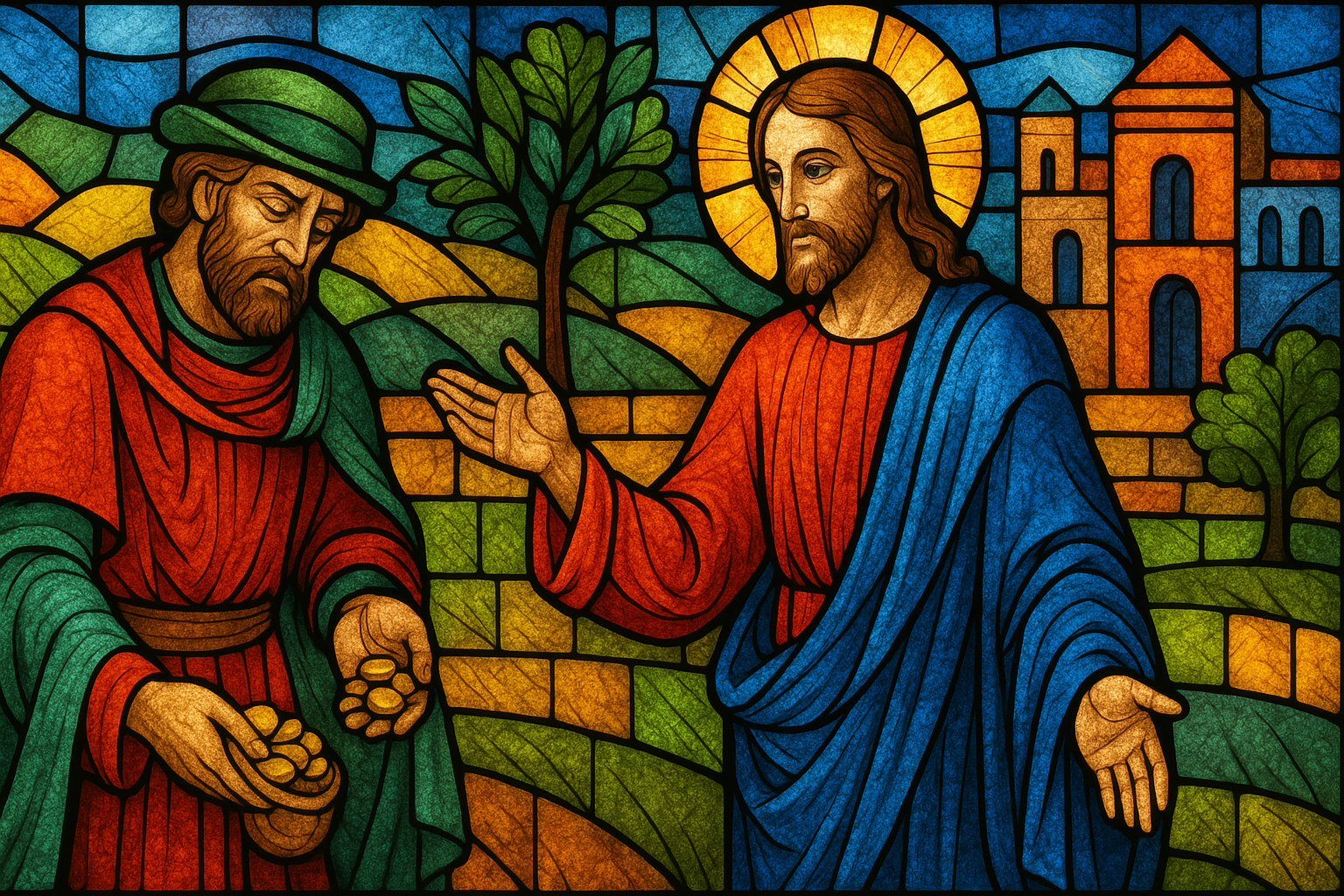
The parable that we read this morning is sometimes called the parable of the unjust steward, and is much more of a prophetic word than we often think.
On the surface, as a teaching, it seems to be an outrageous story. A money manager is about to undergo an audit by his boss. In order to gain favor from his customers, he begins to discount their indebtedness. And here is the bizarre part. When the boss finds out, he commends his employee. Ridiculous, you say, but this is not a primer on successful business practices. If we were to look below the surface and see this story as a prophetic utterance, we would see it in a different light.
As a prophet, Jesus is raising questions, probing our cherished values, and asking us to re-examine our priorities. Beneath the surface, the story is asking, “Are we here to make a profit? Do we see people as primarily consumers? Are we a nation of dealers? Or are we here to show compassion and reach out to those less fortunate? Jesus ends with pointing out that you cannot serve the God of consumerism and the God of compassion at the same time.
Prophets – they make me uncomfortable. I sometimes wonder where the prophetic voice is today when I read about the disadvantaged in our world. The other day, I passed a car with the bumper sticker: “Born to Shop,” and I began to ask myself, “Are we born for shopping or for loving?” Consumerism vs. compassion. Taking care of ourselves or watching for the needy. You can’t serve both those values. He, she, who has ears to hear – let them hear. . .. AMEN
Consumerism vs. Compassion
Consumerism vs. Compassion
September 24, 1995
Scripture: Luke 16: 1-3