Easter
Luke 24:1-10
April 12, 1998
“Sir, could you say a word or two about the resurrection of the dead?” Some bright college students put this seemingly simple question to Caryle Manley, one of the great Protestant preachers.
“I will not discuss that with people like you,” he replied.
“Why not?” they asked.
“I don’t discuss such matters with anyone under thirty.”
“Why?”
“Look at you, ” he said. “Prime of your life, potent, never have known honest-to-God tragedy, failure, heartsick, defeat. So what in God’s name can you know of a terrible world that only makes sense if Christ is risen?”
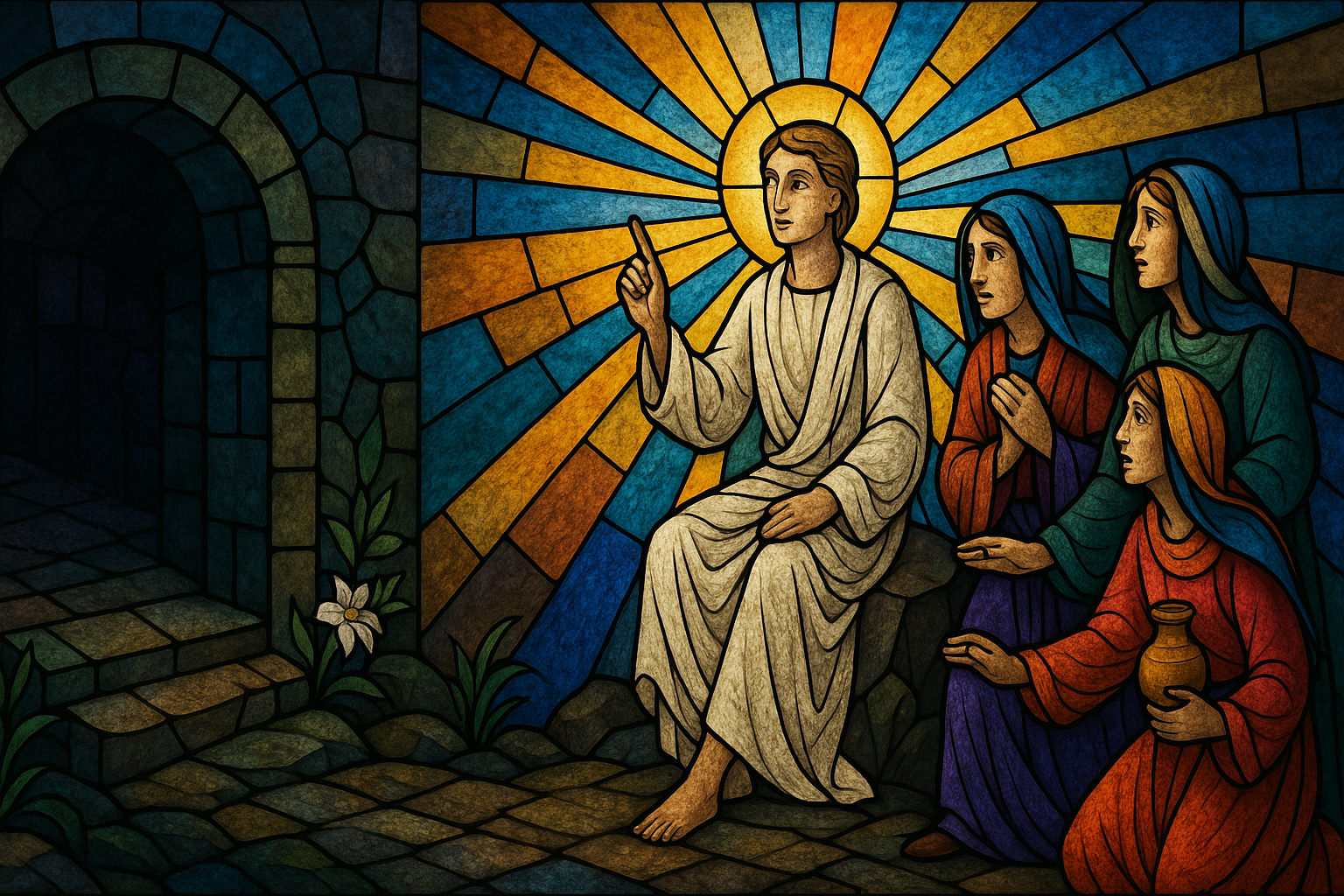
The story of Easter begins with tragedy. Three women come to anoint the dead body of Jesus. They approach the tomb, which symbolically represents the end of all their hopes and dreams. And when they arrive, they discover something beyond their dead ends.
In light of this story, I would like to talk to you about dead ends and what can happen to your own dead ends.
Unlike Manley, I really believe there is no one who hasn’t experienced a dead end – a marriage coming to an end, a child that has died, a job being terminated, a dream abandoned, a relationship severed. Dead ends, we’ve been there. And for most of us, my guess is that when we hit a dead end, there is rarely any light at the end of the tunnel. It’s as if the dead end represents an unalterable wall.
And so it was with the three women. They trudged to the tomb believing that the light had gone out of their hopes and dreams. Their teacher, their leader, their friend, had been killed. And when they reached the tomb, they discovered a young man who said, “Why do you seek the living among the dead? Do you remember what He told you? Can you recall that audacious, fanciful assumption – the message that love will conquer everything – even death?” Do you remember? And more importantly, do you believe? Do you believe that dead ends are not necessarily terminal?
The Easter story is about something that God does with dead ends. Jesus died, was crucified, buried, and then He came back. This is what we celebrate today. But it is not all that we celebrate. We also celebrate that we, too can come back. Not always in the way we might choose. But today we are asked to remember that God does great things with dead ends. From barren wombs, God can bring forth a child. From dry bones, God can form a people. From the dead, God can bring about Resurrection.
In his autobiography, Frederick Buechner recounts how he learned this lesson. For some fifty years, he had been haunted by his father/s suicide. For Buechner, the weeping had never stopped. It was as if the day his father died, he also died.
Many years later, under the guidance of a Jungian therapist, he began an exploration of important people in his life. The therapist has him write dialogues with figures in his past. Listen to how Buechner found new life in the dead end of the relationship with his father.
(He wrote):
Child: How are you?”
Father: “I’m fine.”
Child: “Long time no see.”
Father: “It’s been a long time.”
Child: “Were you sad, Daddy? Did you know what you were going to do when you took your life?”
Father: “I had to do it. Things were so bad. It didn’t seem as if there was a way out.”
Child: “Could I have stopped you, Daddy? What if I had told you I loved you, I needed you?”
Father: “No. Nobody could. I was lost so badly. It felt like I had come to a dead end.”
Child: “I’ve been so worried, so scared ever since.”
Father: “Don’t be. There is nothing to worry about. That’s the secret I never knew. But I know it now.”
Child: “What do you know, Daddy?”
Father: “I know plenty. And it’s all good. I will see you again, for remember, there are no dead ends.”
Buechner says he does not know where that dialogue came from. Who can say whether it was real or made up? But in some mysterious way, it sounds like the message delivered at the tomb: “Why do you seek the living among the dead? On the third day, He shall rise.”
If we can only remember. If we can only keep our ears open to this message. Life doesn’t end. Death is not the last word. Do you hear? Do you believe? Dare we say, “Alleluia?” Amen.