“FINDING THE LORD IN THE VALLEY OF DRY BONES”
Ezekiel 37: 1-14
May 13, 1984
It has been one heck of a week. During most of the time, bad news has rolled in like waves on a beach -one tragedy after another. Everyone I have talked with appears to have been affected by an untimely death, or the murder of a child, or a broken marriage, or a serious, just-discovered illness. The dominant note of the past week seems to have come from the pit of despair.
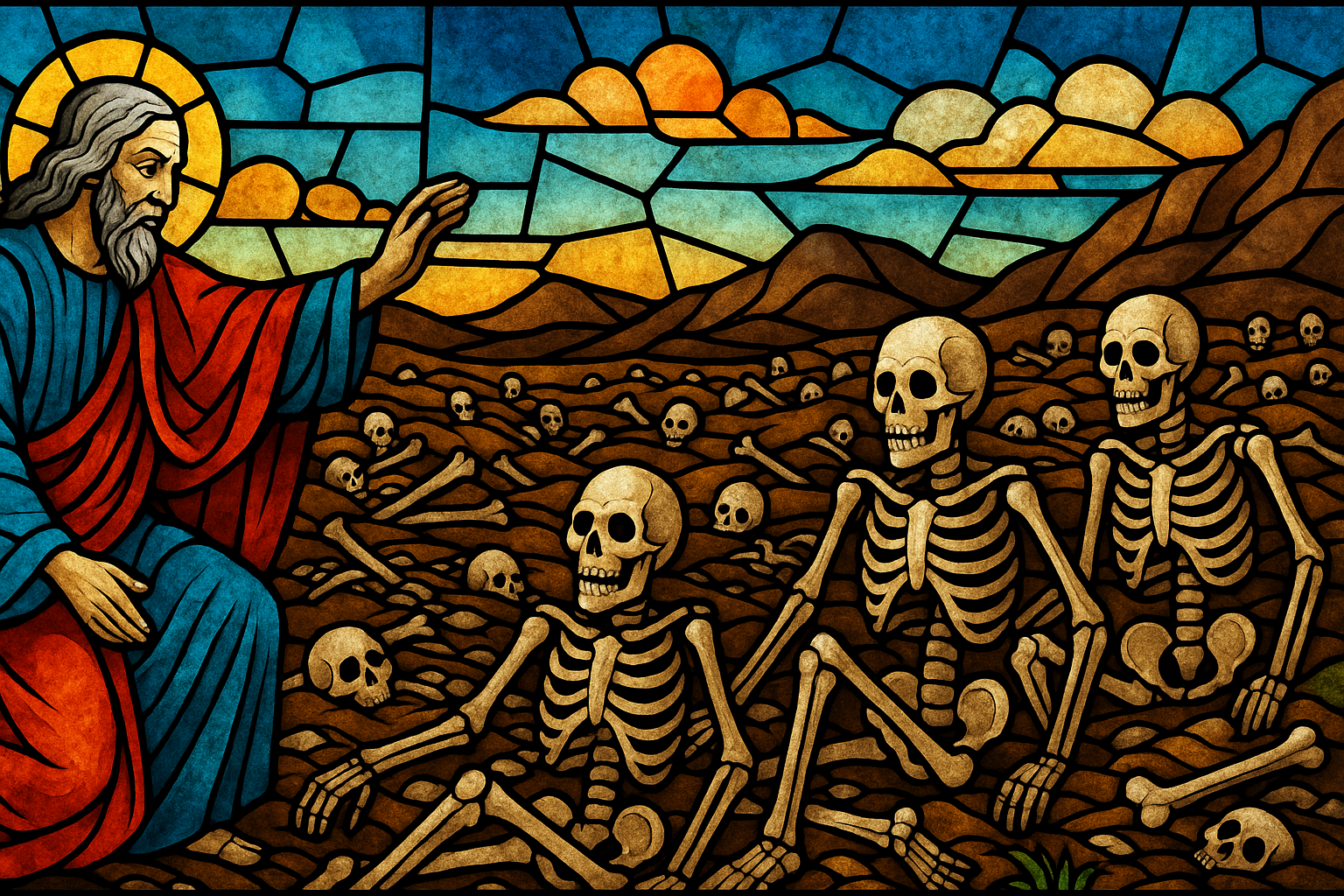
Ezekiel, more than any other writer of Scripture, describes the feelings that many of us have had. He uses the symbol of the Valley of Dry Bones to portray the plight of the Hebrew people. Here is the image for all who feel as if they are in the depths of desolation — cut off, lonely, betrayed, confused, hurting.
You will recall that Ezekiel describes the people of Israel as dry bones- bones without flesh or sinew, separated and cut off from one another, scattered across the valley, and in that vision, the Lord asks Ezekiel if those bones would ever live again. Ezekiel answers from the bottom of that valley, “Lord, thou knowest — not me. ”
Have you ever felt that way? When you are really in the pit of despair, you are not sure that you will ever climb out. In times of dry bones, there is neither hope nor promise nor anticipation that things will ever get better. People tell me they feel numb, cut off, bones without flesh, more like puppets than human beings. And for the most part, people are convinced that tomorrow will just bring more of the same.
Sometimes we are asked, or ask ourselves, if our bones will ever live again, and the best answer we can come up with is: “Lord, thou knowest — not me. ” I can see in some of your faces that you have been there before. You know what it is to be in the valley of dry bones, and it’s not pleasant, is it?
But here is another learning, which I discovered as I meditated on Ezekiel’s vision. It seems almost obvious, but let me simply underscore it, and that learning is that people do not enter or remain in the valley of dry bones because they like it, or think it is an appropriate place to be, The pit is not a place consciously chosen, but we really have little choice when circumstances propel us into valleys.
One of the lay readers spoke to me on Friday and pointed out that Ezekiel was a “downer” for Mother’s Day. All I could say was that it didn’t seem right to have a cheery lesson put a happy smile over a week filled with tragedy, and sometimes, even on Mother’s Day, we can learn more from the lowlands than from the high spots.
All this brings me to my next point. I learned from Ezekiel that the valley of dry bones is often the place where the Lord is found. To use Ezekiel1 s image: Here is where God is to be found breathing life into dead bones,
That seems strange, doesn’t it? Here in the most terrible of places, in the pit of despair, in the valley of dry bones -here is where the greatest gift is to be found. It is almost unreal, isn’t it? You would think that new life would happen on the mountaintops, where things are going well, where we are happy, feeling confident, feeling successful. But not so; Scripture says it happens in the valleys.
Someone once said that the opposite of “real” is not false”, but the opposite of “real” is ‘fantastic”. And this certainly is a fantastic truth contained in Ezekiel- the truth that God comes to us in death situations, breathing new life into the broken spirit, into dead bones. It is a fantastic truth, but to Christians it ought not to be surprising, for it is the truth of the Resurrection.
Well, what does all this have to do with Mother’s Day? I can see many people here with ‘ parents to celebrate this special time. Let me try to tie this day in with the. Valley of dry bones,
At the outset I would declare that, despite the TV and pulp magazines portrayals of family life, much of it is often characterized by living in the pits rather than on a series of pinnacles. And that’s not bad; it’s just difficult. Therefore, I salute mothers who allow their families to remain in the valleys without avoiding or trying to gloss over the low points of family living.
I read a piece from a book by Adolph Guggenbuhl-Craig about family life. In this book, Dr . Guggenbuhl-Craig, an eminent Jungian psychiatrist, poses a key question for every family relationship/ He asks us whether we see the family as/an arrangement designed to do with well-being or with salvation.
That is not an easy question . Essentially he wants to know whether we see the family as a place in which we grow, where we find healing and, ultimately, where we find God. Or is it a place of comfort, happiness and peace? This distinction, he tells us, is terribly crucial to family life. Listen to his/words :
“For the sake of/our well-being, we are urged to be happy, A happy person sits at his family table among his loved ones and enjoys a hearty meal. A person who seeks salvation wrestles with God, the devil, and the world. He confronts death.”
And, we might add, he finds himself or herself walking in the valley of dry bones more often than not. But remember: Even in that valley God can and does breathe new life into broken and separated bones.
Our New Testament lesson, the Lazarus story, is in many ways a parallel to Ezekiel’s vision. it is also a Resurrection story of God’s breathing new life into dead bones,
Lazarus dies, and Jesus weeps. This tells me that he does not take pleasure in our dying, yet he lets them happen. Jesus is not like the anxious parent who tries to protect her child from all difficulties. Instead, Jesus grieves, waits, and stands at the door of the tomb. Then he calls Lazarus by name. “Come out, ” he says.
He does this to teach us that God can and does breathe new life into dead bodies. The great Resurrection message is always the same: God can and does breathe new life into dry, decaying, dead bones.
One last thought: I often feel, after weeks like this one, that they are simply an accident. They are intrusions on my fairly regulated, even-keeled existence. And sometimes think weeks like the past one are indignities to be avoided at all costs.
But the Bible says that dry bones and graves are very much a part of life, and even goes so far as to declare that they are sources, or at least places, where new life happens. I find that irksome and inconvenient; it is not the way I would do it. But it is true, and it is a fantastic truth, it is the truth of the Resurrection.
So, those of you who are in the valleys, remember: We look for salvation, not merely happiness, and we receive a tremendous Mother’s Day gift — the gift of new life when we hear the words: “Lazarus, June, Roger, George, Peggy, come out. ”
What a fantastic Mother’s Day gift from God our Mother and God our Father!
Amen
“FINDING THE LORD IN THE VALLEY OF DRY BONES”
“FINDING THE LORD IN THE VALLEY OF DRY BONES”
May 13, 1984
Scripture: Ezekiel 37:1-14