“Giving – A Blessing Or A Curse?”
Acts 4: 32 – 5: 11,
Luke 16-21
October 16, 1994
Today is the official beginning of our canvass. Actually, the clock started ticking last night. The time for St. Philip’s is now. But I will let you in on a clerical secret. This is the worst time of the year for most clergy. It is the time when parishioners seem to be at their pickiest. It is the time when we lose sight of our generous selves and bring out our critical selves.
One of the most fascinating parts of Holy Scripture is that we can usually find ourselves mirrored in those ancient stories. Even on a day like this, there are to be found characters with which we might identify.
Take the story as found in the Acts of the early church. They, too, had financial problems. We tend to idealize our picture of these early times, and, for the most part, it was a Utopian time. There was an openness, trust, and generosity that was hard to describe. Most everyone looked after everyone else. Yet, like any institution, they still needed money for the mission of the church. And they still had deficits.
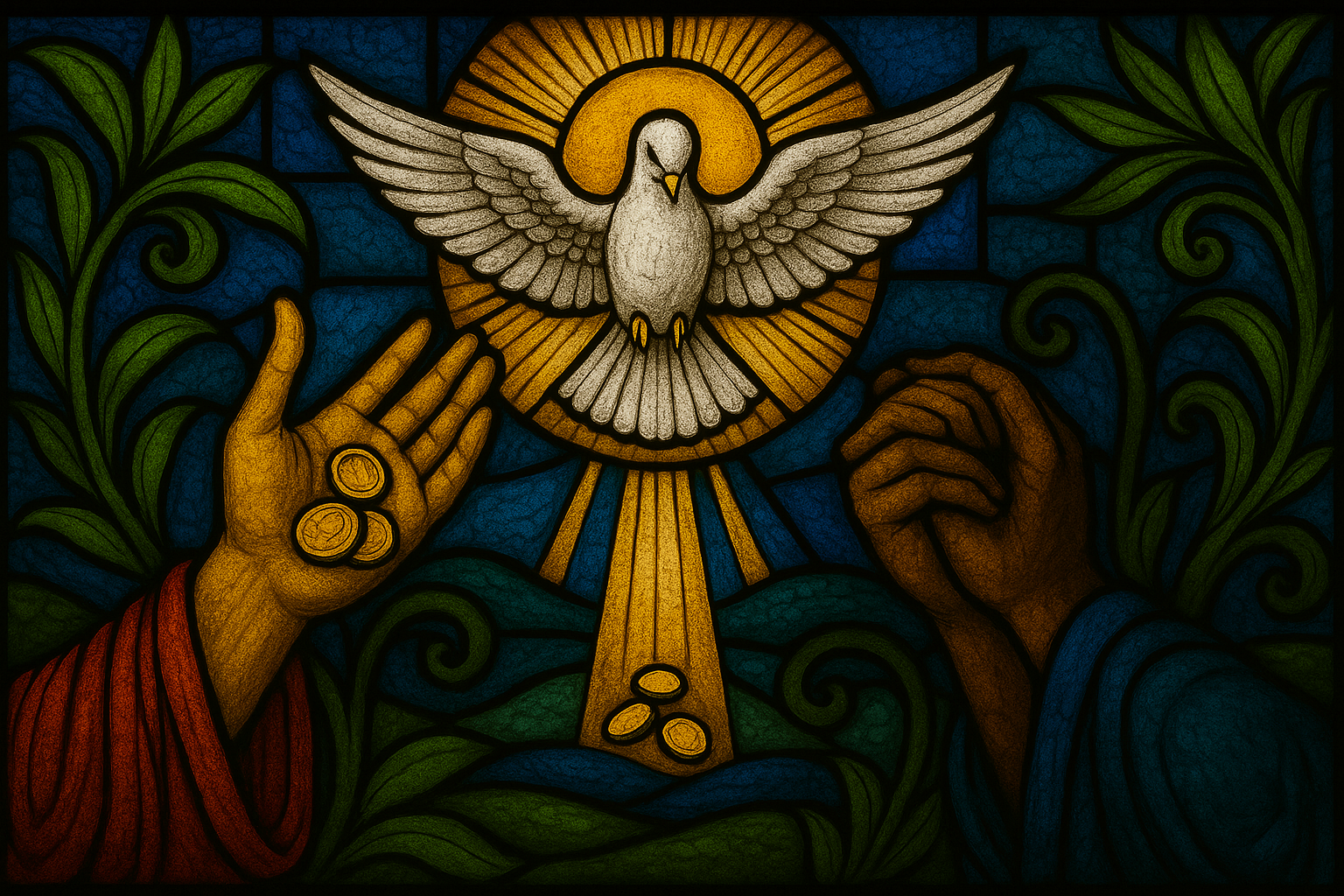
One of the first people we run across in the story of the early church is a man named Joseph, also known as Barnabas. Joseph must have been a well-off member of the church. And when he was told there was an economic need, Joseph immediately sold a piece of property in his native Cyprus and came with all the proceeds of the sale, saying to the disciples: ‘Disperse this money as you see fit.”
It was an electrifying act of generosity. It was a public sign that Barnabas really understood that he was a part of a community of abundance, and not living by a philosophy of scarcity.
It is simply amazing how an act like that of Barnabas can greatly influence and change the climate of a community. Every year I hope we can convince people to be more open about their generosity. People pledging five or ten or twelve thousand a year ought to go public about their support. But every year, people say to me: “Oh, I wouldn’t want to be boasting, or it might make others feel bad.” Well, whatever happened to the notion of encouragement? That’s what the name Barnabas means – “Son of Encouragement.” And thank God we have his witness. Believe me, I’ve never had anybody feel bad or guilty because someone can give more, as long as they are doing the best they can. It’s only those who give token amounts who object to knowing that someone is contributing more. I wonder how many Barnabas’s we have here at St. Philip’s.
Now, there was a couple in that early congregation who were greatly moved by Barnabas’ witness to generosity. They probably came home from church saying, ‘You know, what Barnabas did was magnificent. The church still has more needs – we’d like to do the same, not as much – a small piece of property over on the west side.”
They proceeded to sell a piece of their property to do what Barnabas had done. But somewhere between their intention and the actual deed, they began to experience some internal conflict.
And here I’m influenced by Elizabeth O’Connor, who reminds us that no one is a simple self. We are made up of many selves. She uses these words: ‘We are a parliament of persons.” Our personalities are made up of a whole bunch of ‘selves.” And so in my imagination, I would guess – since the Scripture doesn’t go into details – that Ananias and Sapphira began to have a conflict of selves.
The heroic or generous self applauded the act of generosity. But somewhere between the selling and the giving, the fearful self began to rear its head. ‘How do you know,” the fearful self would say, “that you’re going to be able to meet all your other expenses? Who’s going to take care of you when things are scarce and you get too old to earn a living?”
Or maybe it was the artificial self that emerged_ the critical self that says: ‘How do you know that the church leaders are going to spend your money wisely? There seems to be an awful lot of waste and mismanagement. Why should you sacrifice when you don’t agree with where all the money goes?”
Or maybe the jealous self rose to the surface. The jealous self who compares what you do with others. The jealous self might say something like: ‘Why should I give so much when my neighbor isn’t doing his share?” Or, “I will not receive the same credit as Barnabas did, and therefore it’s not worth the sacrifice. He was made a hero and written up – put on the ruling council – that won’t happen to us.”
Well, I believe that’s what happened to Ananias and Sapphira but I wonder if there is anyone here who has not been plagued by these same negative selves, particularly at canvass time. Let me go even further out on a limb – for during canvass sermons I usually end up offending someone, or so they tell me. If you have felt these negative feelings, you probably are not making a real Biblical pledge. For Scripture is a mirror into all our souls.
But, back to the Ananais and Sapphira story. This, is you’ll recall, is a story of tragedy. Not simply because they let their inner negative selves win the day. Not because they chose the low road and held back a significant portion of money. This is a story of a tragedy because of their dishonesty. They tried to pass off their pledge as a significant gift when it was only a token. The story goes that Peter confronts Ananias with what he is doing, and the shock of it is so great that he keels over and dies.
Notice, carefully, that it was not that Ananias and Sapphira had to give anything. It was all voluntary. The problem was that they claimed to be taking the high road to generosity when they were really on the low road of fear, distrust, and jealousy. And so their gift, instead of being a stepping stone for growth in the Kingdom, became a stumbling block that led to spiritual death
Jack Benny, the comedian in the heyday of radio, used to have a routine that some of us who are a bit long in the tooth remember with fondness. It was about his tightness with money. You recall that Benny had a reputation for miserliness, and many jokes were made about his cheapness. On one occasion, the script had him being grabbed by a mugger who said: “Okay, Benny, your money or your life!” There was a long, long silence – Benny’s timing was always superb. Finally, the silence was broken by his saying: “I’m thinking, I’m thinking
Ananias and Sapphira stopped thinking and hoarded their money – and therefore, they died spiritually. Your money or your life. The time to make that choice is now. The only way we can do this is if we discern that a canvass has really nothing to do with supporting the work of the church. A canvass is a time of choice between the high road of generosity and the low road of fear and criticism. The choice is yours. The time is now. May your pledge be an instrument of blessing during this canvass. AMEN
“Giving – A Blessing Or A Curse?”
“Giving – A Blessing Or A Curse?”
October 16, 1994
Scripture: Acts 4:32, 5:11