Hebrews 11: 8-16
Matthew 5: 43-45
July 4, 1993
If we were to look back over the years of American History, as we well might on this national holiday, I don’t think there would be many here who would conclude that we are living in the best of times.
In fact, on a continuum between the best and the worst of times (to now from Dickens), I would place us somewhere on the downside – on the worst side of the equation.
It is true we’re not in the midst of a war. And there doesn’t seem to be any national crisis. But yet, if we reflect on our history, we might realize that we began with a dream of creating a heaven on earth, of alabaster streets, of plenty for all, of welcoming the sojourner. And now we live in a nation where city streets are littered by the bodies of the homeless, a fifth of whose children go to bed hungry if they are lucky enough to have a bed. And we’re quick to turn away foreigners as undesirables.
it is true – there have been other bad times in our history. Generally, though, in other bad times, we Americans seemed to have retained some sense of who we were – and where we were headed. What makes it so frightening today is that there seems to be no sense of national purpose. The American Dream is nowhere articulated.
Some of you here are doubtlessly thinking that this is no way to speak to a congregation awaiting an ice cream soda. But possibly, just because we are anticipating fun and parties, we ought to stop for a moment and reflect on the American Dream of the past
So what made this nation great? What is unique about this country of ours? What is the myth that has surrounded us all these years?
Two hundred and seventeen years ago, a group of people came together and believed they could establish a covenant with God and with each other, a covenant that would embrace people from many places and persuasions into an inclusive community of love.
The keyword in this vision is covenant. Let me remind you that a covenant is different than a set of laws. Laws tell us the right and wrong things we can do. And a covenant is different than a contract. A contract spells out procedures so that things can get done. A covenant is about relationships. It’s about how people see each other and themselves. It’s about communion with one another. This is why we talk about marriage, to give an example, as being a covenant, more than a contract or a legal entity.
The founders of our country believed we had a covenant with Almighty God and with each other. This was the heart of the American Dream.
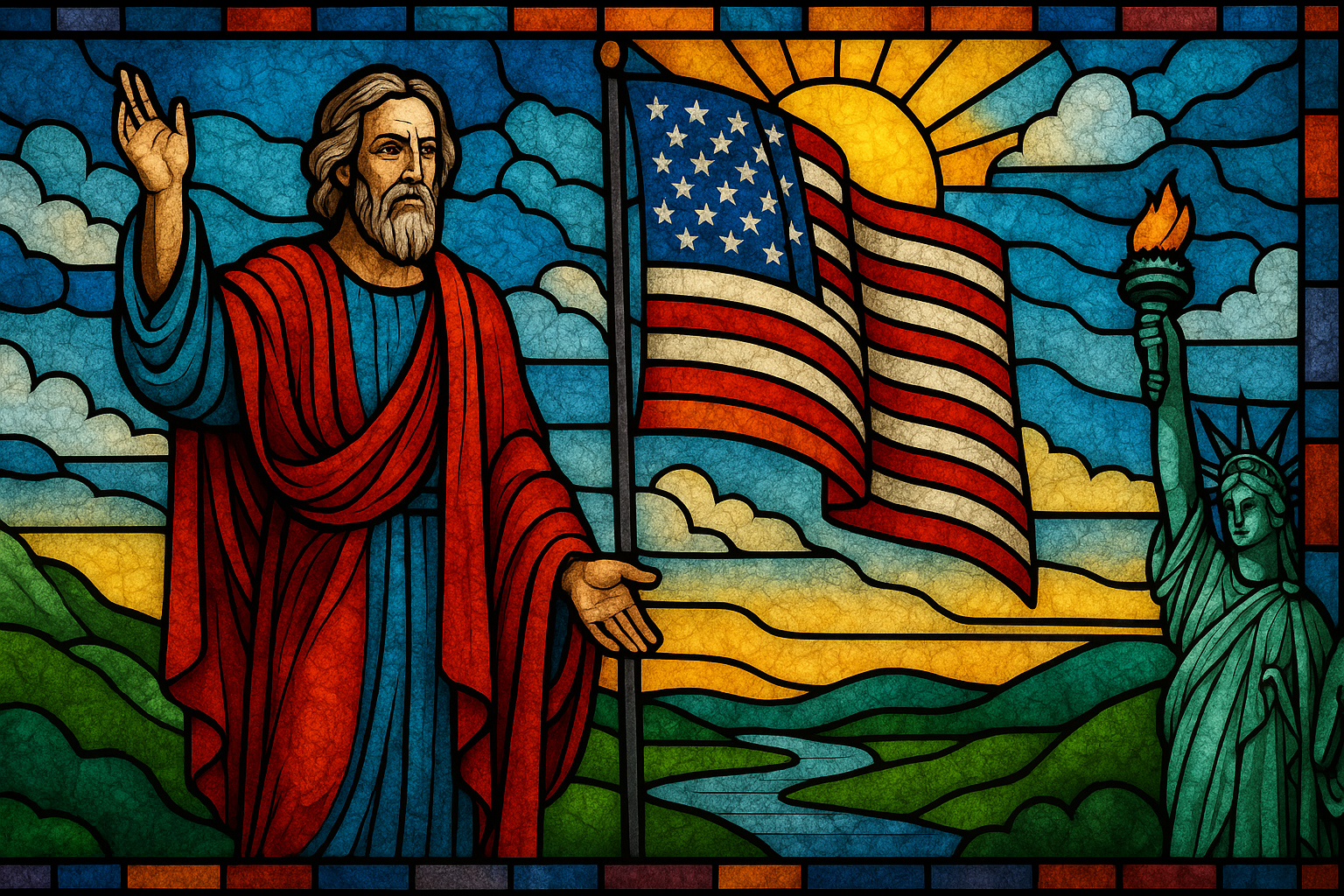
Through the years, we have lost much of our religious underpinnings of the covenant. We have talked more about a social contract and our vision saw ourselves as the great melting pot of the world. That image was symbolized by the words below the Statue of Liberty: “Give me your tired, your poor, your huddled masses yearning to breathe free.” That image has recently been severely tarnished as we’ve turned our backs on Haitians, Cubans, and Central Americans.
So, what has replaced the melting pot as a national metaphor? What has taken over from our understanding of covenant?
Soon after college, I had the privilege of working on the Lower East Side of New York City. This was an amazing community. Wave after wave of immigrants came here to live out the American Dream. The Irish, the Italians, the Jews, the Blacks, and the Hispanics all settled into this small section of New York City.
There were lots of fights and problems, but it was a zesty and exhilarating community. Even with the tensions, and there were many, there was an undeniable sense of community. Not so today, I am told.
The melting pot which we cherished in the 40s, 50s, and 60s has now, as someone put it, become a salad bowl. We are no longer one nation with a vision of being inclusive. We are hyphenated people. You are either an African-American, Asian-American, Hispanic-American, or Anglo-American. The salad bowl puts everyone into little boxes. We have moved from a sense of oneness to a philosophy of “separate but equal.” And where we label everything – from food to clothing – as ethnic, that is, if it doesn’t conform to our own hyphenated category.
We’ve come a long way from our Gospel, which says to do more than love your own kind, even love your enemies (those that are different). Today, the covenant of love that Matthew describes has been replaced by a contract that keeps the salad bowl understanding going, but still divides people into good people and bad people – enemies or potential enemies and friends. The salad bowl philosophy doesn’t have its roots in the Beatitudes – it has nothing to do with a covenant. The salad bowl grows out of a paranoid, contractual understanding, with exclusivity as its basis.
I read with interest that the Battle of Gettysburg will be re-enacted again this weekend, 130 years after the original battle. It reminded me of the scene of the 50th anniversary of the battle that I saw a few years ago. The old men came back one summer day, Confederates and Union veterans, to commemorate the occasion. The most moving part was the re-enactment of Pickett’s Charge.
The old Union soldiers took their places among the rocks on Seminary Ridge. The old Confederate soldiers took their places on the farmland below. After a while, the Confederates started to move forward across the fields where half a century earlier so many of them had died. They were not holding rifles and bayonets – instead, there were canes and crutches as they made their slow advance toward the ridge. As the Confederate troops got near the Union line, they broke into one long defiant rebel yell. Then a remarkable incident took place – a moan, a sigh, a gigantic gasp of disbelief rose from the men on Seminary Ridge. Unable to restrain themselves, the Yankees burst from behind the stone wall and flung themselves upon their former enemies. Only this time, unlike 50 years earlier, they did not do battle. Instead, they threw their arms around each other. Some in blue uniforms, some in gray – the old men embraced one another and wept.
What the old men saw for a moment – 50 years later – was that the great battle was great madness. The men who were advancing across the field of Gettysburg were not enemies. They were fellow Americans – human beings like themselves. What they saw was that beneath the fear and hostility and misunderstanding that divide this country into a salad bowl, there still remained a covenant a relationship which made them all one.
On this 4th of July, we too have an opportunity to renew our covenant with God and with each other- to be Sons and Daughters of our Father in heaven – to keep faith with our ancestors.
This is a day to recommit ourselves to the covenant where old enmities are swallowed up, and we learn to live as one. Remember the goal of the covenant is communion with God and each other – a relationship of love.
So come forward in a short while and receive Holy Communion – and renew your covenant. And who knows? – We may still catch a glimpse of those Alabaster Streets.
Amen
Hebrews 11: 8-16
Hebrews 11: 8-16
July 4, 1993
Scripture: Hebrews 11:8-16, Matthew 5:43-45