Palm Sunday
April 16, 2000
For years, on this Sunday, we have portrayed dramatically the Passion story. Several of us have taken parts, and each time we ask the congregation to assume the role of the crowd. There are only two words that are spoken, but they are repeated several times. “Crucify him” are those lines. We usually ask the congregation to shout them out with gusto.
At the end of the service, inevitably, people come up to me and say, “I felt strange saying, ‘Crucify him.’ If I had been there, I never would have said such terrible words.”
Maybe so and maybe not. If we look closely at the biblical drama, we can usually find ourselves portrayed in most of the characters. So, let’s mingle this morning with the people of Jerusalem, and see if we might find ourselves in the crowd.
Let me set the stage. Jesus of Nazareth recently had a gala entrance into the city. The crowds shouted Hosannas to a king they knew nothing about. And when he went up to the temple and upset the tables of the moneychangers, they wanted to take back their cheers and substitute a cry like, “Jesus, go home. Go back to Nazareth.”
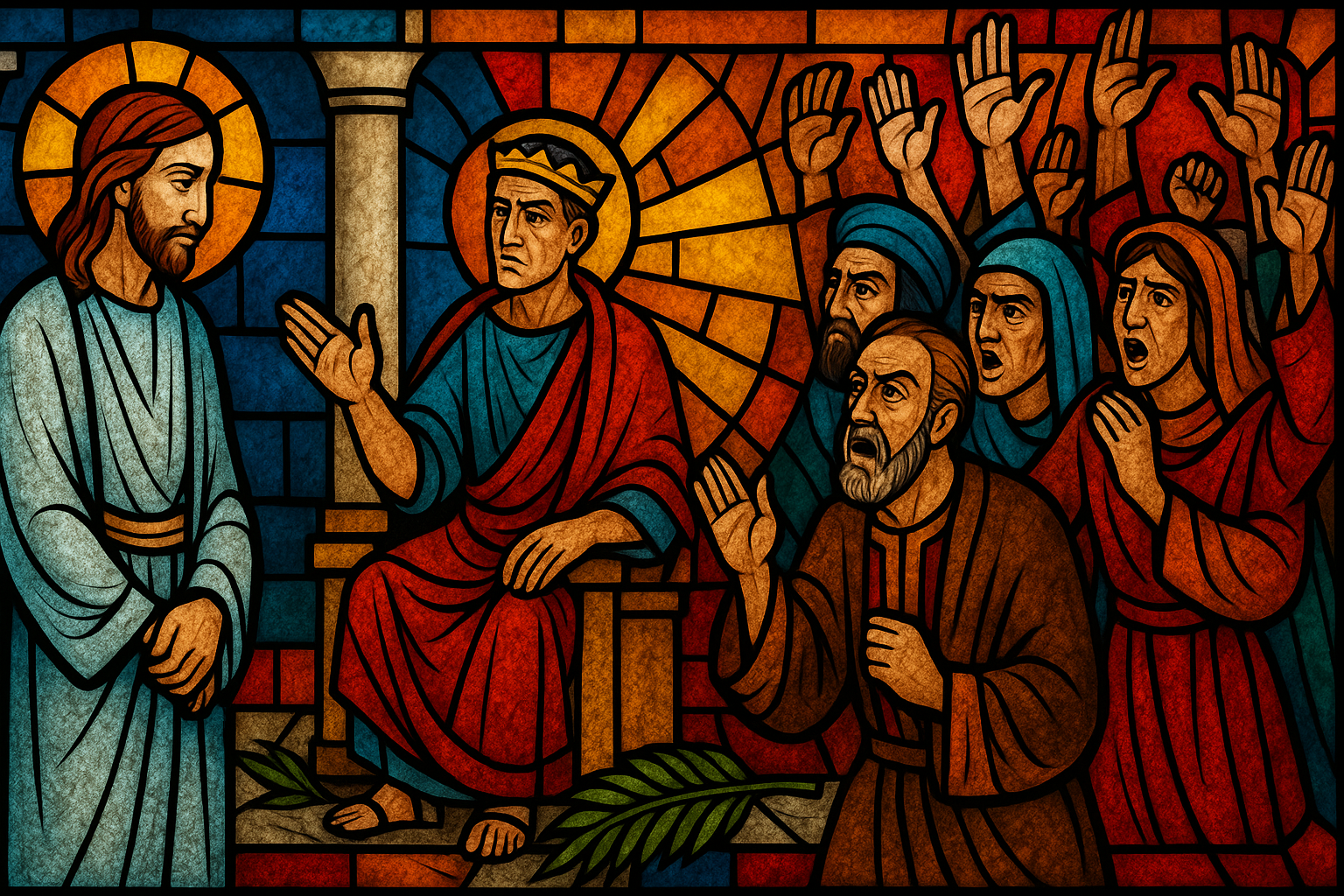
In the scene in front of us, we are in the midst of an angry crowd. Jesus is standing alone off to our left, and Pontius Pilate is in the center stage. He has just delivered the line, “What shall I do with this man?” The crowd yells back, “Crucify him, crucify him.”
As we jostle our way through the crowd, let us imagine we are reporters for the Jerusalem Daily. Our assignment is to find out just what has happened. On our right stands a well-dressed, prosperous type – the kind of person you might find on the vestry of an Episcopal church.
“You, sir,” we say, “Who are you, and why are you shouting ‘Crucify’?”
“I am Jonathan, a Sadducee,” he says, “and I come from a prominent family that has been in this city for generations. I usually don’t attend these kinds of public demonstrations, but today I am making an exception.”
“You asked why I shout Crucify, why I am here? Let me tell you. A few days ago, this man waltzed into the temple and closed down the family business. He is a disturber of the peace, a zealot who is completely out of control. As long as he said such things as, ‘Consider the lilies of the field – see how they grow,’ he was fun to have around. But when he said, ‘Consider the thieves in the temple – see how they steal,’ that was going too far. He was messing with our economic system, and everybody knows that rabbis shouldn’t talk about money. He wanted to change the status quo, and that was just too much. So I gladly shout, ‘Crucify him, crucify him.'”
Elbowing our way through the crowd, we approach another man. “Who are you, sir? And why are you shouting so loudly?”
“Are you addressing me?” he replies. “It’s not my custom to speak to reporters, but today I shall make an exception.”
“I am Samuel, a Pharisee, one of the religious leaders of the temple. It’s our job to decide who’s in and who’s out. My friends and I have been interpreting what’s right and what’s wrong for years.”
“You have asked me why I shout ‘Crucify!’ with such vehemence. The answer is obvious. The man is clearly a phony. He claims to have been called by God, yet he eats and drinks with addicts, thieves, prostitutes, and other low-lifes. And then says that these sinners will get into heaven before good, honest, God-fearing people like us. Can you imagine? Why, he even healed on the Sabbath, which everybody knows is a day of rest commanded by God.”
“I know, you’re no doubt thinking that, as a religious person, I ought to be more merciful. Well, let me tell you – he has broken innumerable Roman laws, and the government is going to make it hard on everyone because of what he’s done. Isn’t it better that one homeless rabbi, who seems quite irrational, suffer, than for everyone to suffer? We don’t need more troublemakers stirring up the people. So by all means, I will continue to shout, ‘Crucify, crucify'”
Now the crowd is beginning to disperse. The verdict has been given. The people have had their way and as they began to leave, we stop one ordinary-looking woman and asked, “You, madam, what is your name and why are you here?” “I am Sarah. Just one of the many housewives of the city. I wasn’t planning on being here. I was doing some shopping and saw the crowd, so I drifted over.”
“Why did I shout ‘Crucify’? I guess I just got swept up in the emotions of everyone else. On the other hand, if so many people, and influential people at that, were saying he’s bad, there must be something here. You know, where there’s smoke, there must be fire.”
“Yes, it’s true. I was part of the crowd shouting hosannas a few days before. Everybody else was doing the same thing. He should have left right then. It’s become apparent that he doesn’t fit. I’ve heard he says outrageous things like, ‘God is more concerned with people who are not our kind.’ Ridiculous! Everyone knows WE are God’s special people. And furthermore, we don’t need religious fanatics who have very questionable morals, telling us to change our priorities.
These are the faces of the crucifiers. I wonder if they are much different from us. Although 2000 years separate us from those who were gathered in Pilate’s courtyard, I wonder what response we might make to the question, “What shall I do with this man?”
Let’s be honest. We are uncomfortable with change, and people who advocate change are rarely made to feel welcome in our lives. Somehow, in the unconscious part of our brain, the message comes to us. If these people really want to change our system, our world may fly apart. Either people have to at in, go along, adjust, or they ought to leave.
Do you recall the slogan of the ’60s? In the height of the Cold War, people used to say, “America – love it or leave it.” And that’s what the people of Jerusalem were saying – either love the system or leave it.
Jesus refused to leave. So they ended up crucifying him. That was then, and this is now, and still Pilate asks us the question, “What shall I do with this man?”
Palm Sunday
Palm Sunday
April 16, 2000