Performance People Versus Grace People
Matthew 20: 1-16; 2 Peter 3: 15-18
September 14, 1997
It is said that we are often blind to the terrible things we inflict upon our children. And it has also been pointed out that we only become aware of these things when we see our children replicating our mistakes on their own children.
This summer I visited my son and his wife and their children. Like a lot of grandparents, found myself troubled at the way they were bringing up their three-year-old.
Whenever Peggy and I came upon the child, her parents would say, “Now, Kendyl, show your grandparents how you can sing, or how you can eat, or how you can climb.” “See,” my son would proudly point out, “she does that better than any three-year-old on the playground.”
My purpose this morning is not to become the Dr. Spock of the preaching circuit. I simply want to observe that expecting a child to produce, to accomplish something for her grandparents’ approval, is a step into the sickness of our culture. It’s what turns us into “performance people.”
“Performance people” are people who grow up feeling that what they do, what they accomplish, is to be measured by some outside audience. And it is this audience (your grandparents, your peers, your co-workers) that tells you whether you are a good person or not.
Caesar Augustus is the perfect example of a performance person. While he was dying (A.D. 14), he is reported to have said, “I’ve played my part well. Dismiss me with applause.”
But what about yourselves? Are you expecting applause? Does your self-worth depend upon the approval rating of some group or person? Do you think you are onstage, and therefore are concerned with looking right, being viewed as a winner, acting like a success? If you have any of these feelings, you’ve probably been brought up as a performance person, and the chances are likely that you’ve passed that on to your children. You might even be like some people I know well, who would secretly like applause at the end of a sermon . . . Crazy, but that’s what performance people often need – the recognition that they have done something that others see as good – and that they have received some appropriate reward. Applause money – a medal.
But consider for a moment our Gospel lesson. Jesus shocks his listeners by declaring that it’s not the high performers who will be first in God’s kingdom. Some who are last will be first, and some who are first will be last. And then, you will recall, he tells a parable which we often misunderstand because of our economic theories. But let me try to retell it in a more modern guise.
Once there was a CEO who said to his employees, “If you continue to work for this company, doing a good job, you will be taken care of in your golden years of retirement_” The employees were asked to perform at a high level, and to even be willing to work overtime. Then they were told that in 30 to 40 years, they would be entitled to a pension and a guaranteed health plan. And sure enough, they did receive what had been promised.
But then a strange thing occurred. These same employees began to see that younger workers were able to retire earlier with the same pension. And even some foreigners who were not part of the company were receiving the same health plan and pension.
When this was reported to the AARP, lawsuits began to be filed. After all, those who had never performed, never borne the burden of 40 years work, were receiving the same benefits. When questioned, the CEO. replied,
“Do you begrudge me my generosity?”
Shocking, unbelievable, we would say. Fair is fair. Those who performed well ought to receive the benefits. And Jesus would say, Fair is fair, but Grace is Grace. God chooses to take care of the losers rather than the winners.
That’s the radical message of Jesus. The message that flies in the face of a performance-based culture. The message that questions whether you have to look like a winner to receive God’s love. The message of Grace, of love that you can’t earn, don’t deserve, and certainly can’t win, is what Jesus came to deliver. It’s a message that someone like Mother Teresa tried to embody when she served the dying of Calcutta as the objects of her ministry.
I don’t know about you, but my life is a dance between performance and grace. I want to communicate the importance of living by grace, and yet rm a part of the culture. I want my grandchildren to be winners, and yet I know that God loves the losers of this world.
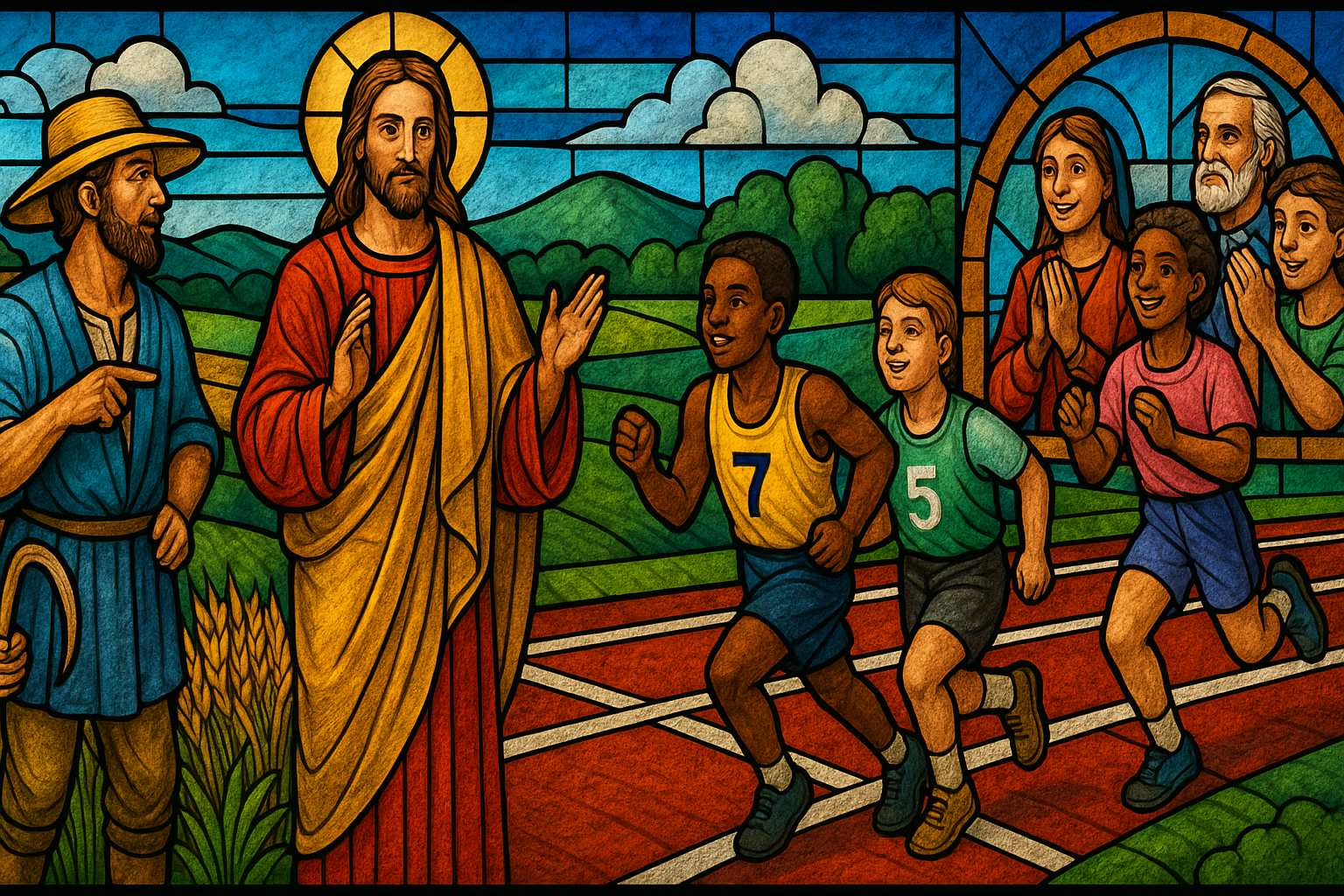
Every so often, an incident occurs that reminds us of this fact and shows us that we really can choose to live contrary to our culture. Such an incident happened several years ago at the Seattle Special Olympics. Nine contestants, all physically or mentally handicapped, assembled at a starting line for the 220-yard dash. They were so proud. At the gun, they all started out, not exactly in a dash, but with a genuine desire to run and win. All that is, except one little boy who stumbled and tumbled over a couple of times, and began to cry. When the other eight contestants realized what was happening, they slowed down, paused, and then came to a complete stop. They then turned and went back – every last one of them. One girl with Down’s Syndrome bent down and kissed the fellow runner and said, “This will make it better.” Then all nine of those very special athletes linked arms and walked to the finish line together.
Every person in the stadium stood in silence, for somehow, they realized that here was Grace in action.
Then they let out a huge cheer, which lasted about fifteen minutes.
Jesus reminds us that the first shall be last and the last shall be first. If I can only remember that for a moment, maybe I can help my grandchildren see success under failure, winning under losing, healing under wounds, hope under despair, courage under fear. And then, God willing, they will become more graceful people. Amen.
Performance People Versus Grace People
Performance People Versus Grace People
September 14, 1997
Scripture: Matthew 20: 1-16, 2 Peter 3:15-18