Preparing for Christmas
December 12, 1999
Recently, in a visit, someone said to me, “Can’t understand why everyone gets all worked up at this time of the year. The Christmas story is a fairy tale for children with little or no basis in reality” (Just what one needs to hear on the first parish call of the day.)
As we prepare for Christmas, it seems important to respond to that kind of remark, for that person represents many in and out of the church. At best, they look at the Christmas story on a par with Santa Claus tales. At worst, they see nothing worth maintaining or preparing for.
So let’s start our thinking with some honest>n The record certainly is bewildering. The birth stories in the New Testament are not very consistent. If this birth was as unique, why is it that St. Paul, the earliest of the New Testament writers, never mentions it? There is no word in the Epistles about Virgin births, or Angels, or Wise Men from the East. There isn’t even any indication in the first four centuries that the church celebrated Christmas
And let’s take it a step further and ask why two of the four Gospels, Mark and John, fail to mention the Birth. And then, if you look closely at the Birth story in Luke and Matthew, you will find that they don’t mesh very well. Both agree that the Birth took place in Bethlehem. But for different reasons and in different locations.
In Matthew, Jesus was born in Bethlehem because that was the home of Joseph and Mary. In Luke’s account, the one we know best from Christmas Eve, Nazareth was where Mary and Joseph lived. They had gone to Bethlehem to register for taxes.
Matthew tells us about the Wise Men and the Star. Certainly important events to be recorded, if they had taken place. Luke doesn’t mention it, and he simply writes about shepherds and angels. Matthew has Jesus born at home. Luke has Jesus born in a stable because the Inn was overcrowded.
Can you see where we are headed? It’s at best a confusing bunch of stories, particularly if we look closely at the record.
One other problem plagues us as we try to openly deal with this story. And that concerns Jesus’ parentage. Was Joseph Jesus’ natural father, or just his legal father? Both Matthew and Luke insist that Jesus was conceived not by the union of Joseph and Mary, but by the union of God and Mary. For many Christians, that’s the key to the Birth story and consequently to their belief system. For other people, a Virgin Birth is simply poetic license, and they point out that Matthew traces Jesus’ lineage through David, which would indicate Jesus was an offspring of Joseph. Many scholars suggest that the term Virgin applied in those days to any young woman who gave birth before they were expected to be fertile. Other scholars note that many religions have similar stories. God impregnates a human being, who brings forth a powerful demigod figure. And so it goes, everybody interpreting the record and reading into it from his or her own viewpoint. It’s enough to get a person thoroughly confused.
Well, that’s at least some of the more rational arguments. I’ve tried to state them as clearly as possible, because we can’t simply dismiss those issues.
It’s what makes a parishioner say, “Why are you getting so worked up about an empty story with no basis in reality?” It’s what makes many sincere people celebrate the holiday without getting involved in religion. It’s what makes Christianity suspect in many places.
Can we begin to cease thinking of the Gospels as biography and history, memory and myth? Yes, myth; but let me remind you, myth, which is much of scripture, is not the same as fantasy. Fantasies are the telling of wild tales with no basis in truth. Myths tell us of truths that lie beyond the facts. Myths contain eternal truth, and the details are not important. Myths can be experienced, but are not open to the skeptic’s method of evaluation. Did Adam and Eve eat an apple in the Garden of Eden? I don’t know. But this I do know. The story in Genesis is more about the truth of human nature than it is about apples and snakes, and gardens.
Much of the problem of the skeptics is that he or she is searching for one right answer, one official reading, and one orthodox stance. Is it Luke or is it John, which is right? Does three different beginnings signify a lack of honesty? Or is it the same story, only told to different audiences at different times?
We, as searching adults, have a problem. Oftentimes, we say it’s with the Bible – so many conflicting stories. But our problem is not as we would think. The problem is not because of inaccurate or hazy details. The problem is that we have lost our imagination. In our quest for details, for what we call facts, we have lost the truth behind the Christmas story. Somehow, we’ve become unable to see truth beyond the so-called historical, factual material.
I think it was TS. Elliot, who once was quoted as saying, “You can’t appreciate the Bible unless you are a poet.” And I would second that and further declare, you can’t be a Christian unless you are willing to exercise your imagination, and go beyond the critical, skeptical fact-oriented understandings of Scripture.
This being the Advent season, a season of preparation, I want to share with you a story from West Africa. I think it’s a parable for Advent. But, it’s also a solemn warning that we have to see beyond our three-dimensional world.
Once there was a young man who owned some milk cows that weren’t producing milk. One night, he stayed up and watched while a beautiful woman rode down on a moonbeam from the heavens and milked the cows.
The next night, he set a trap for the moon maiden. And sure enough, he caught her while she was milking the cows. The young man agreed to release her if she would marry him. She agreed, but made one condition that she be allowed to go back into the heavens to prepare herself for marriage.
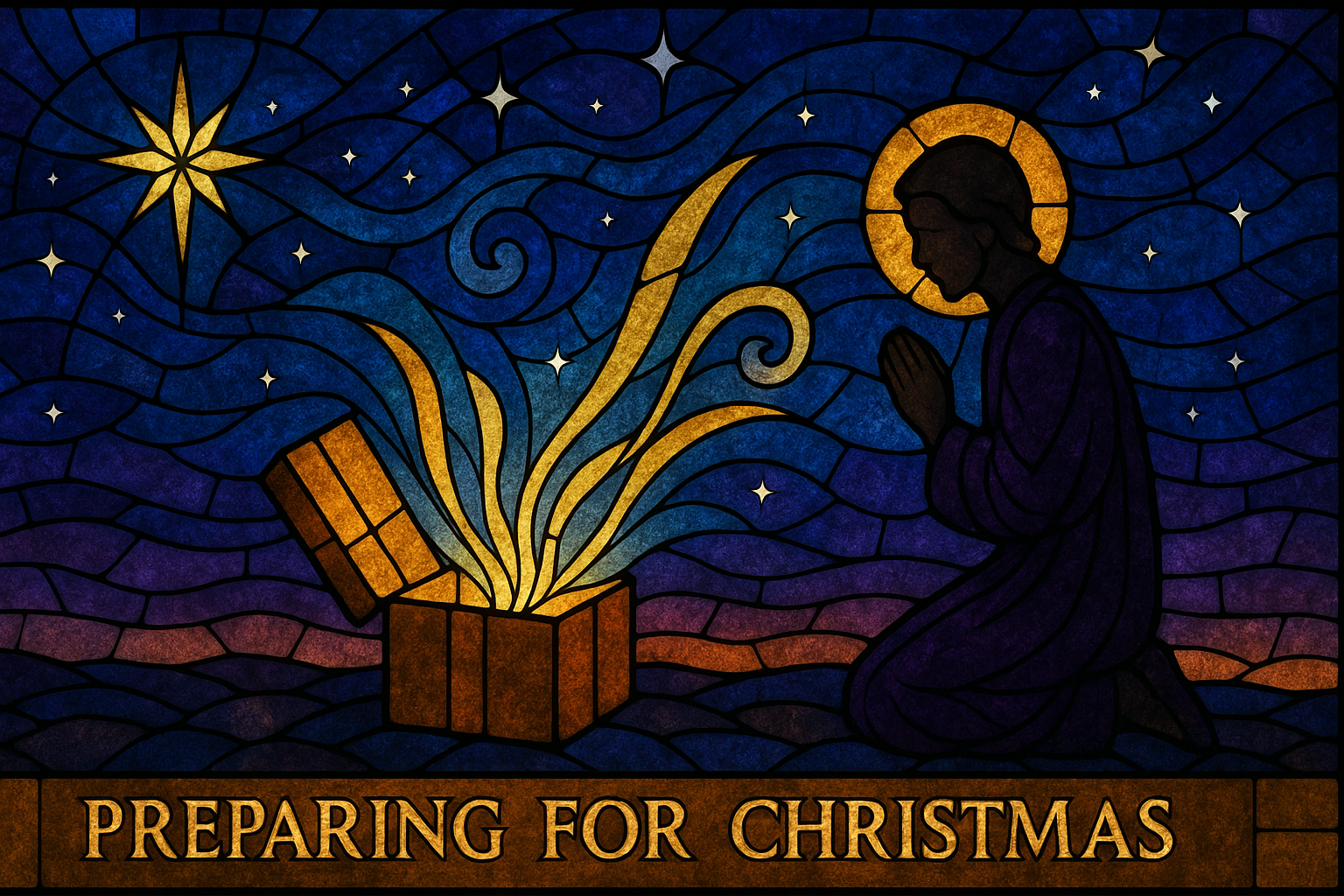
Sure enough, she returned in three days carrying a large box, which a-she placed in their bedroom. Before the wedding, she made her husband-to-be promise that he would not look in the box. They got married and, for a while, lived a full, idyllic time together. But then one day, when she went out shopping, he gave in to temptation and opened the forbidden box.
Much to his surprise, it was completely empty. His bride came in and said, “You looked, didn’t you? I can see it in your face.” The young man replied, “What’s so terrible about looking in an empty box?” And she said, “I must leave you. Not because you opened the box, but because you saw nothing in it. It wasn’t empty. It contained the light, the air, and the smells of my home in the sky. How can I be your wife, if what is most precious to me is nothing to you?”
I think this parable is one of those God stories. It contains a truth beyond any historical details. It’s the word of God from West Africa to those of us preparing for Christmas. It’s the mystery of emptiness.
Advent is an invitation to enter into mystery, poetry, and imagination. The many Biblical stories we hear contain the smells of Heaven, precious truths beyond the facts, wisps of our home with God.
So watch, anticipate, and wait for the Christ child; born of a Virgin who lies beyond our comprehension…But not beyond our Faith.
Amen
Preparing for Christmas
Preparing for Christmas
December 12, 1999