Saying Goodbye
May 19, 1996
John Hughes, a British psychologist, contends that saying hello and saying goodbye are the two major learning tasks all humans need to accomplish. He states: “I would venture to say that 98% of all people in mental hospitals are there because of a faulty ability of saying hello or good-bye. Some adults have never learned to say goodbye. They continue in their childlike relationship long after they have chronologically moved past that stage.”
And so it was with the first disciples. They had been with Jesus throughout his teaching ministry. They had been with him during the past 40 days of incredible intimacy. And Jesus, who was very conscious of where his friends stood in their understandings, must have watched with growing concern as they slipped back into the old dependent relationships. It’s not hard to read between the lines and hear the disciples, looking for approval, wanting Jesus to control their lives, hoping that he would point them in the right direction, telling them how and when to proceed: But Jesus, I believe, wanted something more from his friends. He wanted to see them grow and move into their potential. And he knew that in order for that to happen, he must first teach them to say goodbye.
Several years ago, I lived in the Berkeley area for a semester, and I discovered a remarkable psychiatrist by the name of Sheldon Kopp. I never met the gentleman in person, but I did get to know him through his writings. One of his books has the intriguing title, If You Meet the Buddha on the Road, Kill Him. This refers to the advice that if you encounter anyone who begins to solve all your problems, and you find you are constantly looking for his or her approval, the wisest thing you can do is to say goodbye to that person.
‘Many times,” Dr. Kopp writes, “patients come to him the way a little child takes a broken toy to a parent and they say: ‘please fix this for me, or tell me how to fix it. You are big and I am little. You have a direct line, I will do what you tell me to do.”‘ Kopp’s whole book challenges the validity of this kind of relationship. He suggests that if you want people to grow, you have to teach them to say goodbye and to take the risk yourself of severing a dependent connection.
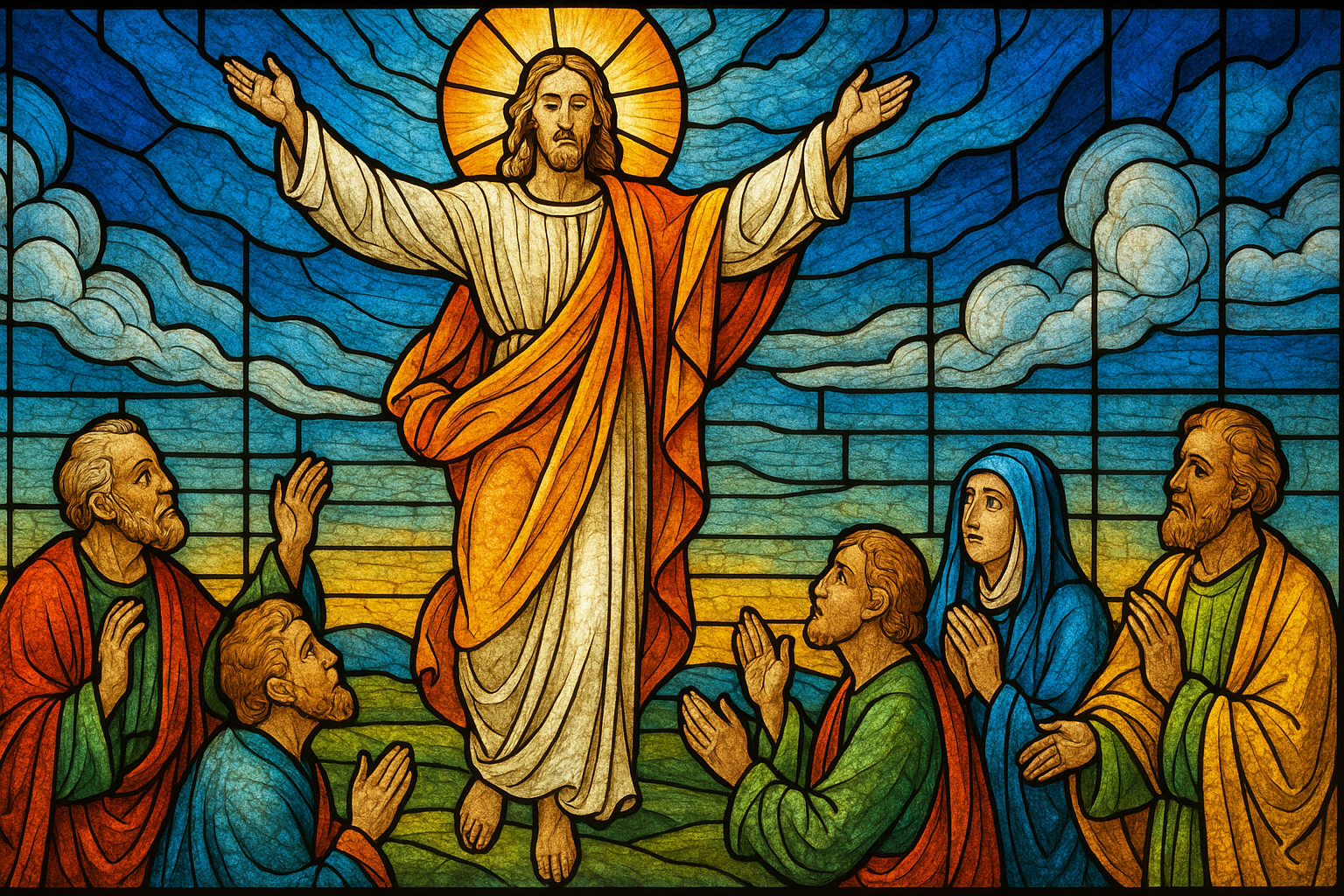
And this is precisely what we find Jesus doing. In the scene that we call “The Ascension”, the disciples learn that Jesus will no longer be around to guide their steps. No longer will Jesus be present, pointing out the pitfalls. From here on out, the disciples were free. Free to choose, free to fail, free to grow.
This, as any parent can attest to is a risky business. Most of us parents are usually plagued by the “what ifs”. What if she forgets what I taught her? What if he is unsuccessful? What if??? But that’s a risk one takes. Most parents know that you can’t protect a child throughout his or her life. I think the popular term is: “You’ve got to give them wings, if you want them to fly.” You’ve got to teach them to say hello to maturity.
So why is it on this special day that we usually see the church stumbling around? Why is it that we usually ignore this key event in the life of Jesus? Why is it that we so often simply argue over the literal interpretation of a very symbolic act?
Is it because deep down we are fearful of the implications of the Ascension? Let’s be honest, most times we are scared to cut the cord, scared that we’re inadequate for what lies ahead. In our religious life, we are scared to say goodbye to our childlike faith and take the risk of a mature religion. It’s so much easier to remain dependent, helpless in our relationship with God- But the Ascension reminds us that Jesus respects us so much that he departs. He gives us space. He lets us stumble & He leaves us with questions rather than easy answers. He lets us wrestle with our doubts rather than spoon-feed our dependencies. J Thomas Merton once spoke of his friend, a Tibetan Lama who had to leave or be killed by the Chinese Communists. A fellow monk sent him a message: “What shall we do now that you are leaving?” The Tibetan Lama sent back this reply: “From now on, brother, everyone stands on his own feet.”
Merton commented, “The time for relying on structures has disappeared.” Structures and people can be helpful, but when they are taken away, you must learn to stand on your own two feet, take the risk of maturity.
The Ascension is one of those essential days when we are challenged to say goodbye to childlike religion. No longer can we depend on the Bible to be our answer book. It suddenly becomes a book that raises questions. No longer can we look to Mother Church for the right response to tough questions. We now have to do our own wrestling with difficult choices in life. No longer can we come on a Sunday just to be fed. From now on, we’ve got to think of feeding others.
Several weeks ago, I scheduled an all-day Saturday meeting of the Quest group. When Saturday came, I was embarrassed. I had forgotten to put it on my calendar. Near the end of the morning, I came home and found this message on my answering machine. “Where are you?” I was totally shocked. But when I arrived at the meeting, much to my surprise, they had organized themselves and had grown in the process. This unplanned event was a key event in the maturity of this group of people. Brothers and sisters, everybody stands on his or her feet.”
I have a friend who has made a promise to any rector that he will give $100 to a church that will set off firecrackers on Ascension day. And one of these days, I intend to collect that money. But I hope we will see the fireworks not as symbolic of Jesus going to heaven, but rather as the time that we celebrate Jesus’ trust in us, for he was willing to leave, to say good-bye, so that we could learn to say hello, and grow in a mature relationship to God.
Amen
Saying Goodbye
Saying Goodbye
May 19, 1995