“St. Michael and All Angels as Messengers of the Most High”
Genesis 28: 10-1
October 1, 2000
It’s a classic story. Two brothers, twins, one the favorite of his father, the other the apple of his mother’s eye. One direct, uncomplicated, filled with integrity. The other, devious, tendency to take the easy way, filled with resentment.
Two brothers, Jacob and Esau, one a good guy, the other a little bent, eager to supplant his brother in his father’s eyes.
I wonder how it feels to be always second best, always a bridesmaid, and never a bride, always looked upon as the less gifted child.
I was at a conference a few weeks ago. It was on ministry and the leader remarked, “If you want to know what to expect from your job, look at your birth order. Look to your family of origin. Look to the relationships that you had with your parents.” Jacob was second in the birth order, and he never received love from his father.
Tennyson, in Ulysses, wrote, “I am a part of all that I have met.” He meant that everything in life shapes us, but some experiences misshape and take their toll on us. Some of the past leaves an indelible mark. For others, it’s a continuous burden. Much as we’d like to forget our past, it always seems to lie in the background. For some, the past has left a bitter taste in our mouths.
Returning to our story. Jacob does a dastardly thing. How low can you stoop, stealing your brother’s birthright? Disguising yourself as your brother and tricking your old blind father. Mother, of course, is his ally. She manages the scene from behind the curtain. So Jacob, tricky Jake, robs his brother of his inheritance. And at least in this, he is successful.
Someone approached me after my sermon last month and said, “I can understand your saying the rain falls on the just and the unjust. I too, believe in the uncertainty of this fragile life. But can you answer this, ‘Why do the bad seem to win most of the time?’ Doesn’t God care about justice?
I’m afraid I didn’t answer that question very well. I simply pointed out that from God’s perspective, in the long run, God works out the plan of redemption in his own mysterious way. Well, maybe and maybe not, you might say. Jacob gains his goal. Esau gets the lesser role.
The story of Jacob is very discouraging if you expect the Bible to be filled with nice things. This story isn’t neat and clean with the good guys winning in the end. Holy Scripture helps us get in touch with the dark, rich, mythic mud of our origins. Here is a story where we learn of the deep psychic ooze out of which our souls are formed.
Brian Anders, a visionary from Iowa, whom I discovered this past year, tells about a plumber who was digging around in the pipes, and he saw something shine in the muck, and it turned out to be the soul of the last tenant. He said he found stuff like that all the time. “You would be amazed at what people lose,” he said.
Moving back to the story of our ancestor, Jacob. We find that old Mom has a good fix on what is happening. Too many people are aware of Jacob’s trickery. And so she suggests that he leave town, and his wife go on holiday, with stage right. Jacob leaves and goes to Beer-Sheba. Actually, he goes camping. And since in those days L. L. Bean wasn’t in business; he has to make do. He goes to sleep outdoors with a rock as his pillow.
I suspect that it wasn’t easy for Jacob to fall asleep. He’s like a lot of us who are enmeshed in the past. The author doesn’t tell us whether he was remorseful, or fearful, or gloating or what. But we can easily speculate, Jacob was unable to lay down the past and move on.
There is a tale told of two Buddhist monks walking in a drenching thunderstorm. They came to a river. A beautiful young woman stood waiting to cross n the other side, but was afraid of the currents. In characteristic Buddhist compassion, one of the monks said, “Can I help you?” The woman said, “I need to go to the other side.” The monk picked her up, put her on his shoulders, carried her through the water, and put her down on the other side. He and his companion then went on to the monastery.
That night, after prayers, his companion took him aside. I have a bone to pick with you. As Buddhist monks, we have taken vows not to look at a woman, much less touch her body. Back there at the river, you did both.”
The first monk said, “My brother, I put that woman down on the other side of the river. You still carry her in your mind.”
That’s a characteristic of many of us. We do something that we’re not proud of, and we can’t seem to put it away and move on. We continue to be obsessed with the past at the expense of the future. We need outside help.
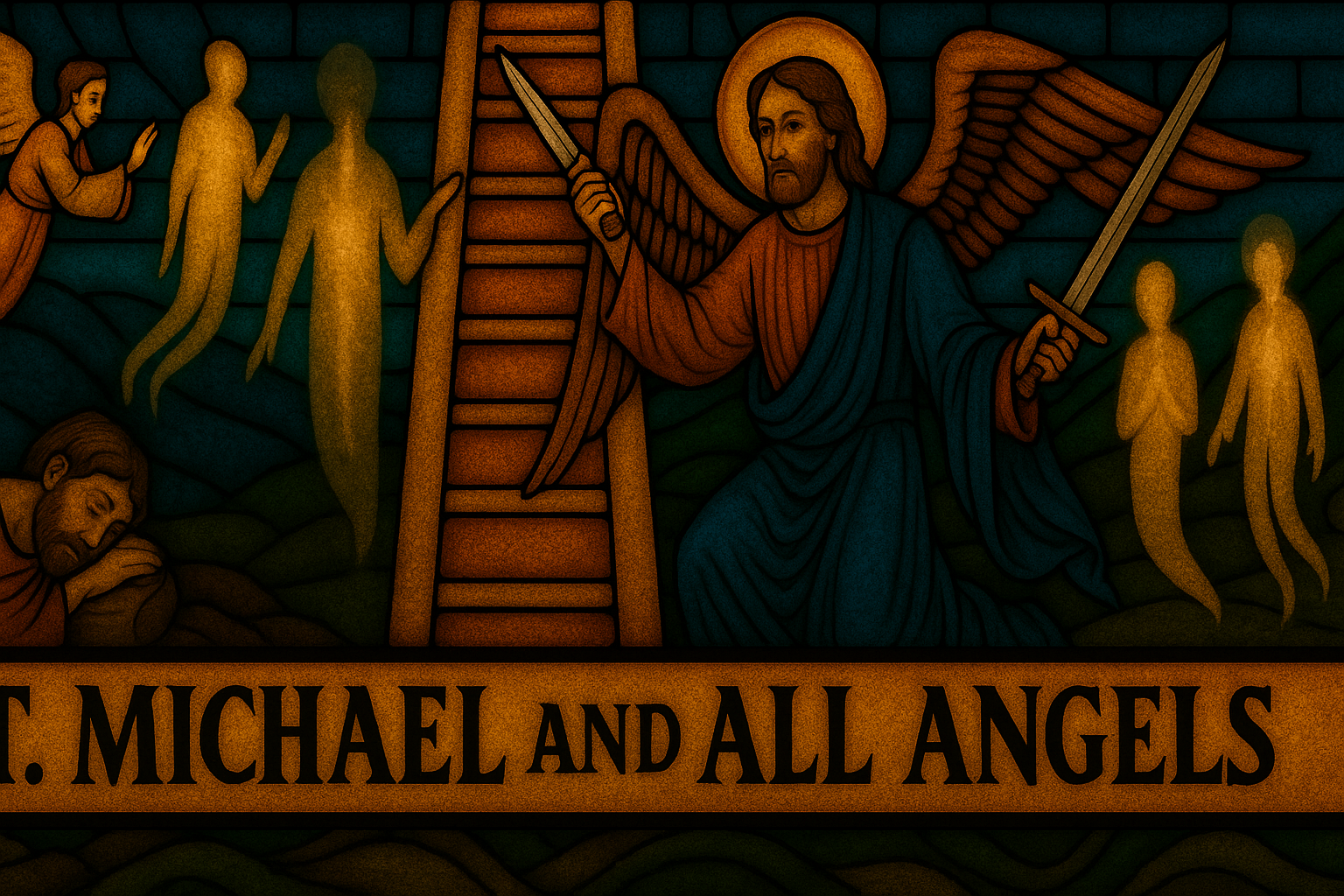
And so it was that Jacob received some help from God in a dream. We read that he saw a band of Angels, ascending and descending from heaven to earth. Angels on a ladder.
I want to ask you all a question. Do you believe in Angels? is there anyone here who really believes in Angels? You do? That’s a relief£ because this is the festival of St. Michael and All Angels. And I believe in Angels.
I’ve seen them. Now, the Hebrew word for angel is Malach, which also can be translated as messenger. Angels are messengers sent to us from God to tell us something important about ourselves. This is often the way God communicates to us. It’s the way he uses to tell us of his love, his caring, and his mercy.
A belief in Angels requires a special way of looking at the world. A special point of view. The story of Jacob is filled with the visitation of Angels at certain times. When Jacob is most in despair, when his guilt seems ready to overwhelm him, Angels appear. Each time they declare that God’s mercy is greater than his sense of justice, and that Jacob, with all his faults, is still a part of God’s family.
Looking once again at Jacob’s story, we find a curious message. From our point of view, we would expect the Angels to chastise Jacob, to present God’s judgment on what he had done to his brother. But no, that’s not what happens. The Angel tells Jacob about his future. They say in effect that our past need not color our future. In God, there is forgiveness and reconciliation, and healing. Jacob’s dream is a dream that we could all have. It’s a dream not simply about Angels. It’s a dream about messages. Angels declare that the worst word about us is never the last word. There is more to come because we, like Jacob, are sons and daughters of God.
A learned old gentleman used to say, “Anyone can learn from experience.” A wise person learns from the experience of others. I hope this morning we have learned a little from our ancestor Jacob. But more than that, I hope we have made contact with the Angels, for their message can change our lives.
In the Middle Ages, the Rabbis came up with a theological truth that seems quite relevant today. They said, “If we could all but see, every human being is preceded by a legion of Angels, who cry out, ‘Make way for the image of God.'” That’s what a human being is. That’s what Jacob’s dream is all about. The future is bright for him and for us, for we are “Images of God.” Can you hear them? They are in front of you. Saying, “Make way, make way. There’s more to come, for you are the image of God.”
Amen
“St. Michael and All Angels as Messengers of the Most High”
“St. Michael and All Angels as Messengers of the Most High”
October 1, 2000
Scripture: Genesis 28: 10-13