The First Shall Be Last and The Last Shall Be First
James 3: 12 – 4: 6; Mark 9: 30-37
September 21, 1997
Last week, I preached on the text, “The last shall be first and the first shall be last.” My basic thesis was that God loves the losers, those who are last, the low performers, the failures in life. I felt pretty good about the sermon until 7:45 on Sunday, when I heard Liz’s interpretations of the same text. Suddenly, I began to feel uncomfortable. Liz’s interpretation was that God loved everyone. The first as well as the last. After listening to the text, I realized that was a closer rendering of the message of Jesus. What should I do? Throw away that on which I had spent twenty hours of blood, sweat, and tears? Should I use the time between 8:30 and 9 to doctor it up? Those of you who were here know I didn’t do any of the above. Instead, I promised I would revisit the text next week.
I believe the reason we tend to miss the interpretation that God treats everyone the same is that we hardly ever do in our own relationships. Deep down, we know without a doubt that some people are bigger and some are smaller, some are brighter and some are less bright, some are younger and some older, some are richer and some poorer. It’s almost a fact of life that we tend to be aware of differences. Many times we even celebrate these differences. How many cars have you seen lately that have written on them: My child is on the honor roll of such and such a school? The only problem is that for your child to be on the honor roll, someone else’s child is probably off it. But let’s cut right to the chase. We are, by nature, “comparing creatures.” And we, by our very nature, want to know where we stand in relation to the people around us. Am I higher or lower, greater or lesser than someone else? By comparing, I begin to know something about where I stand in relation to where you stand. Maybe I can tell what my step might be on the ladder.
Now, striving to find oneself on the ladder and then wanting to be at the top of the ladder isn’t all bad. After all, I would hate to be operated upon by a surgeon who said he wasn’t trying, to be the best. Who wants to go under the knife with the second-rater? Or I would hate to be in an airplane flown by a pilot who didn’t want to be the greatest, the safest, the most competent flyer in the air. We not only want to be the best, but we have been given the capacity to be aware of others, where they stand. We are, by nature, comparing individuals.
The problem starts when we begin to compare ourselves unfavorably to others. This is where discontent enters the picture. We see if we are number two, someone else is number one. If someone else gets the prize, then we will have missed the prize, for we are convinced there are only so many prizes to go around. This discontent quickly slips into the sin of jealousy.
There is an old fable, told by Oscar Wilde, about the devil who was stalking the Libyan desert. He came upon a group of fiends who were trying to tempt a pious, holy hermit. They tried him with seductions of the flesh, they tried to sour his mind with doubts and fears- They told him that all of his sufferings were worth nothing. But the holy man did not flinch.’ Then the devil took over. He said, “What you do is crude, permit me for one moment.” Then he whispered to the hermit, “Have you heard the news? Your brother has been made Bishop of Alexandria.” Oscar Wilde said, “A scowl of malignant jealousy clouded the serene face of the holy man.”
What is it that makes us want to compare ourselves to others and then become filled with discontent? What is it that makes envy and jealousy rear their ugly head? Right from the beginning, in the Garden of Eden, Adam and Eve wrestled with this problem of wanting to be like God. Moses came down from the mountain top and called this problem “covetousness” – the envy over what someone else has or has accomplished.
Did you ever question the right of the Tenth Commandment to be there? I mean, after all those juicy sins like stealing, adultery, and murder? Whoever put these commandments together didn’t have much of a sense of climax. He should have started with the throwaway sin of coveting and worked up to the big stuff.
And yet, it is so true that the commandment, “Thou shalt not covet,” finds us, whether our bag is theology or academia, whether we be hard hats or homemakers. The spirit of covetousness, jealousy, and this discontent with where we are is the root of much unhappiness today.
And so it was with the disciples. Even as they walked along with Jesus, they were still trying to figure out who was the greatest, who would be the number one disciple. And each one coveted that position. That old throw-away sin began to take hold, and sure enough they began to see each other as rivals. “Who would be the greatest?” they; began to speculate.
The gospels are honest. They don’t try to gossip about the sins of their characters. The disciples are very human, and they treat each other as competitors… assuming that if one is ahead, the other is behind.
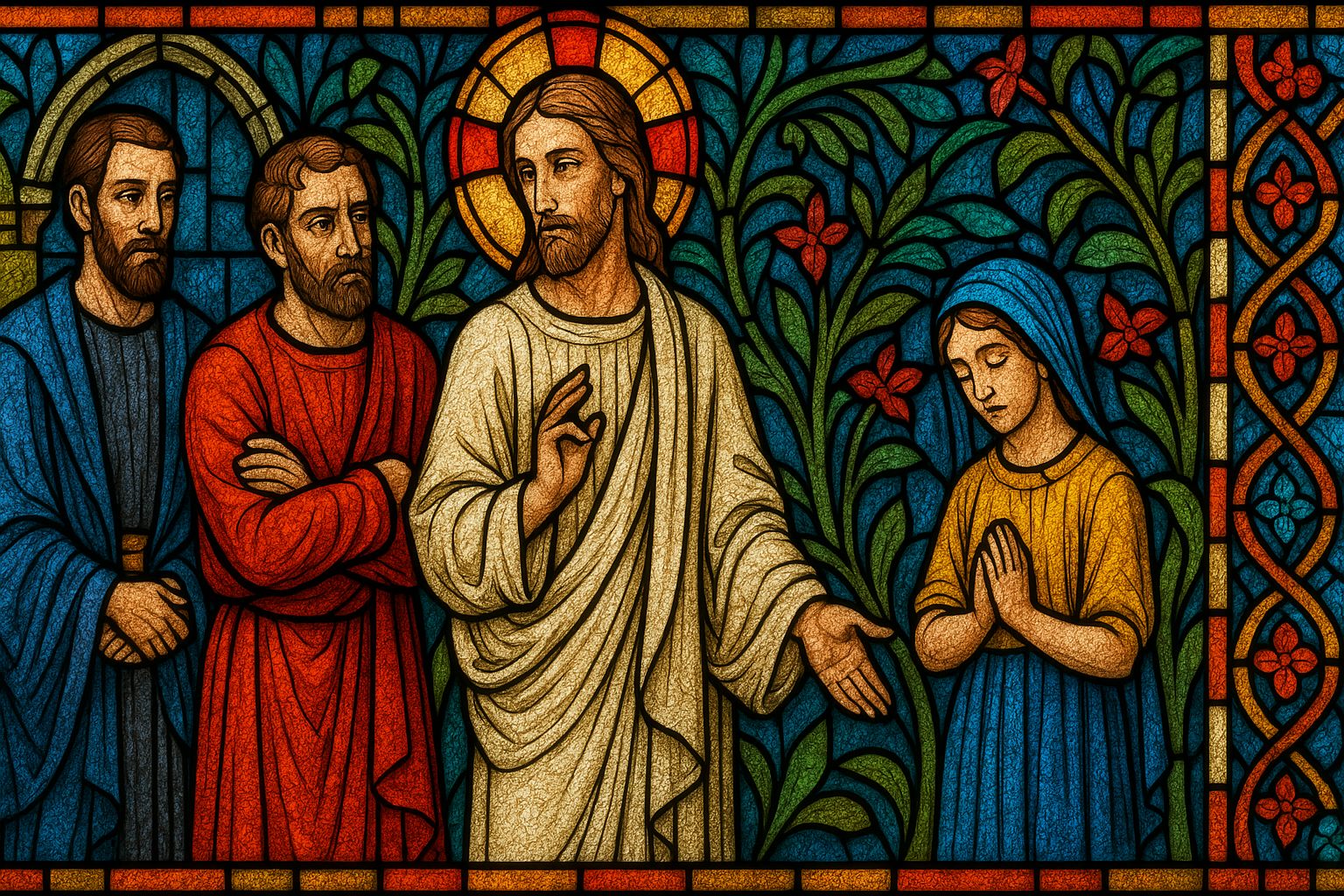
But Jesus interrupts this one-upmanship conversation by placing a child in their midst. He declares, ‘that even a little child is ahead of them in the kingdom. And the only valid comparison is the comparison in service, not status.
I think we need to hear this story to offset our tendency to covet. I think we need to hear this to understand that we live in the kingdom of abundance, where God’s love is measured out to all, “indiscriminately.” And if I am first, you don’t have to be second. You, too, can be on the honor roll.
There are only two choices to cure covetousness. One is to level the playing field, which is unreal. There are differences in people. The other is to learn to rejoice in another’s success. And one can do that if you truly believe that you are living in the kingdom of abundance, where God’s love is given to all, and the first as well as the last are equally accepted into the kingdom.
Let me end our thoughts with a 10th-century parable, old by the rabbis. It’s the story of a Jewish farmer who, while working in the fields, met up with an angel of God. The angel said, “HaiI Jacob, you have found favor with the Master of the Universe. You shall be granted three wishes. The only proviso is that your neighbor Isaac will receive double.”
Now, Jacob was a poor man, barely scraping out a living, so right away he asked for 100 cows. This would make him the most successful farmer in the area. Sure enough, there miraculously appeared in his field one hundred cows. Jacob went to bed that night giving thanks to the Master of the Universe. The next day, when he awoke, the sounds of his neighbor’s 200 cows, and much of the joy from his unexpected windfall, left him.
Later on in the week, when he had told his wife, she suggested that he ask for a Child, an heir. They were childless. Nine months later, his wife gave birth to a beautiful baby boy. And that Saturday, Jacob went to the synagogue and gave thanks for the gift of a child. All went well until he spied his neighbor, Isaac, who was on the other side of the synagogue, giving thanks for a pair of twins. Jacob was furious.
All week, Jacob thought of the unfairness of it all and how he might best his neighbor. Finally, he came up with the solution. That night, he got on his knees and prayed, “Master of the Universe, for my last request, I would ask that you put out one of my eyes.”
At that moment, the angel appeared. “You foolish son of Abraham. You would sacrifice half your eyes so that your neighbor becomes blind. It is God’s desire to bless and not to fulfill your sidelong glances of jealousy. God is a God of compassion. God’s abundance is plentiful . . . for misusing the request, they all will be taken back.”
The rabbis’ parable is one to contemplate. The temptation for jealousy and envy are always present, particularly when we think in scarcity terms. What if we believed that we lived in the kingdom of abundance? What if we believed the first and the last were all the same in God’s kingdom?
He, she, who has ears to hear – let them hear.
Amen
The First Shall Be Last and The Last Shall Be First
The First Shall Be Last and The Last Shall Be First
September 21, 1997
Scripture: James 3: 4-12, Mark 9:30-37