“The Palm Sunday Agenda”
Mark 11:1-11
March 24, 1991
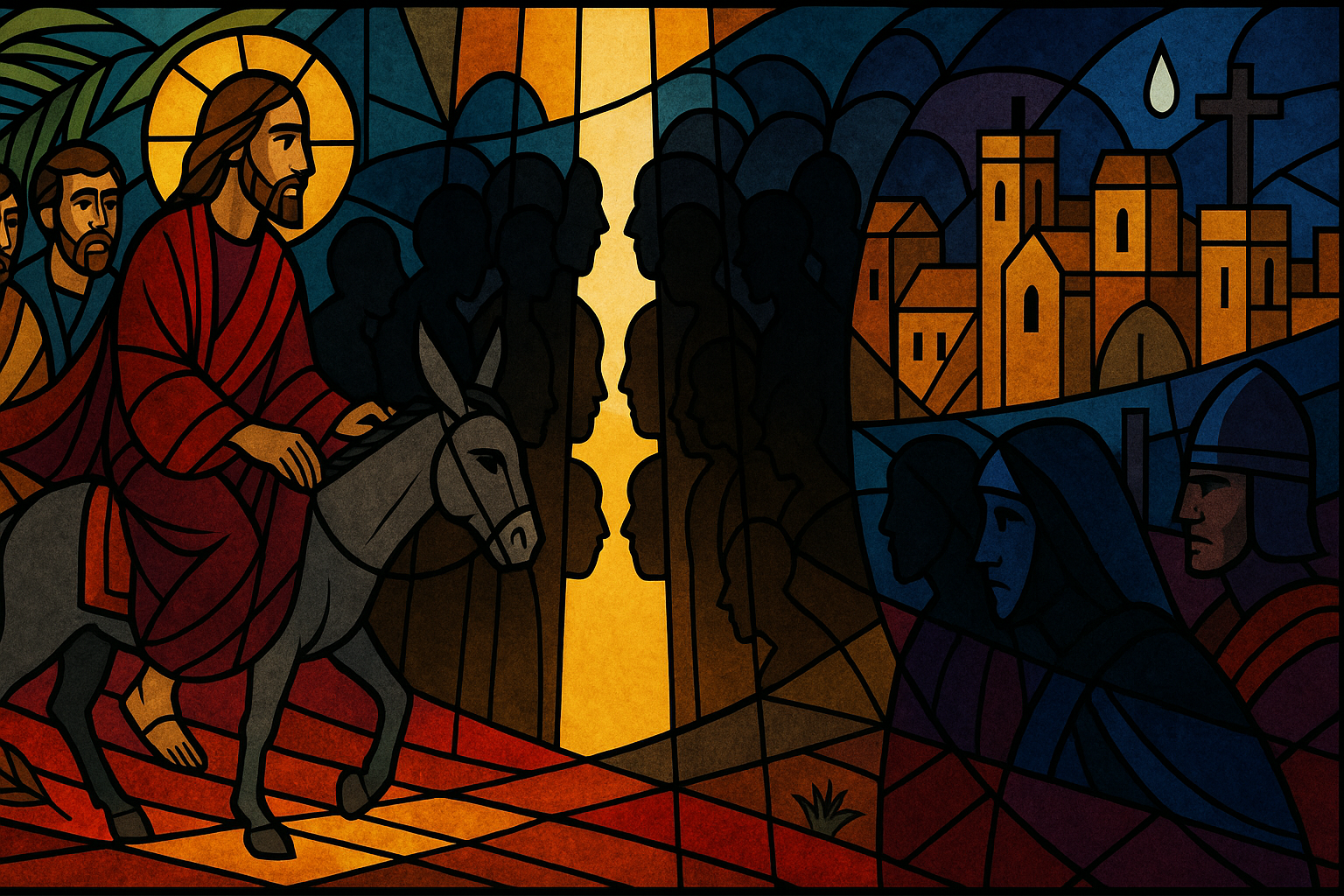
There was a risk to be taken, he was going public. When Jesus rode into Jerusalem, he became more than an itinerant preacher surrounded by a small band of disciples.
There was a risk to be taken, he was going public, when Jesus rode into Jerusalem, he was putting aside his teachings, his healings, and turning to the nation which could make him king, or crucify him. There was a risk to be taken, he was going public. When Jesus rode into Jerusalem, he was leaving the area of personal morality and directing his message to principalities and powers.
There was a risk to be taken. He was going public, when Jesus rode into Jerusalem, it was a festive day for the people, but for Jesus it was a major step towards death.
What would it be like, feel like, to be Jesus as he rode into Jerusalem? I imagine it would be scary. No longer could there be any doubt regarding who he was and what his mission was. No longer could he be dismissed as an insignificant rabbi. He was a public figure with a public agenda.
It is always fascinated me that the enemies of Jesus knew more about him than his own friends. The enemies of Jesus saw him as a real threat to the status quo. Jesus was executed for his politics, not his teachings. He was executed for treason, not for healing the lame, for the blind. It must have been frightening to know that the cost of going public could lead to crucifixion. It also must have been embarrassing when you go public with your weaknesses as well as your strengths get exposed to the light of public scrutiny. You lose your anonymity, and people begin to brand you as a troublemaker Most of the time, most of us are not in the public spotlight, and we may be grateful for that. We are accepted or rejected, acquitted or judged, embraced or denied on surface appearances. But suppose we went public? Then we would begin to live in a glass house, then our past, our present will be examined. Can’t you just imagine people saying after Palm Sunday, Jesus? Ohh yes, I’ve heard of him and I think he was born out of wedlock
. And finally, I imagine going public was also very liberating. Standing up and being counted means that you no longer have to worry about appearances. Once you have confronted the really massive evils, once you have declared yourself to the world, small concerns, minor issues, personal problems seem not very bothersome
one of the great learnings we can have from this day is that the more transparent, the more open we become, the more freedom we have period you are what you are, when you go public, and you no longer have to worry if the message is sent.
Recently, some parishioners shared with me a remarkable little book. It was about how people came out of the file closet in terms of their sexuality. The author says this book isn’t really about sexuality, so much as it is about telling the truth and being powerful in your life. Most of all, he says, this is a book about love as it goes public
. And isn’t that what Jesus did on that first Palm Sunday? He came out of the closet, so to speak, he moved from the private phase to a public agenda. He confronted the principalities and powers of his day, and he placed his feet directly on the road to crucifixion.
The Palm Sunday agenda is costly, for it leads to the accusation of treason, it leads to questioning the status quo, it leads one into being that prophetic minority as opposed to the narrow, church going majority. It leads one into challenging the principalities, the powers, and the institutions of the day.
I have a friend who constantly accuses the Church of trying to skip the Palm Sunday agenda. The church is constantly swooping into the pygmy world of private piety rather than attacking the giant social issues he says. I can hear him now, every time we are faced with a major, difficult issue, the church slips back into personal private morality. The great miracle of the church is its ability to turn wine into water, to turn public issues into private concerns, to turn major evils into personal wrongdoings, rather therefore avoid crucifixion.
Earlier this week, I sat in a room with a group of senior pastors from some of the largest, most successful churches in America from every conceivable denomination. We talked frankly and openly about our problems and opportunities. We explored our common agendas and how we might cooperate. Yet at no time did anyone go beyond the private morality issues. We talked about Jesus, but never mentioned the Palm Sunday agenda. We talked about murder, drugs, suicides, pornography, and homelessness but at no time was there mention of the institutions the principalities, and powers that produce these situations. We talked about individual salvation and how we might communicate the good news to as many people as possible, but no one raised the point that salvation was a corporate word, and that since that first Palm Sunday, the agenda has changed. We are called to address a nation, a culture, a people. Flannery O’Connor in one of her novels, takes a well known biblical phrase and makes a slight adjustment. She says, you shall know the truth, and the truth shall make you odd. Odd. Different. A troublemaker. And that’s what the Palm Sunday agenda will do for you. It will force you out of the closet, to question, to confront, to speak to the city, the nation, the status quo. The Palm Sunday agenda would have us stop answering questions and begin to question some of our answers. Let me just give you 2 examples.
We are told that the economy is recovering. The Palm Sunday agenda would have us ask, for whom? The Dow may be coming back, but what about the hard-pressed elderly, with disadvantaged minorities? is it a recovery for them?
Or we are told that because of our military victories in the Middle East, peace is just around the corner. Maybe we have to question what is meant by peace. I wonder if the Kurds, the Palestinians, and the Jordanians see peace the way we do. Maybe each one of us has to ask, at what price peace, and who is really paying for it?
Can you see these are tough questions, questions that you and I would rather not tackle? We have little knowledge and even less motivation to face these questions. who wants to be branded a communist, fuzzy-headed liberal, unpatriotic? Who wants to walk with Jesus down the path towards crucifixion?
In Saint Luke’s version of Palm Sunday we read, when he drew near and saw the city, he wept over it. I wonder if Jesus weeps over Tucson, over the United States? I wonder if we might stop looking for ourselves and begin looking for the principalities and powers that would crucify Jesus all over again. I wonder
Amen
“The Palm Sunday Agenda”
“The Palm Sunday Agenda”
March 24, 1991
Scripture: Mark 11:1-11