“The Shock of Christ!’
March 5, 1995
Sometimes you can look at a thing a hundred times and not really see it. At other times, you can listen to something a thousand times and not really hear it. And so it is with the parables of Jesus. This past summer, I found myself shaken up by a fresh interpretation of the parable of the Good Samaritan. Since this is the beginning of Lent – and Lent is a time in the church year when we are encouraged to be shaken up as well as to go beyond our traditional understandings – it seems right and proper to start the Lenten season with this well-known parable.
Let me warn you, as we look at this parable, that a parable is meant to shock and undermine the conventional wisdom of the day. If any preacher takes a parable of Jesus and simply interprets it as a moralistic tale, or if any teacher uses a parable to support the prevailing mediocrity of our cultural values, watch out. You will know that he’s not talking the talk or walking the walk according to Jesus. Parables were given to us by Jesus to change our lives, to wake us up, to shock us.
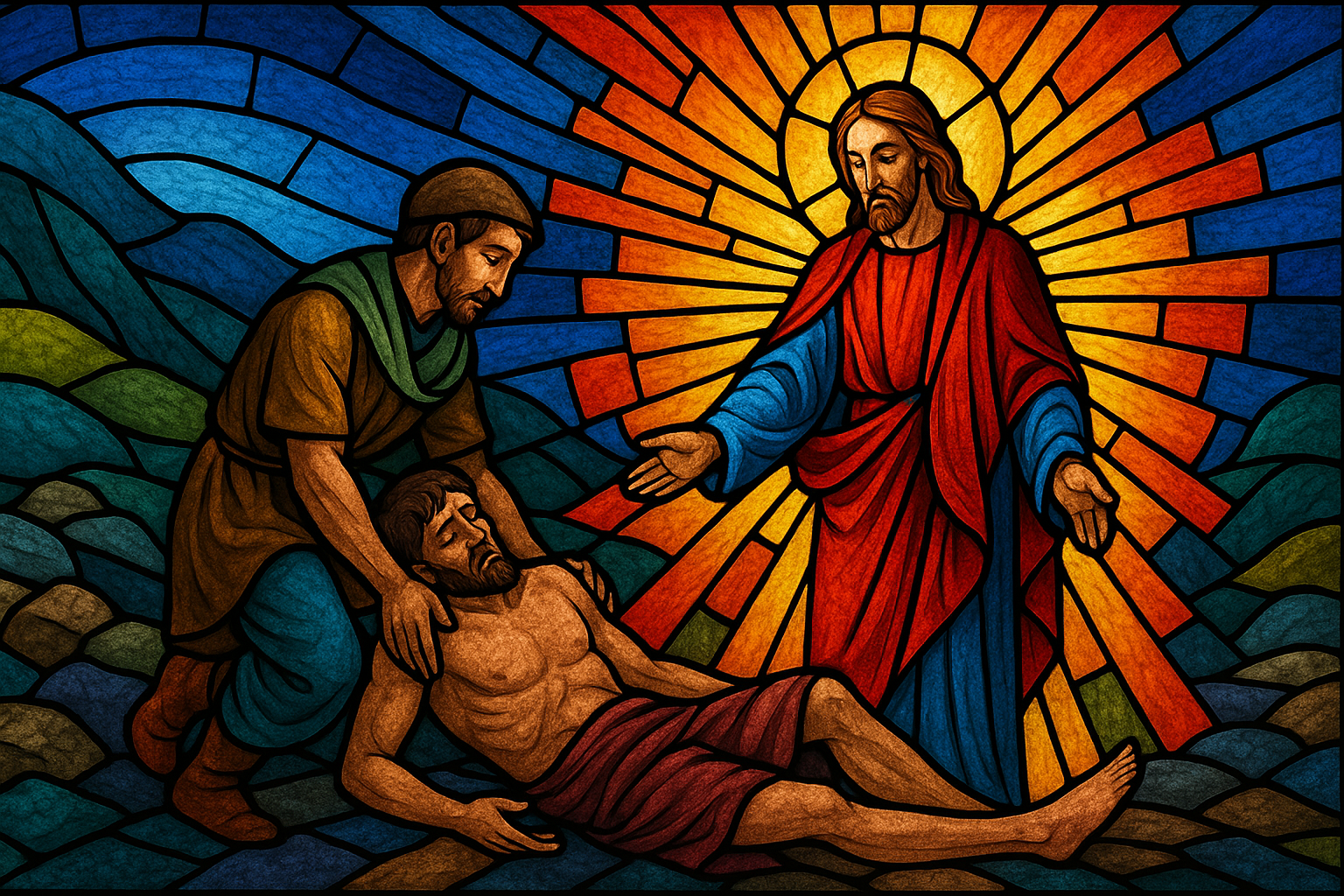
Let me illustrate what I mean by focusing on the story of the Good Samaritan. Conventional wisdom says it is all about being a good neighbor. The moral is that we ought to all do something to help those less fortunate. But is it? Listen to the parable again.
A traveler was on the way down from Jerusalem to Jericho, and he fell among thieves who beat him, stripped him, and left him half dead. Can you identify with that poor man? He’s the underdog – the good person to whom bad things happen. We’ve all been there in one way or another. I want you to hold onto that identification. You’ve lost blood. You’re battered. The sun is beating down upon you. And you’re beginning to wonder if you’re going to live through the day.
Down the road comes a priest. Surely, a priest will help. He’s supposed to be a professional helper. But no, he passes on the other side. Most congregations love this part of the story. Go get ’em, Jesus! it appeals to their sense of anti-clericalism. Most preachers try to gloss over this part of the parable.
And so, being a preacher, I would ask you to concentrate on the main character, not on the errant priest. Let’s keep our focus on the guy in need, lying by the roadside, thirsty, bleeding, half dead. Let’s keep our identification and focus on him
You look up and down the road comes a pious layperson. You’ve lost a lot of blood by this time. And here is this Bible-quoting fundamentalist – a church official – who thinks he knows so much, passing by on the other side. Great! We really are beginning to enjoy the story. Atta boy, Jesus. Stick it to them. Show up the hypocrites. Even though you’re hurting, this is wonderful. Who needs their help?
But you still haven’t been rescued, and you’re feeling weaker and weaker. Desperately, you look down the road. And there in the distance, you can dimly make out a car. As it comes closer, it begins to slow down. And you can see – Oh no! A Samaritan. A lousy Samaritan. A lower type, unbelieving, foulmouthed, unwashed Samaritan.
“I’m okay!” we shout out as he gets out of his souped-up Chevy with a rabbit tail hanging from the mirror. “Don’t bother about me. It’s just a flesh wound.” We mutter to ourselves that we’d rather die than be rescued by the likes of him. And at that moment, we hold the key to the story. Suddenly, it all makes sense. We know why Jesus told the parable.
You see, it’s a parable that disrupts our expectations about saviors. The lawyer starts out asking about being saved, and then he cleverly turns to a more manageable subject. ‘Who is my neighbor? To whom do I have to go out and show some kindness? Can I get away with middle-class charity in order to get myself right with God?” But Jesus does not let him turn the original question around. Jesus’ focus is on who is going to help us. And it’s not who we might expect.
The parable warns us to be prepared to be shocked by the one who saves us. Your salvation may come in ways that you least expect and through people with whom you would not be found dead.
When I think about this parable, I shudder to think how we have subverted the Gospel. The Good Samaritan story has been made into an example of how each of us should go out and help those less fortunate. And then we sit back in a self-sufficient way, thinking that we are the rescuers, and never becoming aware that we are the ones needing to be rescued. As the Catholics often say, “Abusis non tollit usum.” “Abuse does not negate the right use.” So let’s give a fresh hearing to the Good Samaritan story and remind ourselves of the old-fashioned hymn: “It’s me, It’s me, O Lord. Standing in the need of prayer.” (and rescue).
In the past five years or so, there has been a terrific battle going on in the churches regarding the ordination of gay people. I’ve tried to understand it, but I find it difficult. I used to think it was a fight between Biblical fundamentalists and the more humanistic factions of the church. Or between liberal and conservative people. But the more I listen, the more I have become convinced it just isn’t about any of those group agendas. It’s not even about sexuality. The real issue is about who is to be ordained – who is to be licensed to minister. One side says only those who meet the prevailing morality, only those whose lifestyle is considered proper. And the other side says it’s about justice, and it’s about the fact that God uses all sorts and conditions – gay and straight, male and female, black and white for ministry.
Now let’s return to the parable for a moment. Remember, you’re sinking fast – you’re losing blood. And finally, this old beat-up car arrives and an obviously gay ethnic hops out and says, “Step into my car and I will take you to a place where I am known. And you will receive attention, be ministered to.” So what do you do? That is the issue in the parable. And if we want to dig deeper into the meaning of the parable, we find that the Samaritan – or in our later description, the gay ethnic person – represents God. The parable is not about finding some rules for better living. The parable is about your accepting salvation from a God that doesn’t match your Biblical picture. The parable is about meeting Jesus with whom you have never come in contact.
During the next six weeks, I want you to be prepared for the shock of Christ. Be prepared to find out that things aren’t the way you thought they were. Look again at Jesus and be prepared to be shaken up.
Several years ago, a play by Dennis Potter was presented on television called “The Son of Man.” It was a shocking play for many people. It was set in Palestine in the First Century.
The main part was played by a rather stocky British actor who portrayed Jesus as a crazy prophet. This Jesus was a feisty character, not the thin, pale, Galilean tripping around uttering existential platitudes that we usually think of. This Jesus was tough and uncouth, and unattractive. One particular scene was especially powerful. As Jesus is teaching people in the temple, he is interrupted by a lawyer. The lawyer asks if it is lawful to give tribute to Caesar or not. And Jesus, who is distracted and irritated for being interrupted, says, “Give me a coin. C’mon, c’mon, give me a coin. See that head on it? Give to Caesar the things that are Caesar’s. Now shut up!”
I’m not saying the play portrayed the real Jesus. That’s not the point. The point is that we have so sanitized his words that we are not prepared to be shocked. We are not prepared for a shock that will change our lives.
For six weeks, I ask you to concentrate on Jesus. And if you hear words from this pulpit that you can put on a bumper sticker or on a church bulletin board – if you hear from the pulpit suggestions for better living – you’ll know that you’re not hearing Jesus’s words. But if what you hear shatters your comfortable world, makes you anxious, destabilizes you, removes some of your defenses, makes you think – then maybe they are the actual words and spirit of Jesus. I pray that in the next six weeks we all will meet and hear and see the real Jesus. AMEN.
“The Shock of Christ!’
“The Shock of Christ!’
March 5, 1995