“TO THE WORKAHOLIC”
Matthew 6: 24-34
August 12, 1979
This summer, I found out a shocking truth about myself: I am an addict. No, I am not a drug addict, nor am I an alcoholic. But I am addicted to something even more serious and more lethal, though it never is listed as the direct cause of death.
I discovered my addiction upon reading a fascinating book called “Confessions of a Workaholic”. The author, Dr. Wayne Oatles, coined the term ”workaholic” to describe the addictive disease that afflicts many of us.
Let me tell you about this disease because I know about it first-hand. Workaholism and alcoholism have a lot in common as diseases. Both kinds of addicts, to outward appearances, seem to be normal, average types of people. Both do the same things that most people do. Like millions of people, they work to earn a living. Or, in the case of alcoholics, they drink, as millions of people do, to be sociable.
But some people, for one reason or another, become addicted. In the workaholic’s case, he or she starts out as most people do — enjoying, to some degree, his or her work in the office or the home. They talk shop on occasion; they share their work with others and, if they are lucky, they find some enjoyment in what they do from 9 to 5.
But then, over the years, something happens. No longer is it a matter of being able to take one’s work or leave it. No longer can you leave your troubles at the office or put down your housework to go out and play. The workaholic needs his work in order to survive. For him or her, work has become a compulsion, the most important thing in life, just as drink is to an alcoholic.
They say “it takes one to know one”, and I recognized a fellow workaholic the other day when I asked someone about his vacation. He answered me in this way: ”I had three weeks of enforced idleness, which nearly drove me out of my mInd. The only redeeming feature was that I was able to take some paperwork with me. ”
I spotted a kindred soul yesterday when a woman began to tell me how she wasn’t able to say ”no” to any cause or committee or job that she was asked to do. ”After a11,” she said in a classic workaholic response, ”If I didn’t do it, who would?”
I chatted at a party this past week with another typical workaholic. The conversation began with his telling me how early he started work and how late he finished, and how sorry he was that he couldn’t spend more time with other concerns. To some, this line of talk may sound like someone seeking sympathy or making excuses, but don’t be taken in. This is a typical workaholic conversation.
If you listen intently, you can spot the symptoms of a workaholic fairly easily. The terrible thing is that there are so many of us addicts around. We come in every size and shape, and are found in every conceivable line of work, in and out of the home.
The great tragedy of the Christian faith at least the Americanized version, is that it has made the disease into a virtue. American Christianity has enthroned the value of work. A religious aura has been placed around work, and we have called it the Protestant Work Ethic. But it is not confined to Protestants; the sponsors of the disease under the religious banner are aggressively ecumenical. Our models depict Calvin as a hard-driving lawyer, Luther as an untiring writer, Isaiah as a 60-hour-a-week temple worker — and Jesus, the ultimate symbol, as a success-oriented (God help us), work-oriented religionist.
We sometimes forget that Jesus began His public ministry by going to a wedding feast. And He ended it by sitting down for supper with His friends in an upper room. In between, He found time to eat with Zacchaeus and visit the home of Mary and Martha, and even made time for a picnic with the multitude on the side of a mountain. There is almost as much evidence in the Gospels of Jesus cultivating a sense of leisure as of His working to convert and heal people.
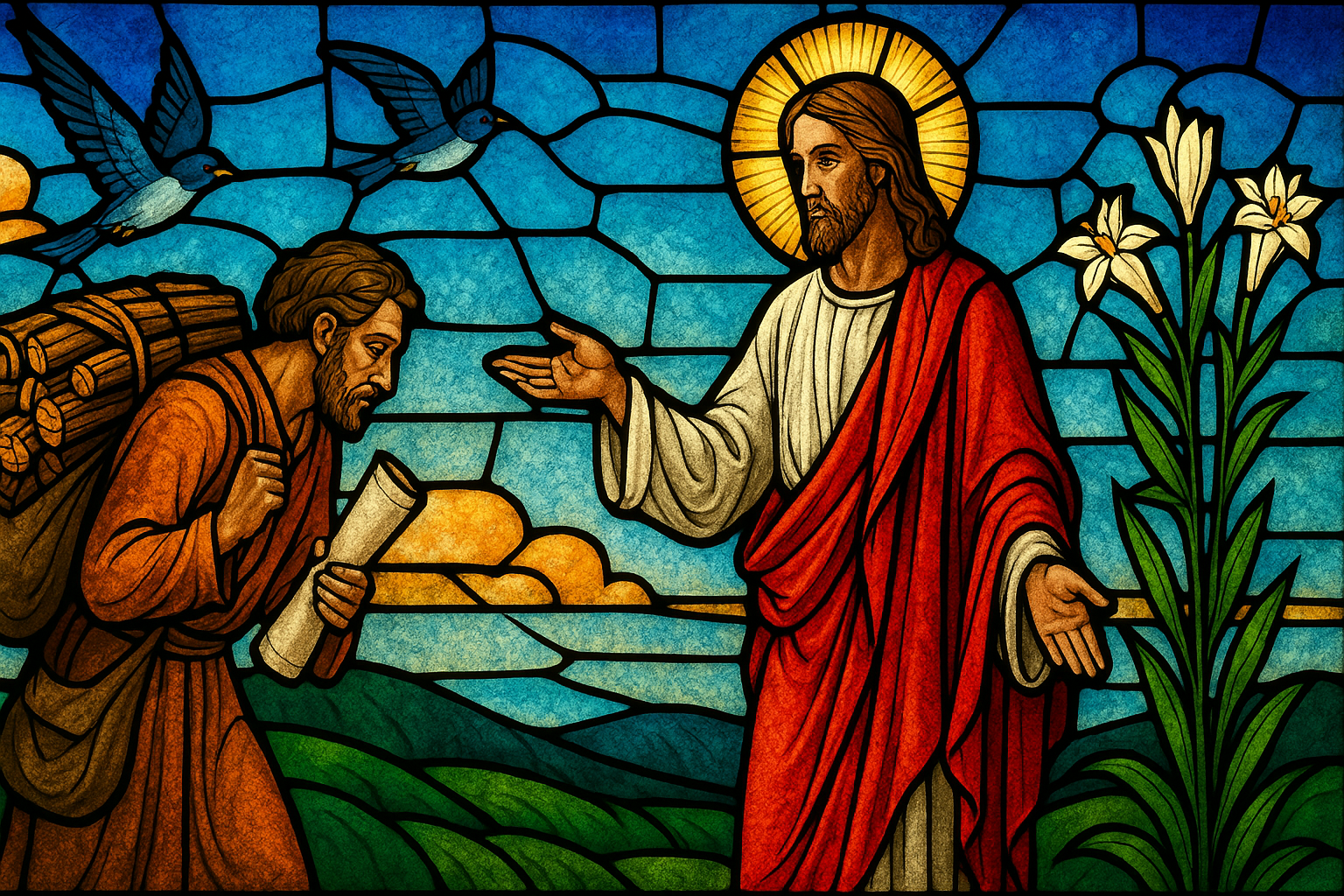
In our lesson this morning, we have an instance in which Jesus spoke directly to workaholics. Do you recall some of His words? Essentially, Jesus said: “Look, why are you so compulsive about your work? Consider the birds. They neither sow nor reap; they have neither storehouses nor barns. Yet God takes care of them. And consider the lilies, how they grow. They neither toil nor spin, but God watches over them.
There is great attractiveness in Jesus’ teachings if we hear them rightly, particularly if you are a workaholic. The word of God that comes to us through the Scriptures this morning is this: As Jesus tells us, you are not going to bring it off by your own efforts. Face up to it, because as long as you think you can bring it off by yourself, you are going to be worried by dread of the future. You are going to be made anxious by the specter of failure, and the chances are that you will be driven to the point of falling flat on your face. But if you can put away your fears, God will watch over you.
Walt Disney has said some wonderful things about life in his cartoons. I can vividly recall a popular, almost classic, cartoon that is in effect, an acting out of the teachings of our parish lesson. Do you remember the old cartoon about Sylvester the cat trying to escape from his enemy the bulldog? I’m sure the TV networks are still running it on Saturday mornings. The plot is always about the same.
The bulldog chases him until they come to a large pond, from which there is no escape. Suddenly, with blind faith, Sylvester takes off across the water, and the bulldog is left barking on the beach. As long as Sylvester remains un-anxious, a lily pad rises up to meet each of his advancing feet. But midway across, the cat becomes fearful. Although his feet have found support thus far, he can see no visible aid for the remainder of the trip. And the moment Sylvester begins to worry about whether the next lily pad will appear, he sinks into the water. The last scene inevitably shows the bulldog standing on the shore and laughing.
As I catch the tenor of Jesus’ message, He delivers solemn warnings that we not end up like Sylvester. He tells us not to worry about the future and not to fret about the past. He bids us to live graciously in the present.
As I watch Jesus ‘ actions in the New Testament, He models someone who has cultivated a sense of leisure, who has learned the secret of play, and mustered the ability to flow with the tide and enjoy life to its fullest.
Now, as a workaholic, I know how difficult it is to live that way and follow in those footsteps. It’s like saying to an alcoholic, “Don’t take another drink. ” Fortunately, Jesus didn’t stop there. He left us with a community in which workaholics can be supported, loved, cared for, and challenged. During the fall and winter season in that community, I hope to speak to many of the issues raised by the workaholic.
In past decades, preachers have challenged the underlying assumptions of their day. At certain times in history when comfort and enjoyment were the ends in life, preachers questioned the assumption expressed by the saying, “Eat, drink, and be merry, for tomorrow we die.” Today we challenge the words, “Work, worry, and get ahead, for your time is very short.”
And the words we hear this morning are the words that challenge the underlying assumption of our workaholic society, which says, ”Work, worry, and get ahead.” The words of Jesus say the opposite. So listen, and ponder, and inwardly digest the words from our lesson that tell us: “Fear not, for the Father will give you all that is sufficient. ”
We began this sermon by saying that workaholics are very similar in some respects to alcoholics. The disease of alcoholism can be stopped– and so can workaholism. It can be stopped, it can be handled, it can even be cured, with God’s grace. I would like to end this sermon with a prayer that is often used by alcoholics, but also can speak, and speak powerfu11y, to those of us who are workaholics.
Let us pray:
God grant us the serenity to accept the
things we cannot change,
the courage to change the things we can, and
The wisdom to know the difference.
Amen
“TO THE WORKAHOLIC”
“TO THE WORKAHOLIC”
August 12, 1979
Scripture: Matthew 6: 24-44