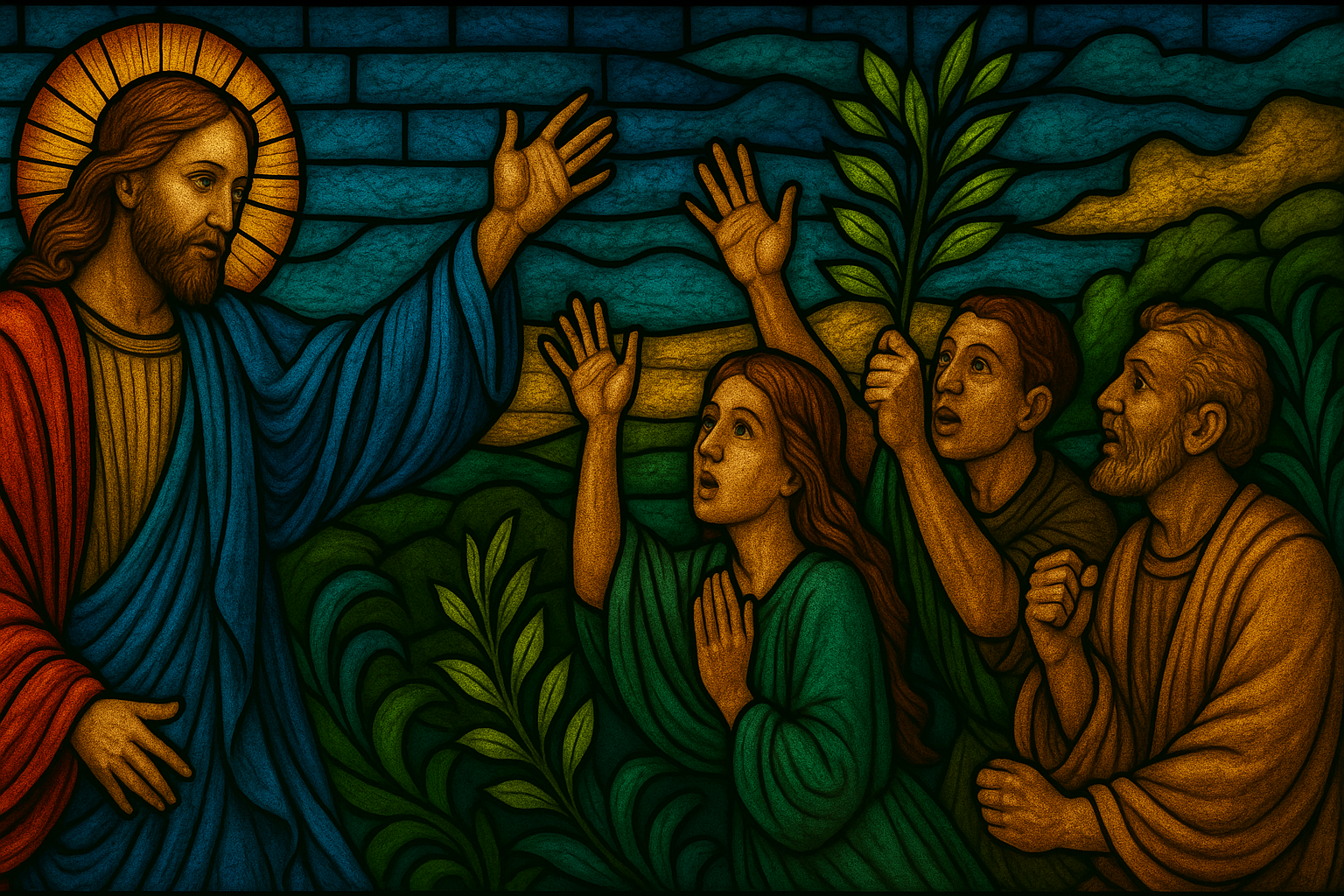
“Welcome Back”
September 10, 1995
A friend of mine recently became rector of St. Bartholomew’s Church in New York City. He recounts this story. One Sunday, a seedy-looking man came to the main service. He walked right past the ushers and sat up front, just under the pulpit. When the rector started to preach, he enthusiastically and loudly responded to each point made in the sermon. Every few sentences, he would let out an “Amen, Amen, brother!” But the man didn’t stop there. In the middle of the sermon, he turned to the people around him and said, “The preacher’s really got the spirit. Let’s all say, ‘Amen.’
This was just too much for the ushers in the back, so one of them in his pin-striped suit and boutonniere quietly came down the aisle and sat beside him and said, “Sir, I’m sorry – we don’t do that here.” “But, but,” the seedy man said, “I can’t help it. I’ve got religion!” The pin-striped usher turned to him with a look of utter amazement and said, ‘Well, sir, I don’t know where you got religion, but you certainly didn’t get it here.”
As we start our fall season, it’s worth thinking about religion. What is it? Where did you get it? Do you have it? Have you found it here?
The word “religion” comes from “religio” in Latin, which means to tie back, or to pull something together. And it refers to what we do as we try to pull our lives together, as we attempt to deepen our ties to God. This is our religion.
Moses, that Old Testament giant to whom we owe so much of our understanding of religion, put it so clearly. “I have set before you life and death – choose.” Religion, therefore, is bringing it all together and choosing life over death. Choosing to come alive over simply existing. Choosing to be a participant in life rather than sitting on the sidelines.
That man at St. Bartholomew’s, however un-Anglican, was at the very least saying, ‘I’m alive. I’ve got the spirit. I’ve got religion. I’ve chosen life over death.”
The great problem for most Christians is not that we don’t believe, not that we don’t know about the Bible; not that we don’t go to church ( at least as some English clergy have taught me – we Anglicans know enough to get hatched, matched and dispatched from the church). The great problem for many of us is that we’re not alive.
Let me share with you a hunch. Most Christians are not alive. They haven’t caught the spirit because they have become vaccinated with a weekly dose of Christianity. In that weekly dose, they have been told that all they have to have for life is to embrace a second-hand knowledge of religion – hearing, singing what others have believed never realizing that they must experience life first-hand. They must choose life over death.
Joseph Campbell, who made such an impact a few years back with ‘The Power of Myth”, said it so well. “I don’t believe,” he said, “that what most people want is to find the meaning of life, nor rules to live by. What they want is an experience of being alive.”
We turn our thoughts to Jesus. As I read Scripture, one major characteristic of our Lord was that he never let a person sit back, retire, rest on his or her laurels, be content with one’s reputation, be a spectator, or sit on the bench. This was the beginning of death – the death of one’s relationship with God. Jesus was always focused on beginnings, not endings. And He believed that beginnings were costly.
For Jesus, it wasn’t simply good enough to be a member. Membership may have its privileges, as the American Express slogan goes, but discipleship has its demands. It calls us out from stagnation to movement, from safety to risk, from endings to beginnings, from stability to chaos, from spectatorship to participation, from death to life.
I resonate with Jesus’s illustration of salt. It’s so basic, down to earth. If salt sits around, remains in a salt shaker – it’s going to lose its taste. We are reminded that if salt is to be alive, it must be used, spread out on food, tasted, flavored, and ingested. And so it is with us. Religion – if it is to be useful, life-giving, zesty – must be used, passed on, spread about, alive.
One of my favorite authors, as many of you know, is Nikos Kazantzakis. In his autobiography, he writes, We know that here on earth for the full span of our lives, Christ is not the harbor where one casts anchor, but the harbor from which one departs, to encounter a wild and tempestuous sea and then struggles for a lifetime” (and we would say becoming fully alive in the struggle). Kazantzakis continues, “Christ is not the end. He is the beginning. He is not welcome. He is bon voyage.”‘
I love that line. Jesus is not here to welcome us, but to say Bon voyage.” And so we might say today that we are not here for Welcome Back Sunday, but rather that we might begin our voyage – our journey in coming alive. How’s that for a slogan? ‘Let’s come alive in ’95.”
Now I would like to invite you to finish this sermon with me_ This is a do-it-yourself sermon. I want to test and see if you can be like that man at St. Bartholomew’s. I want to see if any of you are alive in ’95.
Can you say the word “Amen”? Can you say that? Okay. Amen is a letting-go word. It’s a word you say as you end a prayer, but it’s a call to action. It’s a word that ties you to God and means, “me, too, God.” It’s a word that brings it all together. It’s a word that blesses the past, loves the present, and hopes for the future. I don’t know of any place that God needs to hear some “Amens” from more than at St. Philip’s. Not everybody can say it in a lively way, but we can try. By God, we can try in ’95. Would you say it again for me? “Amen.”
That Amen means that we’re all together here. We’re living out a life here, where people come and love one another. Where we can taste the bread of life together. Where we can feel the spirit of life growing in us. Where can we meet the risen Lord who calls us out to become salt of the earth? Where can we come alive in ’95?
Amen.
“Welcome Back”
“Welcome Back”
September 10, 1995