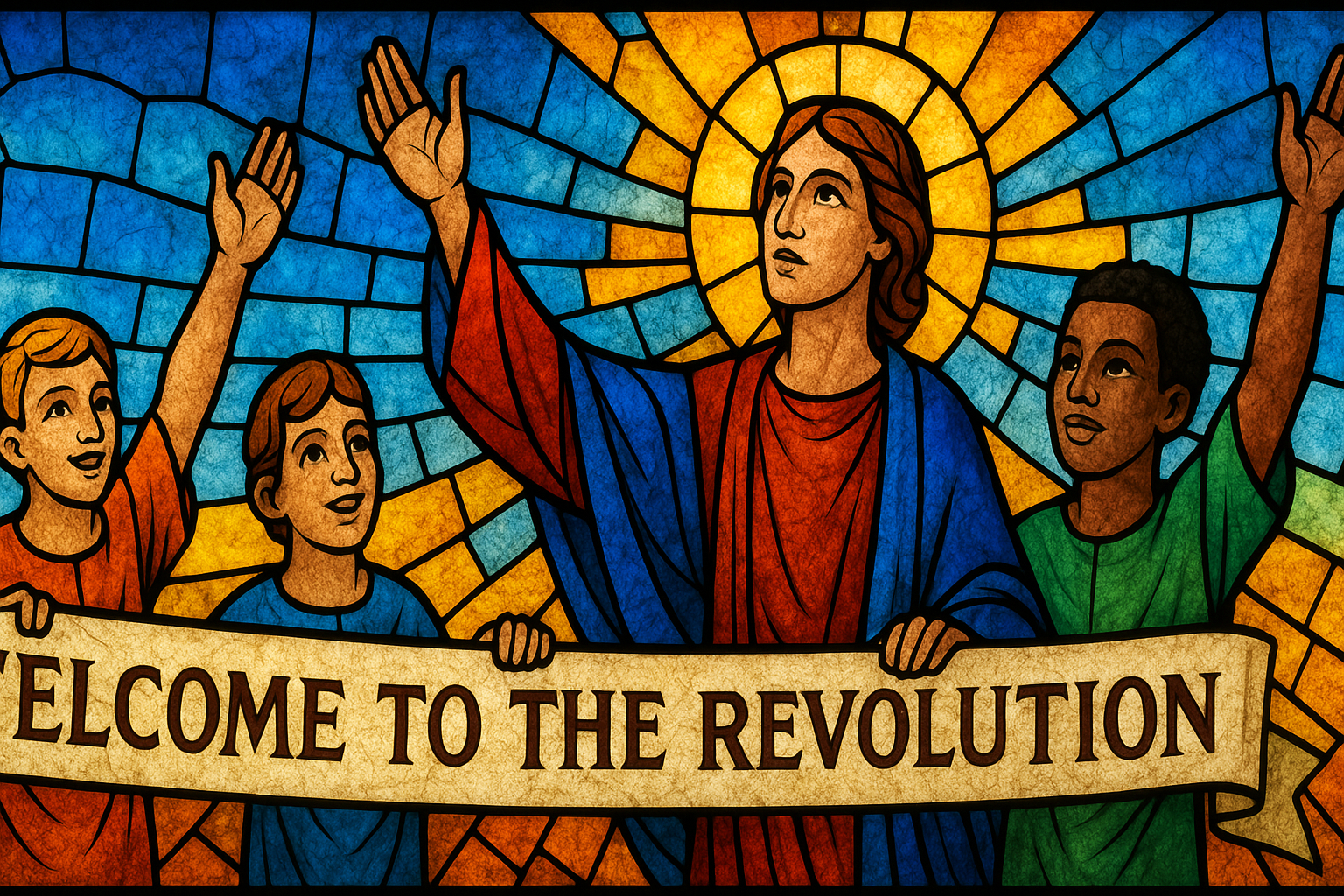
Welcome to the Revolution
August 24, 1997
I want to welcome you back on this special day – this day of new beginnings – this day when we come together to make a fresh start for the fall and winter season.
My text for this day comes not from Holy Scripture, but rather from the pen of the great Christian mystic, Mechthild of Magdeburg. He writes in his journal, “How should we live . . . Welcoming all.”
But first, let me set his words into context – the big picture. I would ask you to consider that we’re at a special time in the life of our church. But even greater than that, we’re at a special time in the life of the world. We’re at a time of radical change, a new millennium where, in order to “welcome all,” we have to radically change our way of doing business.
This summer, I picked up a book by Tom Peters, the management guru. He starts off by saying, “There’s little doubt that the times are crazy, and getting crazier. Whether you’re a banker, a housewife, or a public official, the times are out of joint. And all of us are trying to cope with an insane world.”*
So welcome to the revolution, where everything is being called into question. Where the foundation of the world is crumbling, and even the process of “welcoming all” is not as easy as it used to be. Even the church, that bulwark in a mixed-up world, is a different animal from what it was when we were younger.
Some of you who have been going to the 7:45 a.m. service during the summer will have heard this. Last month, I went to the General Convention in Philadelphia for a few days. I sat down at a luncheon next to a woman, and we talked about how the convention had changed, about how we were going through a revolution. In a voice filled with frustration and anger, she spoke of remembering how former conventions had been “a wonderful, pleasant gathering of old friends.” Then she looked me in the eye and said with feeling, “Before the new Prayer Book, before the ordination of women, before the acceptance of homosexuals, we had a darling little church.
Now, you and others like you have ruined it.” Well, she was right. That darling little church has disappeared, right along with the darling little communities that supported it. We’re no longer a homogeneous grouping of people who have gone to the right schools. We’re no longer the Republican Party at prayer…To be able to welcome all, we are no longer able to have. God as a hobby, and the church as a bastion against the changing world.
A friend of mine accurately identified the mood of many people who, like this woman, feel abandoned by their church. “These people,” he said, “try to escape from the world into a psychological Disneyland, where the 1990s and their deeply conflicted lives cannot be found.” The lady at the convention wanted to be in the 1950s again. She resented anyone telling her that a revolution was upon us and that we are living in a crazy world.
To survive and thrive in this crazy world, we’ve got to do as Alvin Toffler has suggested. We’ve got to reinvent ourselves. To do this, we have to be honest about where we are and where we are going. “To welcome all” is going to call for a lot more than what we are presently doing.
Can’t you imagine our generation at the Last Judgment being interrogated? “Did you feed the hungry? Did you love the downtrodden? Did you welcome all??? “No, but we balanced the budget.” “Did you take care of those who could not take care of themselves, the children, the poor, the third world?” “No, but we cut taxes.”
My point this morning is that we are personally and corporately going through major changes. These changes are going to force us to be more honest about our decisions, more honest about the implications of “welcoming all.”
Choices, that’s what it’s all about. That’s what rm going to be talking about in one way or another for the next six months. Sometimes we’re going to feel uncomfortable, for we’re going to be asking those hard questions, questions like who do we welcome, and how do we welcome them? It’s a high-risk activity, and most of the time, we hope that our choices don’t really matter. But they do-don’t they? Particularly, the choice between love and fear. Love and fear are the choices for those who are in the midst of a revolution. As the poet has said:
There are only two feelings that count, love and fear.
There are only two languages, love and fear.
There are only two activities, love and fear.
There are only two motives, two procedures,
two frameworks, two results, love and fear.
One way or another, we are challenged with choosing between love and fear. The choices tell us what is permitted and what is forbidden in these crazy times- But wait, what does it mean to love, and what does it mean to fear? To fear means to seek safety, to exclude that which may do harm. We are permitted to live our lives and construct our world in the way it has always been, the way we were taught. Trusting in the old ways, the old certainties.
To love means to take risks, to choose aliveness over comfort, to form attachments, to enter into community. And finally, loving means joining the revolution. It is forbidden to rest with the status quo. To love means to be willing to be a part of a new world where the operative words are, “Welcome to all.”
As we start our year together, I would ask you to consider choosing to love, particularly choosing to love children. And to act out that Choice by saying “Yes” to a future that includes making room for children.
I read, not too long ago, of a report on National Public Radio. I haven’t been able to shake it from my mind. A reporter covering the terrible conflict in Sarajevo happened to see a little girl shot by a sniper. The reporter threw down his pad and pencil, and for a few minutes stopped being a reporter. He rushed up to the man holding the child and helped them both into his car.
As the reporter stepped on the accelerator, racing to the hospital, the man holding the bleeding child said, “Hurry, my friend, my Child is alive.” A moment or two later, “Hurry, my friend, my child is still breathing.” Finally, “Hurry, oh my God, my child is getting cold.” When they got to the hospital, the little girl had died.
As the two men were in the restroom washing the blood off their hands and their clothes, the man turned to the reporter and said, “This is a terrible task for me. I must go tell her father that his child is dead. He will be heartbroken.”
The reporter was amazed. He looked at the grieving man and said, “I thought she was your child.” The man looked back and said, “No, but aren’t they all our children?”
Love or fear. Loving means believing they are all our children. Loving means joining the revolution where each of us is truly welcomed as Gods child.
Amen.
Welcome to the Revolution
Welcome to the Revolution
August 24, 1997