“What Can I Know?”
1 Corinthians 13
October 1, 1995
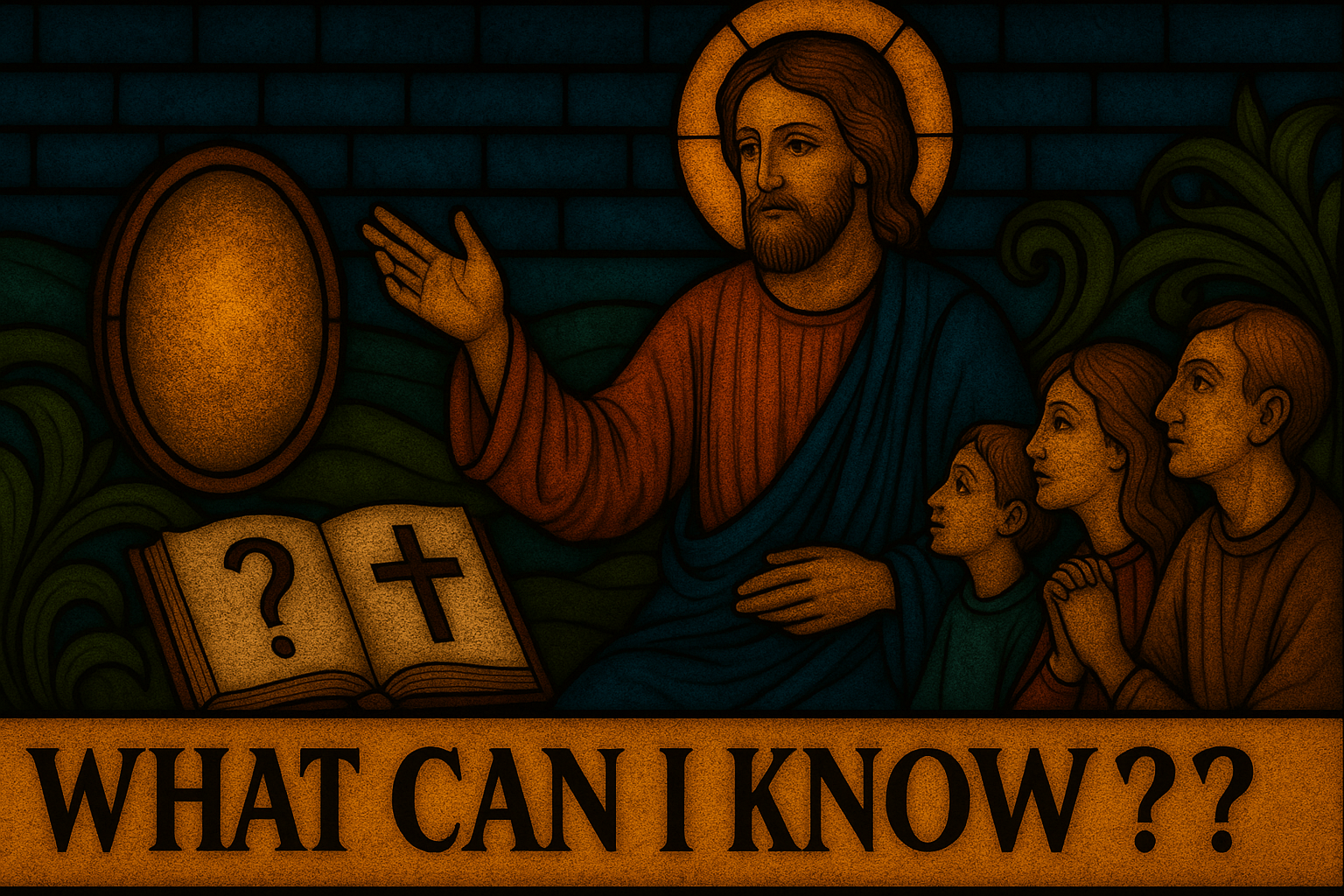
My text comes from the 13th chapter of Paul’s letter to the Corinthians. This is one of the most repeated chapters in scripture. I’m always amazed that 9 out of 10 times, this is the choice of people for their wedding service. It really has nothing to do with marriage. what Paul is basically saying to the Corinthians is Grow up. And so here is my text: when I was a child, I spoke like a child, I thought like a child, I reasoned like a child. But when I became an adult, I gave up my childish ways. In other words, as a friend of mine is fond of saying, we are young only once, but we can’t be immature forever. And how you ask, can we grow from immaturity to maturity, from childish ways to adulthood? There’s the rub. And that’s what I expect to explore with you today. Immanuel Kant once claimed that to grow, to mature from childhood to adulthood, a person must be willing to wrestle with three basic questions. The 1st is, what can I know? How much can I know? What do I need to know to fully become an adult? The second question is, what ought I to do? Here we face what actions are appropriate and what behaviors to grow into full maturity. And finally, what can we hope for in this confusing life? What can we bet on for a full life? Can’t believe that facing these three questions was the beginning of a growth period. you are only young once, but without grappling with these questions, you can be immature forever.
What, then, do we need to know for maturity? The question isn’t really about information. That is easy. The computer takes away the worry from the issue. We no longer have to store data in our brains. All we have to learn is what key to press. But data alone cannot tell us what we need to know about being mature. Information by itself cannot decide, judge, or discern how we might become a fully operational adult. And it certainly cannot tell us how to relate to God, or how to relate to each other.
Scripture offers us 3 principles which are enormously helpful as we wrestle with the question of how much we need to know. The first principle is that we can’t know at all. Paul tells us this when he says, Now we see in the mirror dimly, but never in this world face to face. And wasn’t this the sin of Adam and Eve? They wanted to eat of the tree of knowledge. They wanted to know it all. It wasn’t an apple; it was knowledge to be like God.
There’s a wonderful fable, popular among psychotherapists, about this problem. It’s about a woman who goes to a guru and says she wants to know everything there is to know. So he puts her in a cave and gives her lots of books. At the end of each day, he comes to her and says, Well, do you know everything there was to know? And she says, not yet. So he gets a big stick and whacks her over the head. You think she would be discouraged, but no, she continues to read voraciously, and every day the Guru comes back to The Cave and asks the same question. Do you know everything there is to know? She replies no and the stick comes up and whacks her on the head. This goes on four months. Finally, the guru goes to the Cave. It’s the end of the day, and he asked the question, do you know everything there is to know? And she says no. And as he lifts the stick to strike her once again, she has finally had it. She stops him. The guru smiles and says, Congratulations, you know all that you need to know. You know two things. You know you cannot know everything there is to know, and you know how to stop the pain. I would say to you who are here today, you know all you need to know, and you know how to stop the pain. The useless pain of searching for easy answers in this complex world
The pain of trying to get it all together, to be whole, to be congruent. If we are to be honest, we have a long way to go. The pain of trying to see clearly, when, if we are going to be truthful, we would say that we only see a mirror dimly and only in part. But despite this, we can declare that we are loved and understood as we search for the answers to life. And with that knowledge, the pain can be lessened.
The second truth that is basically related to the first is that human beings are basically unfinished. The principle is so deep in scripture that I wish people would grasp it more fully than they do. We would save ourselves a lot of pain and frustration if people could only realize they are unfinished.
There’s a wonderful story told about some theologians who were studying the creation story. They were puzzled when they read the story of creation, or after every act, saved one, they found the same words. And God saw it and it was good. But there was one particular act where good was not used. When it talked of God creating men and women, the word good was omitted. Finally, the theologians came up with the solution. In its context, they decided that good refers to a job well done, finished. We say, That’s a good job, when we mean it’s complete, it’s concluded. But with human beings, this is not the case. The heavens and earth were finished, wrote one commentator, but human beings were not and are not. We are left unfinished. A rough cut. So that we may be carefully formed, shaped, and changed.
This is buried deep into the heart of scripture period time and time again, it is written that we human beings only begin to know anything by being in community with each other, sharing, supporting. Whenever two or three are together there I am in the midst of you. Knowledge, real knowledge, only comes alive when it is shared. God is present only share. That’s a truth you need to know. It’s a deep truth of the gospel. We can only grow by sharing our questions as well as our pain.
Let me pass on to you a story which is kind of a parable that underlines our thoughts this morning. It comes from the stories of the Hasidim, those are holy men who began a renewal movement in the 18th and early 19th century of Judaism in Eastern Europe.
The story is of a man who lived in a little village somewhere in Poland. He was a good father, a faithful husband, and an honest Craftsman. But what he really lived for was the study of scripture, which he had done most of his life at the feet of the old rabbi who had served the synagogue in the village for more years than anyone could recall. It came about one day that this man had to move to the great city of Kraków to live and work. There was only one thing that bothered him about the move. He grieved his heart to think of leaving his beloved rabbi. So he went and saw the rabbi and poured out his problem to him. Teacher, he said, all my life I have studied with you, now I must move to the great and large city of Krakow. Where will I find another rabbi who can guide me in the journey towards God?
Well, the old rabbi thought for a moment and finally said, I’ve never been to the city of Krakow. I am not acquainted with any of the rabbis there. But this I can do. Can tell you how you might find such a rabbi. When you get to the city of Kraków, look around until you see a synagogue. Any synagogue will do. Go in and ask to see the rabbi and say to him, Teach me how I may learn all about God and the deeper questions of life while I am attending your synagogue? And when the rabbi answers you, listen carefully to what he says. Maybe write it down. And then say, thank you very much, and go on your way, for that is not the one.
Walk around until you find another synagogue. Go in and ask to see the rabbi and say, Teacher, how may I know all about God and the deeper questions of life while I am attending your synagogue? This time, listen very, very carefully and write down for sure. Then go on your way, or he is not the other one either.
Finally, go to another synagogue and see the rabbi and say Teacher, how may I know all about God and the deeper questions of life while I attend your synagogue? And if the rabbi says, my son, all my life I have been wrestling with those kinds of questions. Now there will be two of us searching.
Together we can search. And together we can find the strength to constantly ask the deeper questions about God and the issues of life. And together, possibly some of the pain of not knowing at all, I’ve seen through a mirror darkly, of being unfinished, of wanting to be adults, but finding ourselves to be childlike, some of the pain can begin to be lifted, and we can begin to mature. Now we see in a mirror dimly, but then face to face. now we know in part that we shall be fully known. Amen
“What Can I Know?”
“What Can I Know?”
October 1, 1995
Scripture: I Corinthians 13