What is God’s Name?
Exodus 3: 1-15
March 25, 1992
We begin this morning with the story of Moses. it is a story filled with meanings. Moses, in many ways, represents each of us. You might recall at the beginning of the story, we find him wanting to be a leader of the Jewish community. As a matter of fact, he wants it so much that he goes out and does something that horrifies everyone. And what he learns is that the Hebrew people aren’t ready to accept his leadership. Have you ever been there? Have you ever wanted to lead, but when you looked around found yourself 10 miles down the road and no one was following?
Moses decided to take off, and he went to tend some sheep, which can be translated into modern idiom by saying he left Egypt ” to do his own thing.”
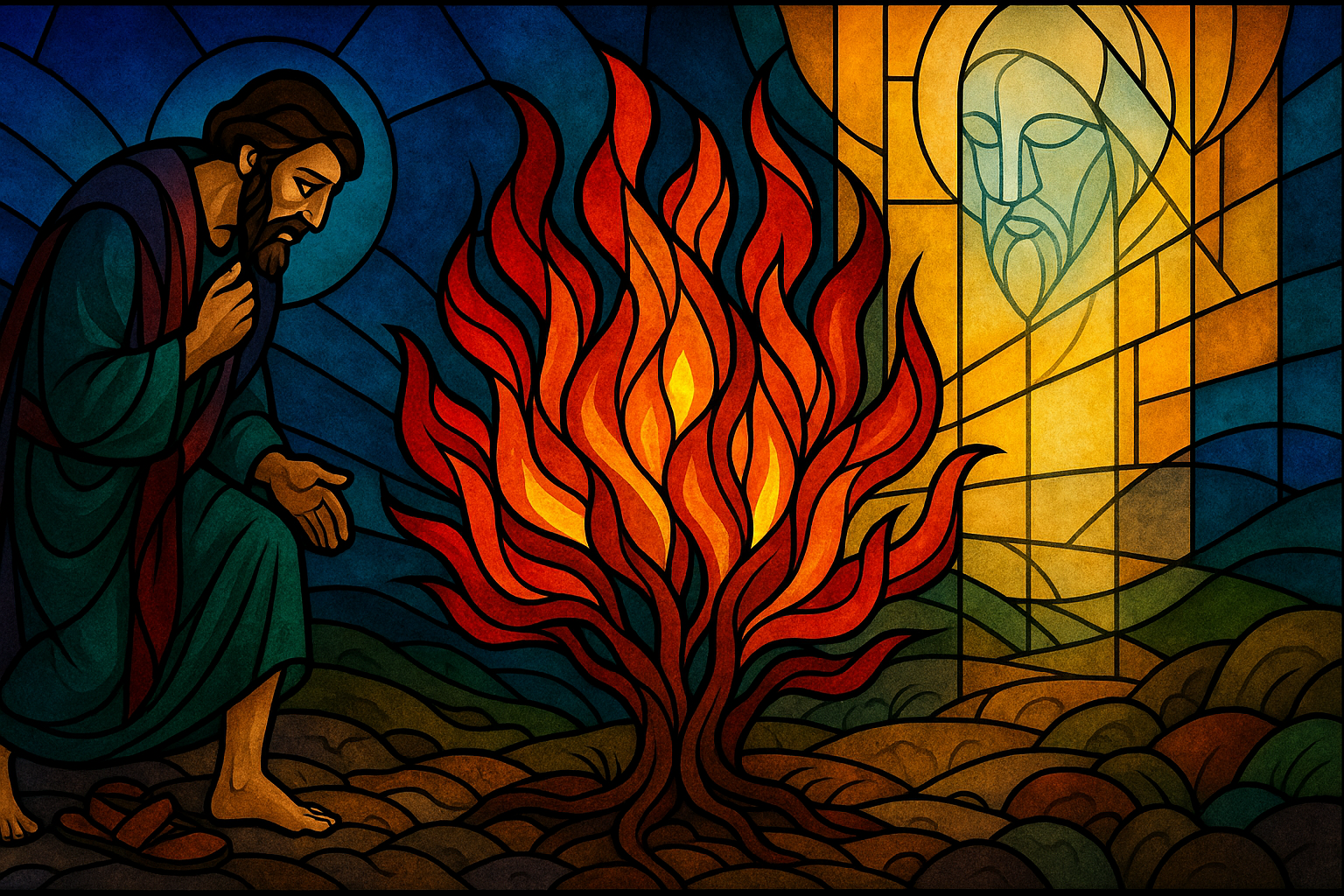
Years later, we pick up his story where he encounters a burning bush and has some kind of religious experience. And like most religious experiences, it contains within it a call to some actions, a call to leadership.
God spoke to Moses and said: -I want you to lead my people. ” And Moses answered: ” bio way, I’m willing to take off my shoes, to acknowledge the validity of this experience, but as to leadership, that’s ridiculous. I’ve tried that route and failed. ” Unfortunately, God doesn’t accept past failures as a reason for present inaction.
Finally, after using up all available excuses, Moses plays his trump card. “Suppose, ” he says, “those Hebrews question who sent me. What will I say? Suppose they say: ” What is his name? What shall I say?”
What is God’s name ? Here we are at the heart of the matter. It ‘s not good enough to declare your leadership. Moses now realizes you have to be called, sent out, set aside for leadership, and the central question is: What is the name of the one who has called you out? What is God’s name?
There is a cute story told of a little girl saying her bedtime prayers with her mother. She began by saying “Dear Harold, please bless Mother and Daddy and all my :friends. “Wait a minute, ” interrupted her mother, ” who’s Harold? “That ‘s God’s name, ” was the answer. ” Who told you that was God’s name?” asked the bewildered mother. I learned it in Sunday School. Mommy. Our Father, who art in heaven. Harold be thy name”.
So what is it, if it isn’t Harold? What do you think God’s name is? Moses standing by the burning bush wasn’t simply stalling. He realized to know God’s name meant to be in a major relationship with God. it was a sign of intimacy _ it was the next step after taking off God’s shoes.
The ancient Israelites traditionally believed in the power of God’s name. His name was never spoken lest they transgress on his majesty and glory. The 10 commandments are very explicit. They warn against taking the Lord’s name in vain. We have watered it down to the point we think the commandment is about cussing or swearing: Not so for the Hebrews. God’s name was not even written, except in symbols. Yahweh, or as we translate it, Jehovah, is a name derived from these symbols, but that name was never to be spoken aloud.
it was too personal, too powerful, to be communicated. And so it was in the New Testament times, Jesus claims to know his name meant power; ” Whatever you ask in my/ name will be done. ”
But what about today? What name do we use when we call upon God? What is God’s name to us? I’m afraid we haven’t even asked the question, for deep down inside of ourselves, we act as if God has taken a sabbatical. Why worry about the name of someone who isn’t there?
At other times we have some sort of a frustrated hope that a God who isn’t there will drop by to tidy things up, even’ once in a at some point, to clear away damage. If we don’t know the name of this overworked maintenance person. Perhaps if we did, we could consider paging him if we had an emergency. We don’t blow God’s name. not out of fear, or reverence, or diffidence. Today, it’s because we are out of touch with God
We’re like the person in the sinking rowboat who gives up bailing and begins to pray and says: “0 God, I know I haven’t been to church, I haven’t supported my work done in your name, I haven’t acknowledged your presence in the past 30 years. But if you’ll just rescue me, I promise I won’t bother you for another 30 years, ”
I can’t leave this analysis without saying a word about the linguistic issue. I recognize our hesitancy also has to do with sexual ambiguities. Do we address God as He or She? Gender seems to make a difference.
The other day, in our clergy lunch, someone asked Abbot David a question about gender confusion in the Godhead. He said: “In the Roman Church, we never speak of Jesus, we always refer to the 2nd person of the Trinity, as ‘The Christ ‘. ” But of course, that just avoids the issue.
God’s name – it has become a political football . We worry over gender at a time when we should be concerned over relationships.
The call that comes from God is the call from the very heart of existence, where there is neither maleness nor femaleness, where there is neither an American God nor an Asian, and where there is neither a Black nor a white God.
We see that God’s naming of Herself was done with infinite tact. Moses says: -Who shall I say has called me out? Who has made me leader?” And God answers : “Tell them ‘ I am’ has sent you ” . Wow, there is a dazzling truth here.
God can not be manipulated, organized, controlled, domesticated, or genderized. God’s name is different from what we would expect. Surprise is her middle name . ” I am” avoids the sexual imagery, yet tells us that God is found within the human condition. “I am” says, in order to name God; we have to look within ourselves, to take off our shoes, and be open to the call. “I am” calls us to finish the designation.
Auden once said, “You have to be a poet in order to speak about God. ” Moses standing on the plains of Midian has left us not with an answer to God’s name as much as a poetic call to action. He takes off his shoes and then asks God’s name.
For if there is any truth of Moses’s call to this: Whenever we ask God’s name, we are given a task, a job to be done. And whenever we identify God’s presence, we are called to leadership.
Elizabeth Barrett Browning, one day, was meditating upon the story of Moses and how it spoke to her life. This is what she wrote:
“Earth’s crammed with heaven
And every canton bush afire with God, but only he who sees takes off his shoes
The rest sit around and pluck blackberries.
I guess the choice is ours. Do you want to be a blackberry picker or do you want to join Moses and learn God’s name?
Amen
What is God’s Name?
What is God’s Name?
March 25, 1992
Scripture: Exodus 3:1-15