What Kind of God Do You Believe In
March 27, 1994
I seem to be into Rabbi stories this year. They often combine the wit and wisdom of the ages. You may have heard this one: “There once was a Rabbi who complained to his tailor about the inordinate amount of time (six weeks) that he was taking to make a pair of pants. ‘After all,’ the Rabbi said, ‘it only took God six days to make the world.’ ‘Yes, Rabbi,’ answered the tailor, but just look – in taking only six days – what a mess he made of it.”
Well, the world is a mess. It’s difficult to deny. And much of our lives – if we’re to be honest – are a mixed bag of messes with maybe a few bright spots. We’re up – we’re down. We lead a parade – and the next moment we’re rejected. The same people who are cheering you on, saying: “Atta boy – you tell them” – are quick to say: ‘Who needs him?!”
Life seems to be one darn thing after another. The good and the bad are all mixed up. Sometimes, when I am feeling particularly cynical, a voice within me says: ‘History, our own as well as the world’s, seems to be merely a record of our deepening psychosis. Everything first appears to be under control, and then everything goes haywire.”
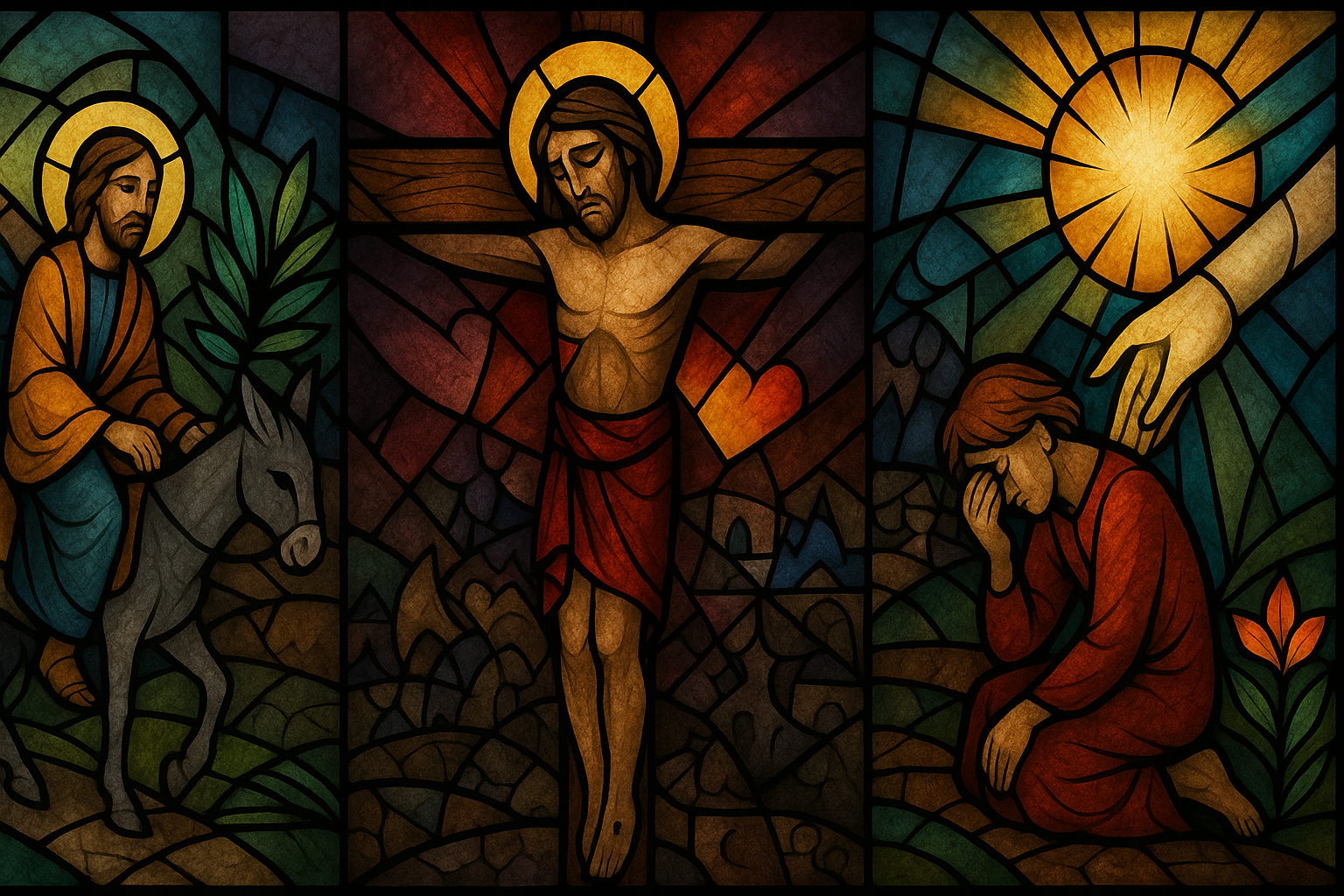
If we allow ourselves to speculate upon the state of affairs, we often raise the question of “why.” What kind of perverse creator allows us to be lifted up to the heights and dropped down to the depths the next moment? What kind of God makes a world where crucifixion follows a triumphant entry? Maybe the Almighty should have taken more than six days.
We used to hear the question: “Do you believe in God?” One doesn’t hear that much anymore. The question now is: ‘What kind of God do you believe in? A God that interferes, protects, helps, rescues?
Or one that allows his son to be killed after leading a jubilant parade?” I sometimes picture a group of people sitting around a table saying: “Should we or should we not mention it? The world is a mess. Things are out of control. Is our God really in charge?”
C.S. Lewis was one of the great Christian thinkers of our day. He started out pretty much as an atheist, but became a champion apologist for the Christian faith. Later in life, he met and married a most beautiful and talented woman. Soon after, his wife took sick and died. In his agony over the death of his wife, Lewis began to seriously question: “In a world where a Beethoven goes deaf,” he writes in his pain, “if there is a God, he must be a spiteful imbecile.” Lewis finally concludes: ‘In a world that is such a mess, God must be a cosmic sadist.”
What kind of God do you believe in? One that is not really in charge – or one that is a cosmic sadist? Neither alternative seems terribly attractive. What kind of God does the Christian religion offer?
So here we are – on the week before Easter, struggling to maintain some kind of cherished beliefs about God. And we have thrown in our face a crucifixion – an early illustration of when bad things happen to good people. What are we to make of this? Is God a sadist? Should we simply give in to despair? The world is a mess. Evil is on the throne, and Goodness is on the scaffold. There is no supernatural intervention in the downers of life. The passion story is about a world gone crazy.
Possibly, the challenge of this day lies in the disintegration of our notions of God. Possibly, we are being asked to look at the world through different eyes
Let me suggest that suffering is one of the ways that God uses to enter into our lives. Simone Weil, the Christian mystic, once said: “The supreme greatness of the Christian Faith’s understanding of God and the world lies in the fact that it doesn’t seek a supernatural remedy for evil, pain, and suffering. Instead, it tells us that there is a supernatural use of suffering.” The God we believe in does not stop a crucifix-
ion. But this we do know – God uses the crucifixion to show the world his love.
Several months ago, Mother Teresa came to the United States. While she was here, she told a story about a woman who was suffering and in a great deal of pain, both emotionally and physically. She had been rejected by most of her family for having AIDS. The woman asked Mother Teresa to explain how this could happen to her. How could God allow this? Mother Teresa said, “Your AIDS is the kiss of God.” When I first heard this, frankly, I was shocked. That doesn’t sound like the God I know. ‘Your bad fortune, your suffering is the kiss of God?” Incidentally, the story doesn’t end there. The suffering woman responded: ‘Please, Mother, tell God to stop kissing me.”
Well, what do we make of all this? Jesus, the Son of God, the Messiah, reveals the very nature of God by starting out leading a parade and ending up on a cross. The kiss of God is not always an invitation to success. It can also be an invitation to crucifixion. And “sometimes it causes me to tremble, tremble. . !’ A thought in conclusion: I must often believe in my life that the hard times, the pain, the messes – are somehow an intrusion, something to be surmounted or avoided – not part of God’s plan. But Palm Sunday reminds me that a crucifixion may be the kiss of God – the way God enters our life.
And remember – as you walk the way of the cross this week – remember that for we Christians, our belief in God is in the one who uses suffering and defeat. And then remember: “It’s not over ’til it’s over.” See you next Sunday. AMEN
What Kind of God Do You Believe In
What Kind of God Do You Believe In
March 27, 1994