Whitsunday 1977
May 29, 1977
One of the non-essential bits of reading to which I often draw back is the Personal Section of the Sunday Times. It’s good fun to browse and imagine what lies behind the short cryptic messages. Here’s a fascinating one I read a while ago. Let me share it with you, Gladys W. Happy Anniversary. Thank you for 14 wonderful, 4 so-so, and 2 rotten years. Signed, Bert W.
Therein – I bet – hangs a tale,
Today is the Feast of Pentecost – or what is generally called Whitsunday- it is the celebration of an anniversary, a time when we remember that God entered into a special relationship with a group of people. A time when God infused Himself – through His spirit – to form a unique community, which we call – The body of Christ, or the bride of Christ, or the spirit-filled community, or simply the church.
On this day, can you imagine, reading in the Tucson paper Personal Section these words? To the Church. Happy Anniversary. Thank you for 1400 wonderful, 400 so-so, and almost 200 rotten years. Signed, God.
Therein also hangs a tale
The church has had some wonderful years. Years where the community has been so caught up, so connected, so spirit-filled – that no one could possibly doubt that these were the people of God.
The wonderful years were the periods in our history, where love, sacrifice, caring, rescue and reconciliation were the principal characteristics of our community. And don’t think that the early church had a monopoly on these characteristics. The vision of the first church at Pentecost has been confirmed.
One of the most stifling factors in the churches growth process is our tendency to sing that old song, ‘ Those Were the Days, with Archie Bunker. Those were wonderful days , to be sure, but they were certainly not the only times. There have been many periods of history where the church has emerged as the healing-saving instrument of God – to a broken, lost world, and it’s been a magnificent sight to behold.
But in the past as well as in the recent days, there also have been so-so and rotten years, Years where, as I heard a preacher say recently: 11Any relationship between God and the Church is purely coincidental.
That the problem exists in recent years as with the good ones. Certain periods of history don’t have an exclusive monopoly on being rotten. The tendency, for instance, is to focus on the Spanish Inquisition, and this blinds us to seeing that other times can be just as rotten, even though they are not as dramatic.
Ted Wedel, the late , great warden of the College of Preachers in Washington, once told a parable that explained how the church moved so easily, from the wonderful to the so-so to the rotten years. Here is a paraphrase of his Story.
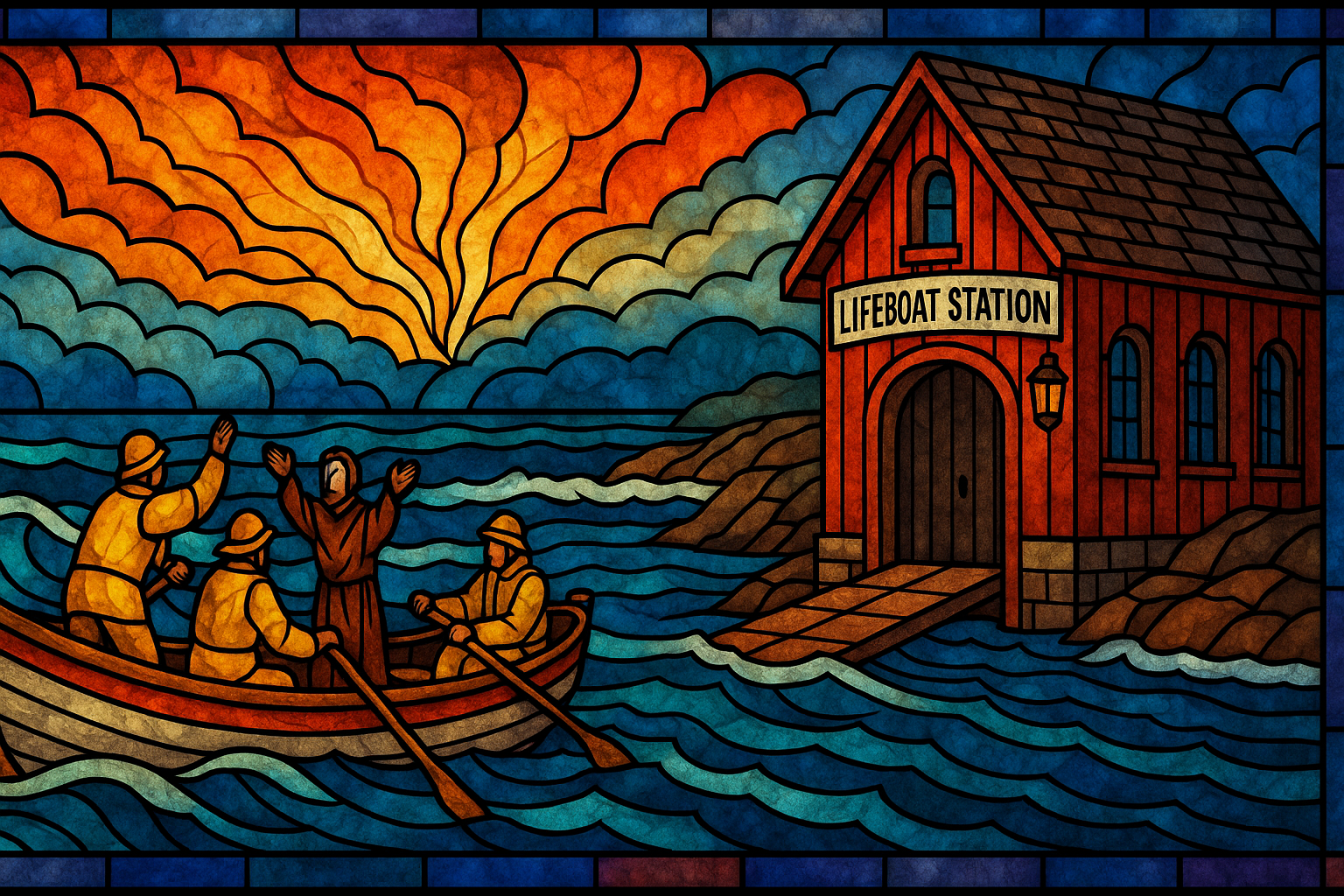
Picture, Wedel said, the church as a coast-guard or life-saving station on some lonely and dangerous coast. We’ve probably all seen one. The coasts of New England abound with similar types. This particular one has stood for many years, and tales of its rescue service are preserved by the successors of the original members. Stained glass windows in the life-saving station honor the heroes of its golden years.
Over time, those who manned the rescue service turned to expanding and beautifying the station itself. Do not life-savers deserve comfort and rest to fit their difficult job? Isn’t our job so important that we ought to, as honorary members, keep adding
more and more to our ranks?” Shouldn’t we spend more and more time discussing who we will take into our ranks?
The problem was that in time, station building and discussing became such an absorbing activity that the rescue service itself was increasingly pushed aside. Sure, traditional rescue drills and rituals were carefully preserved
But as things went from bad to worse, more and more energy was spent in arguing over the proper method of rescuing, and who was qualified to be leaders of the work, Many times in the history of the station – things got so rotten that the actual launching out into ocean storms became a hireling vocation – or one left to a few dedicated volunteers, And when people came in, they were ignored or barely tolerated.
Dr Wedel’s analysis in parable form shows us the process of how we slip from the golden into the rotten years. And this process always lurks in the background of our life together. To be warned of the possibility is to be armed against it.
But to us – on Pentecost Sunday – The Sunday, when we rejoice in our relationship to God, The Sunday when we read of the Original Founders of our life-saving station, The Sunday when we act out our liturgy in the spirit of the early church: We might raise the Are we moving into the good years or the rotten times? Where are we at St. Philip’s?
I have been going around the parish for the past month and hope to continue for the next
five months, having coffee. And I have learned a great deal about your visions and dreams. You’ve shared with me your priorities for St Philip’s, and I’m grateful. Grateful for the opportunity to become closer to many of you.
And grateful for the opportunity to follow up ,- ”I’ll tell you my dream – you tell me yours, 11
The writer of Proverbs said, That without dreams, the people perish. And I would add that after eight coffees, I am even more convinced that without visions, without a vision of the golden years, a parish can slip into the SO-SO years quickly.
It’s so easy to have this life-saving station on Campbell and River road become a beautiful mausoleum rather than a welcoming, inclusive, vibrant home for all people.
On Whitsunday 1977, I want to declare to you that the wonderful Golden Years are ahead of us. All we need to do is learn to dream dreams and act out our visions.
I would like to end this sermon by sharing with you the vision of one of my heroes of the faith. It is a vision he presented to his congregation in England many years ago on Whitsunday and it was the beginning point in the process of transforming a very staid, old, worn-out congregation to a living, vibrant, exciting parish. Here is Dick Shepherd’s vision for his parish in England:
“I saw a great church standing by a square in the great city of the world-‘ Into its doors passed hundreds and hundreds of all sorts and conditions of people going up to the temple of their Lord with all their difficulties, trials, and sorrows.
And I said to some of these as they passed Where are you going? And they said: This is our home. This is where we have been made to feel welcome. . where we have learned of the love of Jesus Christ.
Amen
Whitsunday 1977
Whitsunday 1977
May 29, 1977