“A Dangerous Book”
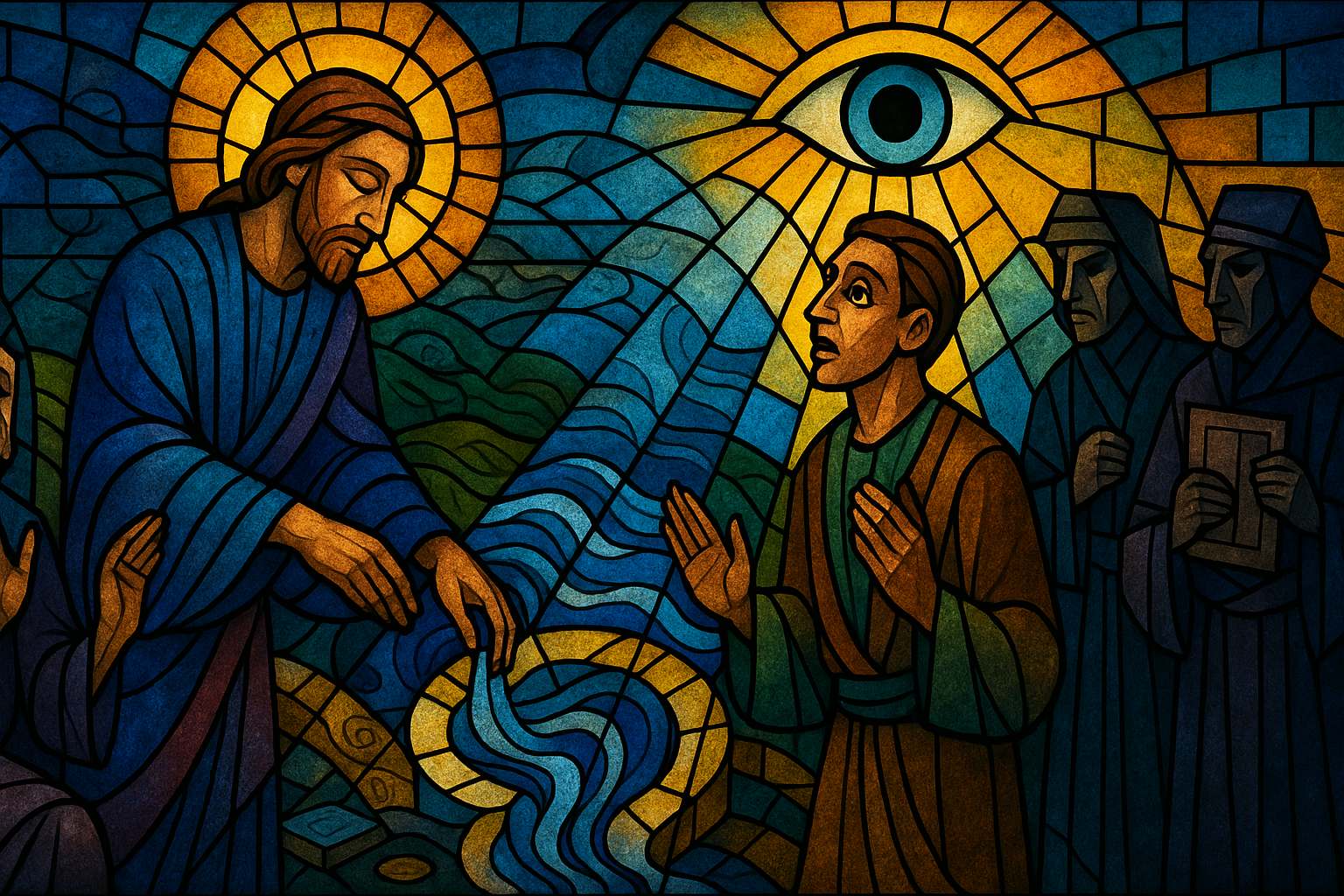
John 9: 1-28
March 17, 1996
I have great sympathy for a group from Indiana. They want to place a card next to all the Gideon Bibles in hotels – a card which says: “Be careful, this book can be hazardous to your health. If read closely, it is a dangerous book.”
Perhaps most books should carry warning labels like cigarette packages. Strange things happen when one reads an important book. The Bible, especially, can change your outlook on life. If read closely, it can be a scandal. It is meant to upset us. Its power lies in its refusal to fit into our well-ordered scheme of things.
Take, for example, our morning reading. We’ve heard it before – John’s account of Jesus healing a blind beggar. We hardly register when the story is told. Yes, that’s right. Jesus was a healer, and he healed a man who was blind. But what has that to do with us? What does a story of a person being healed 1900 years ago have to do with us?
There is a group of scholars who have gathered a certain notoriety in the past year. They call themselves ‘The Jesus Seminar.” The purpose of the group is to determine which stories in the Gospels about Jesus are historically accurate. In other words, is it true? Did it really happen that way? One of their conclusions is that John’s Gospel, from which we just read, is not literally true. It probably did not happen in the way John reports it. But, having said that, they would go on to say, “Look closely at the story for it can open our eyes to the real Jesus.” John is not trying to give us a detailed account of Jesus’ life. He is inviting us into a new relationship with Christ.
So, let’s take the invitation and look closely at the story. And let’s do it to meet Jesus in a new and radical way.
The first thing we might notice is that Jesus challenges the conventional wisdom of his day. “Rabbi,” the disciples ask, ‘Who sinned – the blind man or his parents’ Conventional wisdom said: “You reap what you sow,” or to put it into 20th Century words, ‘You get what you deserve.” The Jew of the First Century looked out on a world that was governed by the law of rewards and punishment. If a person were blind, obviously, he was being punished for some transgression, or possibly it was his parents’ fault.
We who are so much more sophisticated with a smattering of know-how of modern medicine think to ourselves: “How naive. We have knowledge of disease and how hard times can hit the bad as well as the good people.”
But are we really so different? Isn’t it true that conventional wisdom tells us that if we are good we will prosper?
Don’t most people believe that God will reward the just and bring good fortune to the righteous? And just in case God slips up in this life, we hang on to a belief about the Last Judgment, where if nothing else works out, the good guys will at least win in the end. Isn’t that our conventional wisdom?
The Jesus of this story says “no” to conventional wisdom. He declares that God is a God of compassion, not a God of rewards and punishments. And to show this, he heals the blind man.
Looking at the story again, we find an amusing subplot. The man is healed, and the people refuse to believe that it happened. The neighbors begin to question his identity. And then the religious leaders start in on his parents. Denial is very much a dynamic here. After all, it wasn’t done by a recognized, card-carrying healer. And it wasn’t done in the proscribed way. It’s sort of the way many of us react when we hear of alternative medicinal cures. First, we dismiss it as voodoo medicine or magic. And then we say it didn’t really happen – the person didn’t really have the disease that he or she thought.
A friend of mine preached a sermon several weeks ago where he said that everyone traveled through life with some kind of a map. These maps provide us with landmarks that tell us what to make of certain experiences. They help us from getting lost. ‘Everyone,” my friend said, ‘has such a map.
Some maps are small and sketchy. Some maps have been largely inherited or borrowed from other people. The map helps us to see what is real and what is imagined.”
The Jesus presented in this story is one who is not recognized by conventional maps. He heals in an unorthodox manner. He spits on the ground, puts a little dirt on the man’s eyes, and tells him to go wash in a pool. Not only is he unconventional in his approach, but he doesn’t have the proper credentials – no seminary degree or medical school license. Is it any wonder that the whole incident is called into question? is it any wonder that with their old maps the Pharisees would say: ‘We know that God has spoken to Moses – but as for this man Jesus, we do not know where he comes from.”?
John, in this story, reminds us of the difficulty of religious people recognizing Jesus. “This man is not from God,” they declare, “for he does not keep the Sabbath.” If one looks closely at the Gospels, one cannot help but see that Jesus was unalterably opposed to what Biblical scholars call the purity code, those regulations found in such places as Leviticus. (It always amazes me how Christians are always quoting Leviticus to buttress their arguments.) The reason Jesus was against these laws, or codes of conduct, was because they attempted to tell who was pure and who was impure, who was in the right and who was in the wrong, who was saved and who was damned, who was in and who was out. The healing of a beggar is a bold statement that in God’s eyes, there are no ins and outs. The good news is that God’s love is for everyone, regardless of who you are or where you’ve been.
I understand that a few weeks ago, in Peter’s class on “The Bible and The New York Times,” the question of the heresy trials came up. Someone asked me my opinion. Frankly, it sickens me. The people who profess to follow Jesus want to reestablish the purity laws.
The Jesus I meet in this story is not concerned with orthodoxy or who is a heretic and who is pure. Those who are involved in heresy trials are showing the world a different story than the one we are looking at this morning. The Jesus that I meet in the Gospel tells us that there are no ins and outs. This is the Jesus who heals on the Sabbath, eats with sinners, and has a beggar, an outcast, become one of his disciples.
Good people, the Bible speaks to us across the centuries. We are invited to meet a Jesus we often miss. What the church asks us to do on a Sunday is to let these stories speak to you. And when you get caught up in heresy trials and trying to determine who should be a disciple and who should be kept out, when you find yourself concerned with petty certainties and petty orthodoxies, let a story like today’s open your eyes to the real Jesus.
The story of the healing of the blind beggar. Is it true?
Did it happen in that way? Marcus Borg, one of the Jesus Seminar people who inspired mu(!h of what I have said, often starts his talks by quoting a native American storyteller. The old storyteller often begins his stories about God by saying: ‘Now I don’t know if it happened this way, but I know this story is true.” And so I would end this sermon on the Gospel of John by saying: ‘l don’t know if it happened in this way. But I know it is true.” So be careful about reading this story closely, for it may be hazardous to your understanding of Jesus. But maybe, maybe – it’s better than being blind.
AMEN.
“A Dangerous Book”
“A Dangerous Book”
March 17, 1996
Scripture: John 9: 1-28