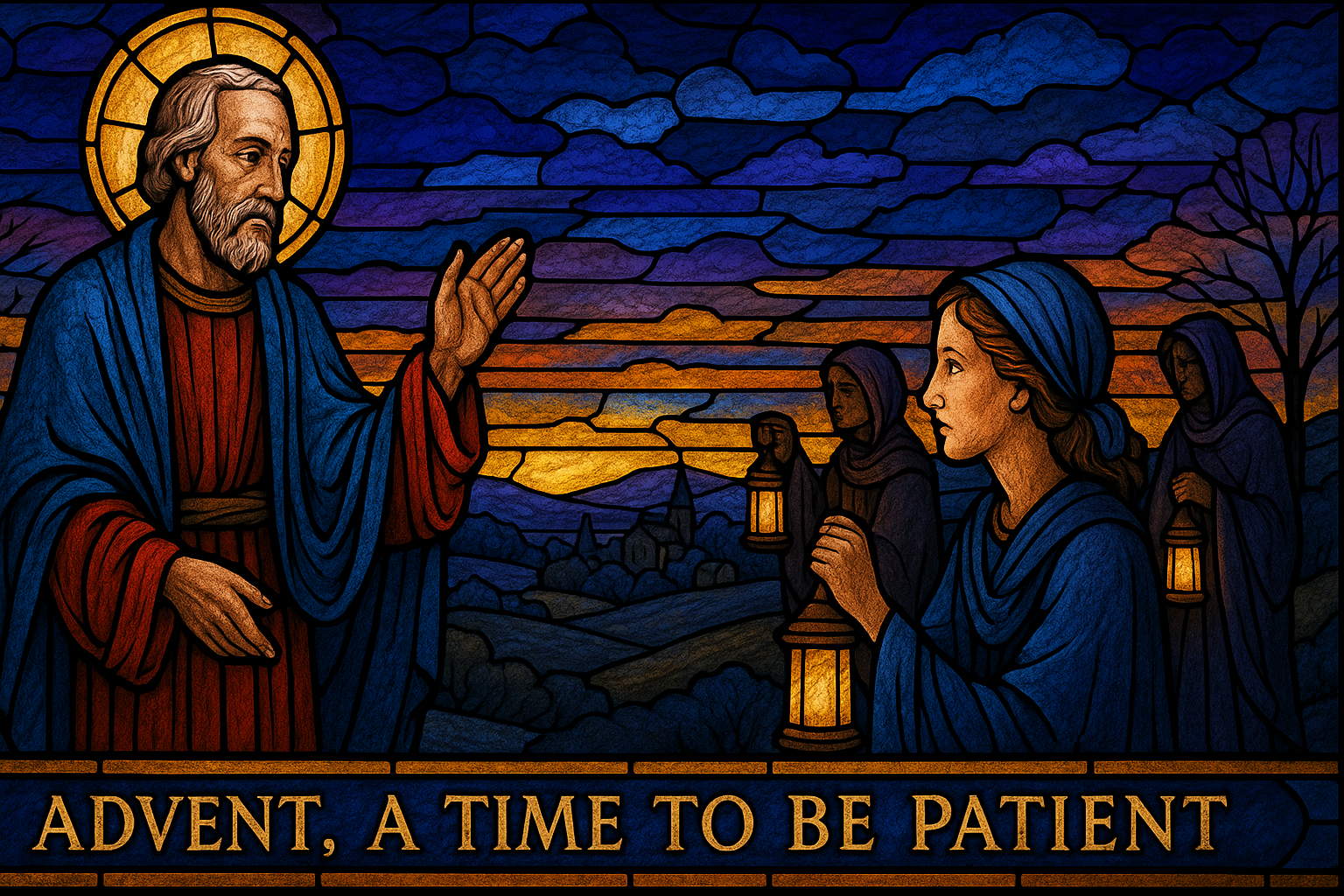
“Advent, A Time to Be Patient”
James 5: 7-10; Matthew 24: 42-51
December 17, 1995
I want to begin our thoughts this morning with a prayer that the Archbishop of York gave at a gathering of bishops from all over the world. Let us pray:
Eternal God, who tarries oft beyond the time we hope for, but not beyond the time appointed by thee; From whom cometh in due season, the course that cannot fail, the truth that cannot be. Make us faithful to stand upon our watchtowers, and await – what thou wouldn’t say to us. Amen.
I have a friend who starts playing Christmas carols long before Thanksgiving. She tells me she just can’t wait. By the time Christmas arrives, she’s an emotional wreck – worn out, stressed, over-stimulated, and broke from visiting those churches of commerce which we often call Malls.
Malls, you know, are really secular churches. They have liturgies as intricate as the one you are now participating in at this moment. The muzak plays the hymns. The computers are their scriptures. The cash registers ring out the “amen&” The sales are the rubrics, and the discounts are the blessings.
But wait, my middle name isn’t Scrooge. I love Christmastime. I really do. I even love to shop – once in awhile. But the church, in all its wisdom, has tried to counteract all the hoopla and busyness by suggesting we insert four Sundays before Christmas and call them Advent. This is a time to move away from the frenetic scene and try to recover a sense of waiting, a sense of mystery, and a sense of anticipation before we give in to the holiday frenzy.
The church is not playing the Grinch who stole Christmas. It is merely reminding us to see these four weeks as a mysterious time of waiting, sort of like a pregnancy, where you really can’t do anything about it. Just let it happen, don’t plan it, don’t control it – just let it happen and it will all turn out. Advent is a season where we are presented with the uncontrollability of things. The perverse refusal of God to be packaged, managed or controlled by either the stores, our culture, or our own anxieties at this time of the year.
I don’t know exactly to whom or at what time of the year James is writing his Epistle (which we read partially in church), but I think the church was quite smart in choosing this portion for the third Sunday in Advent. But listen to his words to us: “Be patient, good people, until the coming of the Lord. Be patient.” But how, we ask, can you be patient in an impatient time? How can you be patient when you have a great longing, a strong desire to fill up the emptiness, to go back to being a child, to have a miracle happen, to control the way and the time that God will come to us? How can you learn to wait and watch and anticipate rather than being concerned with making it happen?
Let’s face it – even at our best, we don’t handle deferred wants very well. We want to do things, handle wants, fix our needs – right now. As someone said: ‘We have a fixation on the fixable.” Patience is not a high value in our culture. Waiting is only a last resort when nothing else seems to work.
A long time ago, Samuel Beckett wrote a brilliant play which was a spectacular failure. He called it Waiting for Godot. It was a big flop on Broadway and on television. Its lack of success came from its thesis which was repellent to our credit card culture – the culture which says you can have it all and you can have it now – just use the plastic.
In the play, two vagabonds chat aimlessly on a stage. Their purpose for coming to this place, they explain, was to wait for God, who had promised to come at some future date. The records are faulty. It might happen on Friday or on Saturday, or on Sunday. The thing they cling to is that he said he would come. “In the immense confusion,” a character says, “one thing alone is clear. We are waiting for God to come.”
People reacted negatively to that message. They wanted to hear about a world where we could have instant gratification. No waiting. Where God would come on call. Where we could make it happen on time and in our own way. People wanted certainty, not confusion. They wanted to hear that they were in control of life. But are we?
Becket, like the writer James of our Epistle, was reminding us to move from instant gratification to deferred gratification, from receiving it all right now to learning to be patient.
James wrote in his Epistle to a people who are at the end of their rope. They had tried everything in their bag of tricks, and no miracle had happened. God had not instantly appeared. They had called repeatedly upon the Lord, and nothing had changed. They had hoped that God would “tear open the Heavens” and come down to show them the way. And nothing occurred. So James is saying that after you have tried everything, when all else fails, read the instructions, which say: ‘Be patient. God will come is his/her good time.”
The secret is learning to wait on God. Learning to just ‘be” and put away all thoughts of doing or of making it happen. Learning to simply sit back and to enjoy God. Thafs a lesson that I am learning as a grandparent. What I’ve had to do is put aside my expectations with my grandchild. Oftentimes, I want her to perform on cue and be that special, well-behaved child that any grandchild of mine of course, would be. What I have had to learn, sometimes painfully, is that she is a two-year-old and no matter what I do, she is going to act like a two-year-old. And I’d better learn to enjoy her as she is. And so it is with God. No matter what we do, we cannot control God, nor can we expect God to act the way we would like. And therefore, our only task is to learn to sit back and let it happen.
Let me illustrate the problems we face when we do this by quoting from some reflections by a friend in Boston. “I remember,” he said, “in seminary years ago hearing from the classical teaching of the church something incomprehensible. It came from John Calvin in what has come to be called The Westminster Catechism.’ The question is asked: What is the chief end in life? And the answer Calvin suggests is: ‘To glorify God and enjoy him forever.’
My friend said, “I had no idea what to make of that. Talk to me about living a moral life, and I could understand that. Talk to me about working for a better world, talk to me about making a contribution to the world, and I might feel burdened, but I would know what you’re talking about. But, tell me that the main point of my life is to glorify God and enjoy God forever, and I was clueless. Could it be that the whole business of religion isn’t about duty and hard work? Maybe the job of even being here on Sunday for church isn’t first of all to teach us some good lessons or some good tips for life. Maybe we’re here to enjoy God. And maybe we’re here to just be and not do.” And maybe, I would add, we’re just here to wait and watch and anticipate God’s presence among us, touching our souls, being born in us, and simply enjoying him forever.
So to that person that I mentioned at the beginning, whom I stressed out, or to all of you who find December a trying time, would echo James’ words: ‘Be patient. Be patient until the coming of the Lord.” And use this Advent to learn to enjoy the Lord and learn to let it happen. And when the pre-Christmas anxiety hits you, try sitting back and maybe repeating to yourself that magnificent prayer on page 832 of the Prayer Book that reads
“0 God of peace, who has taught us that in returning and rest we shall be saved. In quietness and in confidence shall be our strength. By the might of thy spirit lift us, we pray to thy presence, where we may be still and know that thou art God. For remember, remember, our end is to enjoy and glorify God as we await God’s coming. . .. AMEN.
“Advent, A Time to Be Patient”
“Advent, A Time to Be Patient”
December 17, 1995
Scripture: James 5: 7-10, Matthew 24: 42-51